Sage and Health: What Human Studies Have Tested
Sage has been studied for specific concerns, but each result applies to the preparation and group tested, not to every sage product or every woman.
Human trials have examined sage for menopause symptoms and sexual function, metabolic markers in women with PCOS, and several other concerns. Some studies report improvements, but they test different preparations, outcomes, and populations. For example, a menopause trial tested a particular extract, while a postmenopause study tested inhaled essential oil. Neither establishes that sage tea or an unspecified supplement has the same effect. 159
Sage isn’t one interchangeable treatment. In human studies, it has been taken as an extract, used in aromatherapy, rinsed in the mouth, applied as a dental gel, or given as a vaginal tablet. The result depends on the preparation, the people studied, and what the researchers measured. A finding with one form of sage doesn’t establish a general health benefit.
Menopause: a promising result from one short trial
A double-blind, placebo-controlled trial randomized 80 menopausal women ages 48 to 65 to a particular fresh sage extract tablet or placebo for four weeks. The researchers reported greater improvement with sage in overall menopause symptom and hot-flush severity scores. They did not find a significant effect on the genitourinary symptom subscale. This is direct evidence in menopausal women, but it comes from one short trial of one extract. 9
Sexual function is a separate outcome. In a randomized trial, 64 postmenopausal women in Iran received either inhaled sage essential oil or almond oil for six weeks. At the end, the sage group had higher reported scores for sexual function and satisfaction. This is a small study of aromatherapy, not evidence that taking sage by mouth improves sexual function. 1
A separate aromatherapy trial involved women ages 15 to 45 and compared jasmine, sage, sweet almond, and no treatment. The report found differences between the aroma groups and the no-treatment group; sweet almond also differed from no treatment. It reported some sage advantages over jasmine on individual measures. The abstract does not establish the sage preparation or exposure method, so this study shouldn’t be described as specifically testing inhaled sage oil. 6
PCOS: early findings on selected markers
One randomized placebo-controlled trial examined 70 women with PCOS who took an oral sage extract or placebo for eight weeks. The researchers reported lower triglycerides and a change in an oxidative-stress marker with sage, but not significant changes in other lipid markers. A separate report on insulin-resistance measures lists the same trial registration and describes additional outcomes from a parallel trial. These reports therefore aren’t independent confirmations, and changes in markers don’t establish that sage treats PCOS or prevents its complications. 58
A different placebo-controlled trial tested sage leaf extract in 80 people with type 2 diabetes and high cholesterol or triglycerides for three months. It reported improvements in several blood sugar and lipid measures compared with placebo. The study focused on people with these conditions, and its abstract doesn’t report a women-specific result. It can’t establish a benefit for women generally or for people without diabetes and lipid problems. 4
Other trials answer narrower questions
For oral discomfort, a randomized trial compared a sage-tea mouth rinse with saline in 88 people receiving inpatient hospice care for late-stage cancer. Overall oral-health scores improved similarly in both groups. Dry-mouth ratings improved more with sage on two measures. That result in a seriously ill population doesn’t establish that sage helps everyday dry mouth. 2
A small split-mouth trial tested sage gel as an addition to dental scaling and root-surface treatment in 14 people with periodontitis, including 10 men and four women. Some dental measures improved more at sage-treated sites after one month. The study was small, short, and did not report a women-specific analysis. 7
A trial of 111 participants with vulvovaginal candidiasis compared a sage vaginal tablet, clotrimazole, and the two together. On the reported positive test result after treatment, sage alone did not differ significantly from clotrimazole alone; the combination group did differ from clotrimazole alone. This small trial doesn’t establish sage as a substitute for established treatment. 3
What to compare before drawing a conclusion
Start with the preparation and outcome, not just the word “sage.” The menopause study used a particular extract; the postmenopause sexual-function study tested inhaled essential oil; the oral-discomfort trial used a prepared rinse. Those results don’t automatically apply to culinary sage, tea, or a supplement with a different formulation. 129
The evidence is a collection of individual trials in specific groups, often with short follow-up. The most relevant finding may be encouraging, but it isn’t the same as proof of a broad benefit for women. For any claim, ask: Was the preparation the same? Were participants similar to the people the claim is about? Did the study measure the outcome that matters?
Sage trials by preparation and outcome
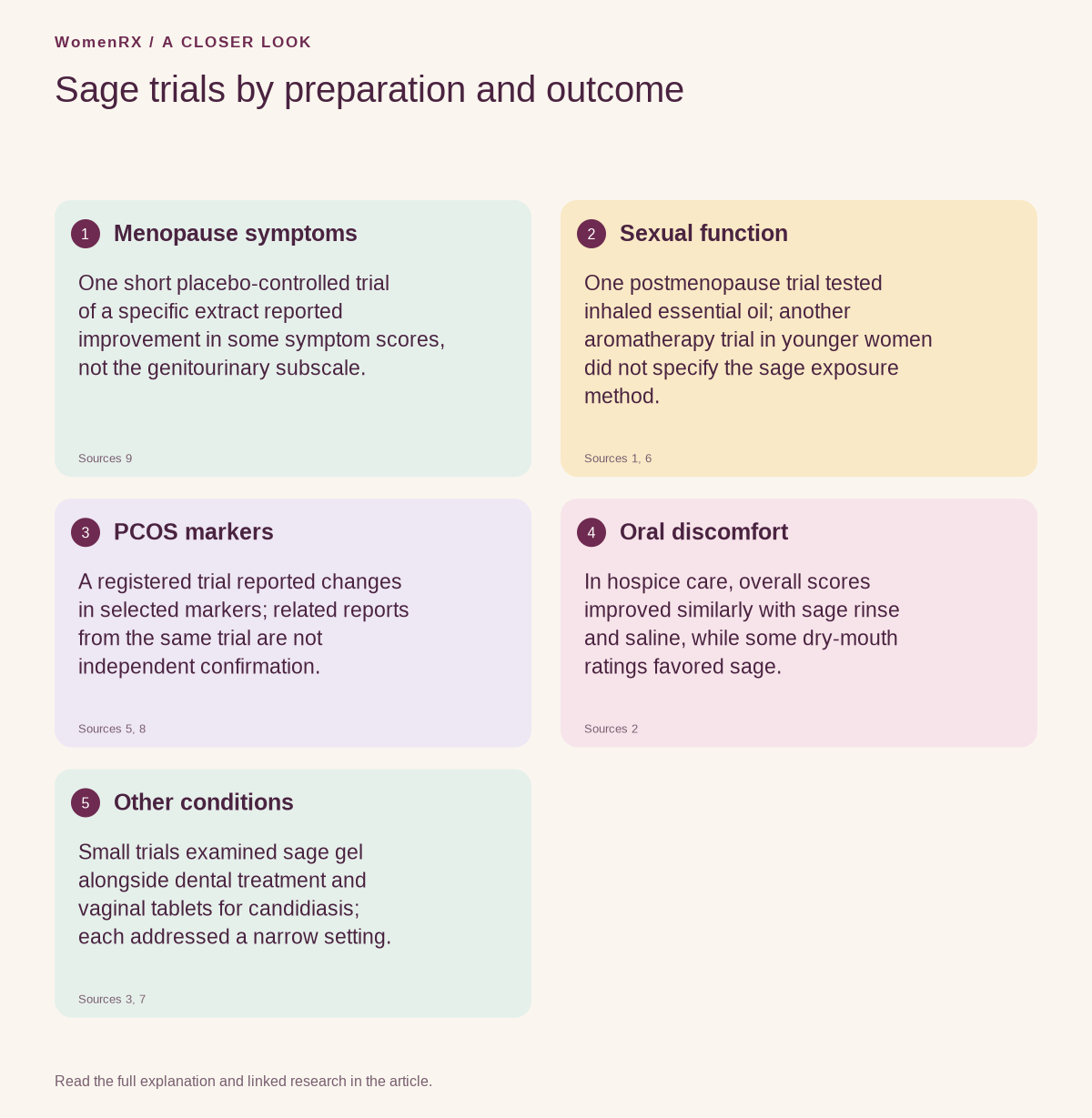
Menopause symptoms: One short placebo-controlled trial of a specific extract reported improvement in some symptom scores, not the genitourinary subscale.9
Sexual function: One postmenopause trial tested inhaled essential oil; another aromatherapy trial in younger women did not specify the sage exposure method.16
PCOS markers: A registered trial reported changes in selected markers; related reports from the same trial are not independent confirmation.58
Oral discomfort: In hospice care, overall scores improved similarly with sage rinse and saline, while some dry-mouth ratings favored sage.2
Other conditions: Small trials examined sage gel alongside dental treatment and vaginal tablets for candidiasis; each addressed a narrow setting.37
Read the figure as text
These comparisons show what a specific human trial tested. They don’t establish that other sage products have the same effects.- Menopause symptoms: One short placebo-controlled trial of a specific extract reported improvement in some symptom scores, not the genitourinary subscale.9
- Sexual function: One postmenopause trial tested inhaled essential oil; another aromatherapy trial in younger women did not specify the sage exposure method.16
- PCOS markers: A registered trial reported changes in selected markers; related reports from the same trial are not independent confirmation.58
- Oral discomfort: In hospice care, overall scores improved similarly with sage rinse and saline, while some dry-mouth ratings favored sage.2
- Other conditions: Small trials examined sage gel alongside dental treatment and vaginal tablets for candidiasis; each addressed a narrow setting.37
More questions, answered
Does sage tea have the same evidence as sage capsules?
These studies don’t establish that. They tested specific extracts or tablets, aromatherapy, a prepared mouth rinse, a dental gel, or a vaginal tablet. A result with one preparation shouldn’t be assumed to apply to tea or another product.
Sources you can check
- Effect of Salvia officinalis scent on postmenopausal women's sexual function and satisfaction: a randomized controlled trial.Heydarpour S, Sharifipour F, Heydarpour F. · BMC women's health · 2023Return to first citation
- A mouth rinse based on a tea solution of Salvia officinalis for oral discomfort in palliative cancer care: a randomized controlled trial.Monsen RE, Herlofson BB, Gay C, Fjeld KG, Hove LH, Malterud KE, Saghaug E, Slaaen J, Sundal T, Tollisen A, Lerdal A. · Supportive care in cancer : official journal of the Multinational Association of Supportive Care in Cancer · 2021Return to first citation
- Comparing the effectiveness of Salvia officinalis, clotrimazole and their combination on vulvovaginal candidiasis: A randomized, controlled clinical trial.Ahangari F, Farshbaf-Khalili A, Javadzadeh Y, Adibpour M, Sadeghzadeh Oskouei B. · The journal of obstetrics and gynaecology research · 2019Return to first citation
- Improved glycemic control and lipid profile in hyperlipidemic type 2 diabetic patients consuming Salvia officinalis L. leaf extract: a randomized placebo. Controlled clinical trial.Kianbakht S, Dabaghian FH. · Complementary therapies in medicine · 2013Return to first citation
- Exploring the therapeutic impact of Salvia officinalis on lipid and oxidative stress markers in patients with polycystic ovary syndrome - a randomized placebo-controlled clinical trial.Maleki-Hajiagha A, Mojab F, Amidi F, Amini L. · BMC complementary medicine and therapies · 2025Return to first citation
- A comparison of the effect of aromatherapy with Jasmine (Jasminum) and clary sage (Salvia officinalis) on sexual dysfunction in women of reproductive age: A randomized controlled clinical trial.Hajabdollahi Z, Loripoor M, Mohseni M, Khalili P. · Journal of education and health promotion · 2025Return to first citation
- Clinical Effectiveness of Salvia officinalis in Periodontitis: A Split-Mouth Randomized Controlled Trial.Aljuboori IW, Mahmood MS, Al-Rihaymee SA. · Cureus · 2024Return to first citation
- Efficacy of Salvia officinalis extract on the prevention of insulin resistance in euglycemic patients with polycystic ovary syndrome: A double-blinded placebo-controlled clinical trial.Amini L, Mojab F, Jahanfar S, Sepidarkish M, Raoofi Z, Maleki-Hajiagha A. · Complementary therapies in medicine · 2020Return to first citation
- Effectiveness of Menosan® Salvia officinalis in the treatment of a wide spectrum of menopausal complaints. A double-blind, randomized, placebo-controlled, clinical trial.Wilfried D, Nina CDG, Silvia B. · Heliyon · 2021Return to first citation