Sage for Menopause: What the Research and Label Tell You
A few small studies tested specific sage preparations for hot flashes, but their results don’t establish that culinary sage or any supplement is effective or safe for everyone.
Sage research for menopause symptoms is limited to particular preparations: one study tested a fresh-leaf tablet, and another tested an extract capsule. Those findings don’t establish a proven dose or show that cooking sage, essential oils, or a blended product works the same way. Before using a supplement, check its species, ingredients, directions, and warnings, and ask a pharmacist to review it alongside your medicines.
Start with the exact product, not just “sage”
The menopause studies looked at Salvia officinalis, but they did not test the same preparation. One was an eight-week, open-label study of a tablet made from fresh sage leaves. The other was a small study of a sage-extract capsule. That difference matters: a result for one preparation doesn’t show that dried culinary sage, a tea, an essential oil, or a multi-ingredient supplement will have the same effect. 2 3
Check the label for the full botanical name, Salvia officinalis, and whether it describes a leaf, extract, oil, or blend. Look for the amount per serving, the serving directions, other active ingredients, and any warnings. If the label doesn’t make the preparation clear, you can’t tell how closely it resembles what was studied. Even a close match doesn’t guarantee the same product or result.
What the hot-flash studies found
In the open-label study, 69 menopausal participants with at least five hot flashes a day took a fresh-sage-leaf tablet once daily for eight weeks. The study reported a 50% reduction in its combined measure of hot-flash frequency and intensity by week four and a 64% reduction by week eight. Because there was no comparison group, the improvement can’t show how much was due to sage rather than other influences, such as changes over time or expectations. 2
A separate study included 30 postmenopausal women who took a 100 mg sage-extract capsule daily for four weeks. The study reported significant before-and-after differences in severity for symptoms including hot flashes and night sweats; the abstract doesn’t state whether those symptoms increased or decreased. The abstract doesn’t describe a comparison group, so this result also can’t establish that sage caused the changes. Its capsule and short study period are not a general dosing recommendation. 3
Taken together, these studies offer an early signal, not a firm answer. They don’t establish which preparation works best, whether the benefit lasts, or whether every person with hot flashes will respond. The North American Menopause Society identifies hormone therapy as the most effective treatment for vasomotor symptoms, such as hot flashes; that gives you a useful point of comparison if symptoms are bothering you. 1
A practical label-and-safety check
Before trying a sage supplement, use the label to answer these questions:
- What is the species and preparation? Look for Salvia officinalis and a clear description of the form. Don’t treat kitchen sage as equivalent to a concentrated extract or a studied tablet.
- What else is in it? A menopause blend may contain several active ingredients. Check each one rather than assuming the evidence for sage applies to the whole product.
- Are the directions and warnings clear? Don’t use a study’s dose as your own instructions. The small studies tested particular products for limited periods, not every commercial formulation.
- Have you checked it against your medicines? The menopause studies don’t provide a usable list of medicine interactions or establish that combinations are safe. Show the complete label, including all ingredients, to a pharmacist so they can check your specific medicines.
These studies involved menopausal women, not people who were pregnant or breastfeeding, and they don’t answer safety questions for hormone-sensitive health concerns. If any of those apply to you, get individualized advice before using sage as a supplement. That’s different from ordinary culinary use, which these studies did not evaluate.
Keep the decision proportional to the evidence
If you’re considering sage because of hot flashes or sweating, the clearest takeaway is that the research concerns a couple of specific products, not “sage” in every form. A supplement label can help you see what you’d be taking, but it can’t fill the research gaps. If symptoms are persistent or disruptive, you can also discuss established options with your clinician rather than relying on a supplement alone.
Sage forms: what was studied
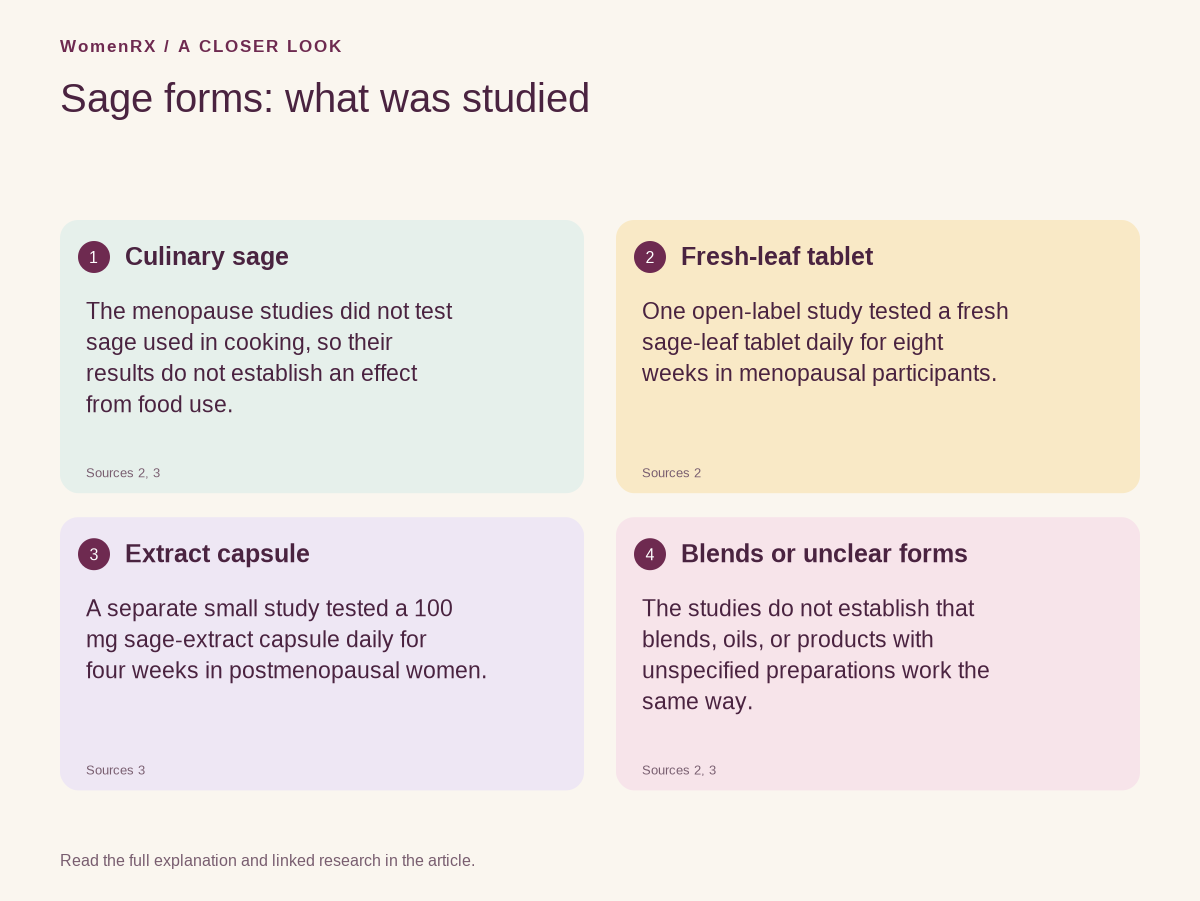
Culinary sage: The menopause studies did not test sage used in cooking, so their results do not establish an effect from food use.23
Fresh-leaf tablet: One open-label study tested a fresh sage-leaf tablet daily for eight weeks in menopausal participants.2
Extract capsule: A separate small study tested a 100 mg sage-extract capsule daily for four weeks in postmenopausal women.3
Blends or unclear forms: The studies do not establish that blends, oils, or products with unspecified preparations work the same way.23
Read the figure as text
The menopause findings apply to particular preparations, not automatically to every product labeled sage.- Culinary sage: The menopause studies did not test sage used in cooking, so their results do not establish an effect from food use.23
- Fresh-leaf tablet: One open-label study tested a fresh sage-leaf tablet daily for eight weeks in menopausal participants.2
- Extract capsule: A separate small study tested a 100 mg sage-extract capsule daily for four weeks in postmenopausal women.3
- Blends or unclear forms: The studies do not establish that blends, oils, or products with unspecified preparations work the same way.23
More questions, answered
Does the research establish a daily sage dose for hot flashes?
No. One small study tested a 100 mg sage-extract capsule, and another tested a fresh-leaf tablet. Those are descriptions of study products, not a proven dose for other supplements or for you. 2 3
Is culinary sage the same as a menopause supplement?
The studies described specific tablets or capsules, not the amount of sage used in food. Their findings can’t establish that culinary sage has the same effect. 2 3
Sources you can check
- The 2022 hormone therapy position statement of The North American Menopause Society.“The 2022 Hormone Therapy Position Statement of The North American Menopause Society” Advisory Panel. · Menopause (New York, N.Y.) · 2022Return to first citation
- First time proof of sage's tolerability and efficacy in menopausal women with hot flushes.Bommer S, Klein P, Suter A. · Advances in therapy · 2011Return to first citation
- The effect of Saliva officinalis extract on the menopausal symptoms in postmenopausal women: An RCT.Dadfar F, Bamdad K. · International journal of reproductive biomedicine · 2019Return to first citation