Sage for Menopause: What the Timing Evidence Shows
One open trial tracked a fresh-leaf sage tablet for eight weeks, but its abstract doesn’t report a comparison group or establish a dependable time to relief.
A menopause trial tested a once-daily tablet made from fresh sage leaves in postmenopausal participants, tracking hot-flash frequency and intensity for eight weeks. Its intensity-rated hot-flash score fell 50% by week four and 64% by week eight. The abstract describes an open trial but doesn’t report a comparison group, so these changes don’t establish that sage caused them or predict when it will work for you. 2
What the trial actually tested
The timing evidence comes from one open, multicenter trial in Switzerland. It enrolled 71 postmenopausal participants who had been menopausal for at least 12 months and reported at least five hot flashes a day. Participants took a tablet made from fresh sage leaves once daily for eight weeks, after a one-week baseline period. Researchers used diaries to track hot-flash frequency and intensity. 2
This was a specific preparation, not a test of sage tea, culinary seasoning, a different extract, or sage essential oil. Results from one form shouldn’t automatically be applied to another.
What “50% by week four” means
The trial reported that its intensity-rated hot-flash score fell 50% within four weeks and 64% within eight weeks among the 69 participants in the intent-to-treat analysis. That score combined hot-flash frequency with ratings of intensity. The study also reported that the average number of flushes per day declined week by week, but the abstract doesn’t give the size of each weekly change. 2
Those figures describe change during the study, not a guaranteed response time. The abstract calls the trial open but doesn’t report whether there was a comparison group. Without that information, the abstract alone can’t show whether the changes were due to sage or distinguish a sage effect from other reasons symptoms might change, such as natural variation or expectations. It also doesn’t show how the same preparation would compare with another treatment or with no treatment. 2
So, if you’re asking how long sage takes to work, the most accurate answer is: one study observed changes over several weeks, but there isn’t a reliable onset estimate. The 50% and 64% figures shouldn’t be read as a prediction for an individual.
Traditional use isn’t the same as established relief
Sage has a history of traditional use for sweating and menopausal hot flashes, but tradition alone doesn’t establish that a supplement works. 2 The North American Menopause Society’s 2023 position statement does not recommend supplements or herbal remedies for menopausal vasomotor symptoms, based on its review of the evidence. That broad recommendation isn’t a sage-specific finding, but it puts this trial’s result in context. 1
The study also focused on hot flashes and other menopause complaints over eight weeks. It doesn’t establish long-term benefit, and it shouldn’t be taken as evidence that every sage product, or every menopause symptom, will respond the same way.
Safety depends on the preparation and the person
The trial enrolled postmenopausal participants, so it doesn’t establish safety during pregnancy or breastfeeding. A review of herbal medicines raises a possible concern involving sage and diabetes or blood-pressure medicines, without specifying how they might interact or how likely an interaction is. If you take either type of medicine, check the exact sage product with a pharmacist or prescriber rather than assuming the concern applies equally to every preparation. 23
If you’re comparing products, look for the specific plant preparation rather than assuming that “sage” means the same thing across a fresh-leaf tablet, tea, extract, and essential oil. The clinical timing result applies only to the fresh-leaf tablet studied, and even for that preparation it offers no dependable promise of when, or whether, you’ll notice a change.
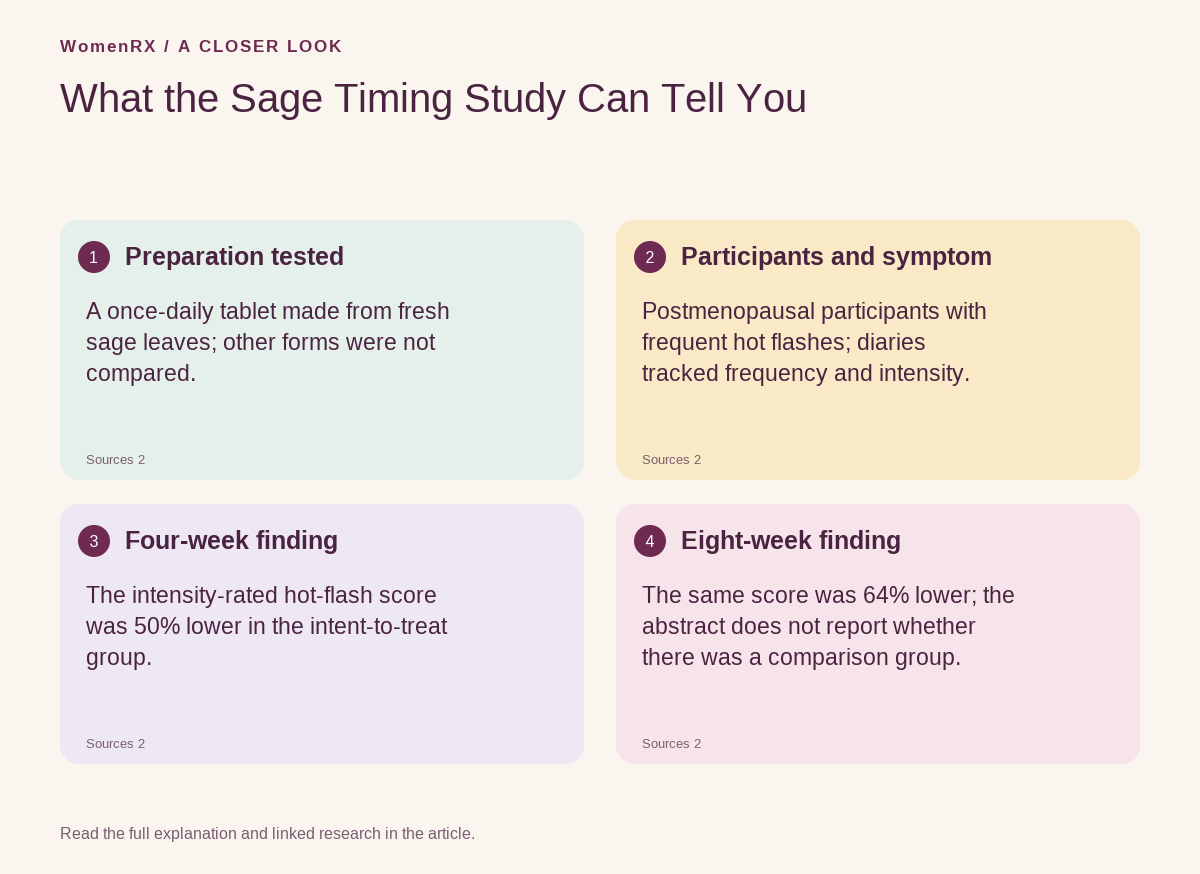
What the Sage Timing Study Can Tell You
Preparation tested: A once-daily tablet made from fresh sage leaves; other forms were not compared.2
Participants and symptom: Postmenopausal participants with frequent hot flashes; diaries tracked frequency and intensity.2
Four-week finding: The intensity-rated hot-flash score was 50% lower in the intent-to-treat group.2
Eight-week finding: The same score was 64% lower; the abstract does not report whether there was a comparison group.2
Read the figure as text
The evidence applies to one preparation and one study period; the reported score changes do not establish a personal response timeline.- Preparation tested: A once-daily tablet made from fresh sage leaves; other forms were not compared.2
- Participants and symptom: Postmenopausal participants with frequent hot flashes; diaries tracked frequency and intensity.2
- Four-week finding: The intensity-rated hot-flash score was 50% lower in the intent-to-treat group.2
- Eight-week finding: The same score was 64% lower; the abstract does not report whether there was a comparison group.2
More questions, answered
Does the study show that sage works in four weeks?
It reported a 50% decrease in an intensity-rated hot-flash score by week four. The abstract describes an open trial but doesn’t report a comparison group, so that change isn’t proof that sage caused it or a reliable forecast for another person. 2
Is sage tea equivalent to the studied supplement?
No equivalence was tested. The trial studied a tablet made from fresh sage leaves, so its findings don’t establish the effects or timing of tea, other extracts, culinary sage, or essential oil. 2
Sources you can check
- The 2023 nonhormone therapy position statement of The North American Menopause Society.Menopause (New York, N.Y.) · 2023Return to first citation
- First time proof of sage's tolerability and efficacy in menopausal women with hot flushes.Bommer S, Klein P, Suter A. · Advances in therapy · 2011Return to first citation
- A review of effective herbal medicines in controlling menopausal symptoms.Kargozar R, Azizi H, Salari R. · Electronic physician · 2017Return to first citation