When to Take Sage: Morning or Evening?
A sage-extract study on hot flashes and a separate cognitive trial used different schedules, but neither compared morning with evening use.
Neither the hot-flash study summarized in a systematic review nor a separate cognitive trial tested whether sage works better in the morning or evening. The hot-flash study used a daily extract capsule without reporting a time of day; the cognitive trial gave an extract during testing visits. Those schedules don’t establish when to drink sage tea or take another supplement. 1 2
A daily schedule isn’t a time-of-day recommendation
If your sage product says to use it daily, you might wonder whether that means morning, bedtime, or whenever you remember. The distinction is between how often a preparation was used and whether one time of day worked better than another. The sage studies described here address the first question, not the second. 1 2
For hot flashes, a systematic review summarizes an eight-week trial in postmenopausal women. Forty-two participants received a daily Salvia officinalis extract capsule, and 42 received placebo. The review reports a difference between groups in hot-flash frequency, but its trial summary doesn’t specify what time participants took the capsule. It therefore can’t tell you whether morning use, evening use, or taking it before a night sweat makes a difference. 1
That matters if menopause symptoms are your reason for trying sage. A study finding about hot-flash frequency is not also a finding about the best hour to take it. And because this trial involved postmenopausal women, its result shouldn’t be presented as a tested schedule for everyone in perimenopause. 1
An extract given at a study visit is a different situation
A separate randomized trial examined memory and attention in 20 healthy adults older than 65. Researchers gave a standardized sage extract after a baseline assessment, then tested participants over the following hours. The abstract doesn’t report a women-specific result. This was a short-term cognitive-testing protocol, not a daily menopause routine or a morning-versus-evening comparison. 2
The preparation differs, too. The hot-flash trial used an extract capsule, while the cognitive trial used a standardized extract under study conditions. Neither tested the timing of sage tea. You can’t turn either study’s schedule into directions for a different tea, capsule, or extract just because all are called sage. 1 2
What to do with the directions you have
Read the instructions for your particular preparation rather than borrowing a schedule from either study. Check whether they specify a time of day, describe how to prepare it, or simply say how often to use it. If they don’t name a time, these studies offer no demonstrated morning-or-evening advantage to guide that choice. Picking a time that fits your routine is a matter of convenience, not a benefit shown by these trials. 1 2
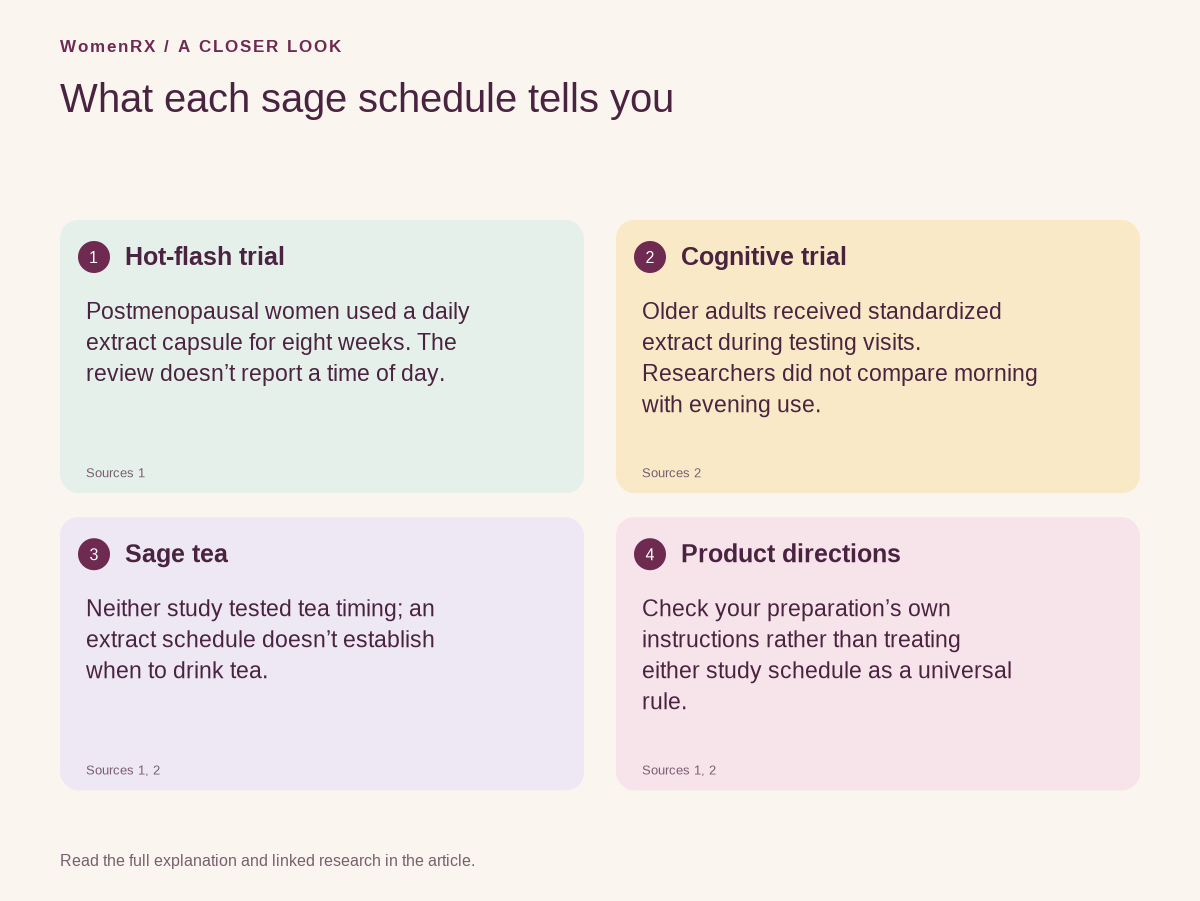
What each sage schedule tells you
Hot-flash trial: Postmenopausal women used a daily extract capsule for eight weeks. The review doesn’t report a time of day.1
Cognitive trial: Older adults received standardized extract during testing visits. Researchers did not compare morning with evening use.2
Sage tea: Neither study tested tea timing; an extract schedule doesn’t establish when to drink tea.12
Product directions: Check your preparation’s own instructions rather than treating either study schedule as a universal rule.12
Read the figure as text
The preparations and research questions differ, and neither study tested a best time of day.- Hot-flash trial: Postmenopausal women used a daily extract capsule for eight weeks. The review doesn’t report a time of day.1
- Cognitive trial: Older adults received standardized extract during testing visits. Researchers did not compare morning with evening use.2
- Sage tea: Neither study tested tea timing; an extract schedule doesn’t establish when to drink tea.12
- Product directions: Check your preparation’s own instructions rather than treating either study schedule as a universal rule.12
More questions, answered
Should I take sage before bed for night sweats?
The hot-flash trial summary doesn’t report bedtime use or compare bedtime with morning use. Its finding about hot-flash frequency can’t establish that taking sage before bed works better for night sweats. 1
Sources you can check
- The efficacy of Iranian herbal medicines in alleviating hot flashes: A systematic review.Ghazanfarpour M, Sadeghi R, Abdolahian S, Latifnejad Roudsari R. · International journal of reproductive biomedicine · 2016Return to first citation
- An extract of Salvia (sage) with anticholinesterase properties improves memory and attention in healthy older volunteers.Scholey AB, Tildesley NT, Ballard CG, Wesnes KA, Tasker A, Perry EK, Kennedy DO. · Psychopharmacology · 2008Return to first citation