Sage for Menopause Symptoms: What Trials Actually Show
Sage has been studied for hot flashes and sexual function, but the findings come from specific preparations and small postmenopause studies.
Some studies report improvements in menopause symptoms with sage, including hot flashes and sexual-function measures. But the evidence is limited: a review of four hot-flash studies found a pooled estimate whose confidence interval included no effect, and a small trial of inhaled sage oil looked only at sexual function over six weeks. These results don’t establish that other sage products will help. 3 4
Sage is sometimes promoted as a menopause supplement, but “sage” can mean a leaf, an extract tablet, or an essential oil used as aromatherapy. Those aren’t interchangeable treatments. The human research has focused on postmenopausal women, so it doesn’t establish what sage does for women in perimenopause or for everyone over 40.
Hot flashes: a possible signal, not a settled result
A 2023 systematic review and meta-analysis included four studies involving 310 postmenopausal women. All four studies reported reductions in hot-flash frequency or severity. But the pooled estimate for frequency was -1.12, with a 95% confidence interval from -2.37 to 0.14. Because that interval includes zero, it does not rule out no difference. The estimate also had substantial heterogeneity (I²=71%), meaning results varied across the studies. For severity, the pooled estimate was also inconclusive. 4
The review authors’ conclusion describes the frequency result as significant, but the confidence interval they report crosses zero. That mismatch makes it hard to treat the pooled finding as conclusive. And the review’s product details don’t establish that all four studies tested the same preparation, much less a product you might find on a store shelf. 4
A 2020 randomized trial tested tablets containing sage extract in 66 postmenopausal women with menopause symptoms. Participants took the study tablets for three months; the researchers reported improvements in flushing and several other symptom scores compared with placebo. This is a finding about that trial’s extract-tablet regimen, not proof that culinary sage, essential oil, or any retail supplement will have the same effect. 6
Sexual function: a different product and a narrow study
A randomized trial in Iran studied inhaled Salvia officinalis essential oil in postmenopausal women. The intervention group inhaled two drops twice daily, five days a week, for six weeks; the control group used almond oil. At six weeks, the sage group had higher scores on measures of sexual function and satisfaction. 3
That result is worth distinguishing from the hot-flash research: it tested an aroma, not an oral supplement, and measured sexual-function outcomes rather than hot flashes. It was also a small, short trial. Its participants were a specific group of postmenopausal women, so the finding may not apply to other women or explain which parts of sexual wellbeing might change. It doesn’t show that sage treats vaginal dryness or other genitourinary symptoms. 3
Why a bottle may not match a study
Even products labeled for menopause can differ. A laboratory analysis of four commercial sage supplements found that the amount of polyphenols and flavonoids varied across products. That study measured chemical composition, not whether one product eased symptoms better than another. So a label saying “sage” doesn’t show that the product matches a preparation used in a clinical trial. 5
The North American Menopause Society’s 2023 statement does not recommend supplements or herbal remedies as a group for menopause-related hot flashes, reflecting the limits of the evidence. That guidance doesn’t prove sage can never help; it does mean the current findings aren’t strong enough to make sage a well-supported hot-flash treatment. 2
If you’re weighing sage against other options, focus on the symptom you want to address and the product form you’re considering. For bothersome hot flashes, established treatment options have a stronger evidence base: hormone therapy is the most effective treatment, and the menopause society also lists several evidence-supported nonhormone approaches. Sage’s research is much narrower, and a result with one preparation shouldn’t be assumed to transfer to another. 1 2
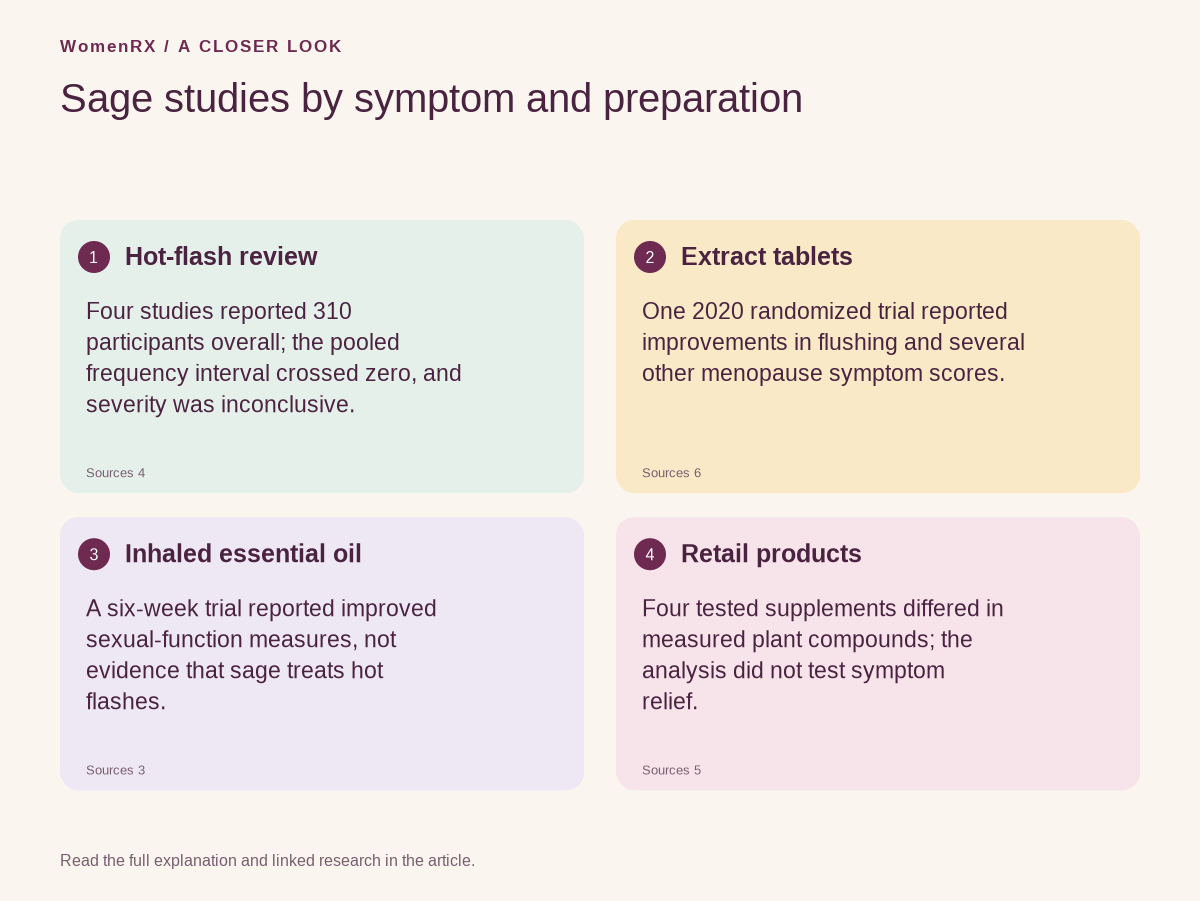
Sage studies by symptom and preparation
Hot-flash review: Four studies reported 310 participants overall; the pooled frequency interval crossed zero, and severity was inconclusive.4
Extract tablets: One 2020 randomized trial reported improvements in flushing and several other menopause symptom scores.6
Inhaled essential oil: A six-week trial reported improved sexual-function measures, not evidence that sage treats hot flashes.3
Retail products: Four tested supplements differed in measured plant compounds; the analysis did not test symptom relief.5
Read the figure as text
The findings are easier to interpret when the symptom, sage preparation, and evidence limits stay together.- Hot-flash review: Four studies reported 310 participants overall; the pooled frequency interval crossed zero, and severity was inconclusive.4
- Extract tablets: One 2020 randomized trial reported improvements in flushing and several other menopause symptom scores.6
- Inhaled essential oil: A six-week trial reported improved sexual-function measures, not evidence that sage treats hot flashes.3
- Retail products: Four tested supplements differed in measured plant compounds; the analysis did not test symptom relief.5
More questions, answered
Does sage help with night sweats or sleep?
One randomized trial of sage extract tablets reported improvement in night sweating and sleep-related measures among postmenopausal participants. That single trial doesn’t establish that sage products generally improve sleep or night sweats. 6
Is sage proven safe to use long term for menopause?
These studies don’t establish long-term safety. One small, six-week aromatherapy trial reported no side effects, but that isn’t enough to establish safety for prolonged use or for other sage preparations. 3
Sources you can check
- The 2022 hormone therapy position statement of The North American Menopause Society.“The 2022 Hormone Therapy Position Statement of The North American Menopause Society” Advisory Panel. · Menopause (New York, N.Y.) · 2022Return to first citation
- The 2023 nonhormone therapy position statement of The North American Menopause Society.Menopause (New York, N.Y.) · 2023Return to first citation
- Effect of Salvia officinalis scent on postmenopausal women's sexual function and satisfaction: a randomized controlled trial.Heydarpour S, Sharifipour F, Heydarpour F. · BMC women's health · 2023Return to first citation
- The Effect of Salvia Officinalis on Hot Flashes in Postmenopausal Women: A Systematic Review and Meta-Analysis.Moradi M, Ghavami V, Niazi A, Seraj Shirvan F, Rasa S. · International journal of community based nursing and midwifery · 2023Return to first citation
- The Different Phytochemical Profiles of Salvia officinalis Dietary Supplements Labelled for Menopause Symptoms.Maggini V, Bertazza G, Gallo E, Mascherini V, Calvi L, Marra C, Michelucci F, Liberati C, Trassi A, Baraldi R, Firenzuoli F. · Molecules (Basel, Switzerland) · 2023Return to first citation
- The effect of Salvia officinalis extract on symptoms of flushing, night sweat, sleep disorders, and score of forgetfulness in postmenopausal women.Zeidabadi A, Yazdanpanahi Z, Dabbaghmanesh MH, Sasani MR, Emamghoreishi M, Akbarzadeh M. · Journal of family medicine and primary care · 2020Return to first citation