Sage Supplements for Menopause: What Was Actually Studied
Small studies of specific sage preparations offer a possible hot-flash signal, but they don’t identify a reliably effective supplement.
Sage has been studied mainly in postmenopausal women, using particular oral extracts or fresh-leaf tablets. A review found four hot-flash studies, but their pooled results don’t establish a dependable benefit. Inhaled sage oil was studied for a different outcome, sexual-function scores. Before buying a supplement, check what’s in each serving and whether its ingredients fit your medications and circumstances. 4 3 2
Start with the preparation, not the word “sage”
If you’re considering sage for sweating or hot flashes, the first question isn’t which bottle has the strongest menopause claim. It’s whether the bottle resembles anything researchers tested. An oral extract, a tablet made from fresh leaves, and an essential oil used for inhalation are different preparations. A result for one can’t simply be transferred to another. 5 7 3
The studies most directly relevant to hot flashes enrolled women who were postmenopausal. They don’t tell us whether sage has the same effects during perimenopause, when periods may still be changing. 4 5 7
What the hot-flash studies found
A 2023 systematic review included four studies with 310 postmenopausal participants. Three assessed hot-flash frequency, three assessed severity, and only one assessed duration. The authors favored sage for reducing frequency, but the confidence interval around their pooled frequency estimate included no effect. So did the interval for severity. Results also varied substantially between studies. That combination makes it hard to predict whether sage would help you, or by how much. 4
Looking at individual studies shows why the distinction matters. In one randomized, placebo-controlled trial, 66 postmenopausal women were assigned tablets containing sage extract or placebo for three months. The sage group’s tablets contained 100 mg of extract each, taken three times a day in the study. Researchers reported improvements in several symptom measures, including flushing and sleep. That’s a result for the studied tablets and trial population, not a suggested serving size for a product you might buy. 5
Other findings are less able to isolate sage’s effect. A study of 30 postmenopausal women reported improvements after four weeks of a daily 100-mg extract capsule, but its abstract describes a before-and-after comparison rather than a result against a separate control group. An eight-week Swiss study reported fewer hot flashes while participants took a daily fresh-sage-leaf tablet; it was open-label and had no placebo group. Symptoms can change over time, so neither study alone can show how much improvement the sage caused. 6 7
The practical takeaway is not that every trial was negative. It’s that encouraging findings from particular preparations haven’t yet added up to a reliable answer about which supplement, if any, works for hot flashes. The Menopause Society’s 2023 position statement does not recommend supplements or herbal remedies for menopause-related hot flashes and night sweats. 4 2
Don’t confuse the essential-oil study with a capsule study
A separate randomized trial assigned 64 postmenopausal women to inhale Salvia officinalis essential oil or almond oil over six weeks. Researchers measured sexual-function and satisfaction questionnaire scores and reported higher scores in the sage group. They did not test an oral supplement for that outcome. The finding doesn’t establish that swallowing sage oil or taking a sage capsule improves sexual function, and it isn’t a hot-flash result. 3
Likewise, symptom-score changes aren’t proof that sage “balances hormones.” The human trials described here measured experiences such as flushing and questionnaire scores, not a demonstrated correction of hormone levels. 3 5 6
A useful check before you buy
Read the Supplement Facts panel and the full ingredient list rather than relying on “sage for menopause” on the front. Check whether it names Salvia officinalis, whether it describes an extract or another preparation, how much is listed per serving, and how many capsules or tablets make up that serving. Then look for other active ingredients. This won’t make a retail product equivalent to a trial preparation, but it can stop you from mistaking a multi-ingredient blend or a per-capsule amount for what was studied. Formulations can vary considerably: a 2026 analysis of 201 menopause supplements sold through UK retailers found highly variable ingredient combinations. That UK survey does not verify what is in any particular US product. 5 6 7 8
Before using one, show the complete label to a pharmacist or clinician if you take medication or have a health condition. Ask them to review the whole formula, not just the sage. These studies don’t establish a verified list of sage-drug interactions or long-term safety across products, so a blanket claim that sage is interaction-free would go further than the evidence. The postmenopausal trials also can’t establish safety during pregnancy or breastfeeding; if either applies, get advice specific to that situation rather than treating menopause findings as reassurance. 3 5 6 7
If hot flashes are disrupting sleep or daily life, you don’t have to choose between an uncertain supplement and doing nothing. Evidence-backed options include menopause hormone therapy, which remains the most effective treatment for hot flashes, as well as certain nonhormonal prescription treatments and approaches such as cognitive behavioral therapy. Which tradeoffs make sense depends on your health history and what you want help with most. 1 2
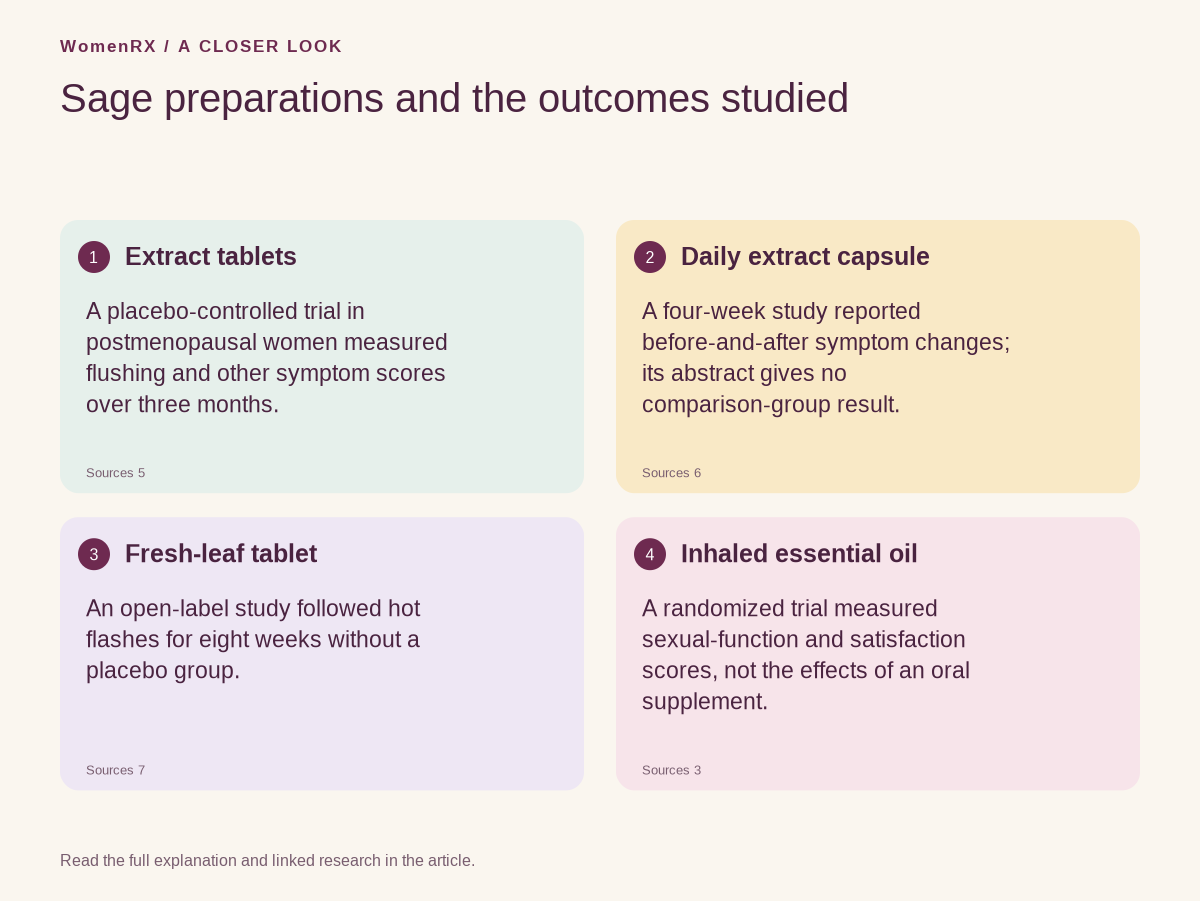
Sage preparations and the outcomes studied
Extract tablets: A placebo-controlled trial in postmenopausal women measured flushing and other symptom scores over three months.5
Daily extract capsule: A four-week study reported before-and-after symptom changes; its abstract gives no comparison-group result.6
Fresh-leaf tablet: An open-label study followed hot flashes for eight weeks without a placebo group.7
Inhaled essential oil: A randomized trial measured sexual-function and satisfaction scores, not the effects of an oral supplement.3
Read the figure as text
The form of sage matters: these studies measured different symptoms under different conditions.- Extract tablets: A placebo-controlled trial in postmenopausal women measured flushing and other symptom scores over three months.5
- Daily extract capsule: A four-week study reported before-and-after symptom changes; its abstract gives no comparison-group result.6
- Fresh-leaf tablet: An open-label study followed hot flashes for eight weeks without a placebo group.7
- Inhaled essential oil: A randomized trial measured sexual-function and satisfaction scores, not the effects of an oral supplement.3
More questions, answered
Do these findings apply to sage tea?
The human hot-flash studies described here used specified extracts or fresh-leaf tablets. They don’t establish that sage tea has the same composition or effect. 5 6 7
Were night sweats studied separately?
Some oral-extract studies recorded night sweats or broader menopause symptoms, but the focused review primarily analyzed hot-flash frequency and severity. It doesn’t provide a dependable, separate estimate of benefit for night sweats. 4 5 6
Sources you can check
- The 2022 hormone therapy position statement of The North American Menopause Society.“The 2022 Hormone Therapy Position Statement of The North American Menopause Society” Advisory Panel. · Menopause (New York, N.Y.) · 2022Return to first citation
- The 2023 nonhormone therapy position statement of The North American Menopause Society.Menopause (New York, N.Y.) · 2023Return to first citation
- Effect of Salvia officinalis scent on postmenopausal women's sexual function and satisfaction: a randomized controlled trial.Heydarpour S, Sharifipour F, Heydarpour F. · BMC women's health · 2023Return to first citation
- The Effect of Salvia Officinalis on Hot Flashes in Postmenopausal Women: A Systematic Review and Meta-Analysis.Moradi M, Ghavami V, Niazi A, Seraj Shirvan F, Rasa S. · International journal of community based nursing and midwifery · 2023Return to first citation
- The effect of Salvia officinalis extract on symptoms of flushing, night sweat, sleep disorders, and score of forgetfulness in postmenopausal women.Zeidabadi A, Yazdanpanahi Z, Dabbaghmanesh MH, Sasani MR, Emamghoreishi M, Akbarzadeh M. · Journal of family medicine and primary care · 2020Return to first citation
- The effect of Saliva officinalis extract on the menopausal symptoms in postmenopausal women: An RCT.Dadfar F, Bamdad K. · International journal of reproductive biomedicine · 2019Return to first citation
- First time proof of sage's tolerability and efficacy in menopausal women with hot flushes.Bommer S, Klein P, Suter A. · Advances in therapy · 2011Return to first citation
- What is in the bottle? An analysis of the ingredients in menopause supplements.Sullivan P, Boylan AM, Harper JC. · Climacteric : the journal of the International Menopause Society · 2026Return to first citation