Sage Supplements: What the Research Actually Shows
Sage has been studied in several forms, but results from a concentrated extract, a mouth rinse, or a specific menopause tablet don’t establish what ordinary sage tea will do.
The clearest women-specific research is one small, four-week trial of a particular Salvia officinalis tablet in menopausal women. It reported improvement in some symptom scores, including hot flushes, but not genitourinary symptoms. Other studies tested extracts or mouth rinses for different purposes. Their findings don’t automatically apply to culinary sage, tea, other sage species, or every supplement. 2 4
The form matters as much as the herb
Sage in a meal, sage tea, an extract capsule, a standardized tablet, and a mouth rinse aren’t interchangeable. They can differ in plant species, plant material, extraction method, concentration, and how they’re used. Most clinical findings described here concern Salvia officinalis in a particular prepared form, not sage as a general category. Sage leaves are also used as a food flavoring, but that doesn’t make food use equivalent to taking a concentrated product. 3
A useful way to read any sage claim is to ask: Which species, which preparation, and which outcome did the study actually test?
What the menopause study found, and what it didn’t
One randomized, placebo-controlled trial enrolled 80 menopausal women ages 48 to 65. For four weeks, participants received a specific tablet made with an ethanolic extract of freshly harvested Salvia officinalis or a placebo. The researchers reported better scores with the sage product on overall menopause symptoms and hot flushes. They also reported improvements in some psychological and somato-vegetative symptoms, such as fatigue, and in sleep measures. The genitourinary symptom score did not significantly improve. 2
That’s a promising result for the particular extract and short study period. It doesn’t show that sage tea, culinary leaves, essential oil, or another supplement will have the same effect. Nor does one trial establish how well the product works over longer periods or for every menopausal woman. The trial reported only three adverse events in total, none judged treatment-related, but a short study of 80 people can’t settle longer-term or uncommon risks. 2
Other preparations have been tested for different questions
Extract capsules and blood-sugar or cholesterol measures: A placebo-controlled trial studied a Salvia officinalis leaf extract in people with type 2 diabetes and elevated blood lipids for three months. The researchers reported changes in several glucose and lipid measures compared with placebo. A separate two-month trial tested an extract alongside existing diabetes and cholesterol medicines in men and women with type 2 diabetes. It also reported changes in several measures. These are findings about specific extracts in people with diabetes, not evidence that sage treats diabetes or that the results apply to healthy people. The second study included both men and women but did not report women’s results separately. 1 3
Mouth rinse: A 2026 randomized trial compared herbal mouthwashes, including a standardized aqueous sage infusion, in 175 healthy participants. The study reported improved plaque and gum-inflammation scores for the active rinses compared with placebo, but it found no significant differences among the sage, chamomile, and ginger rinses. This is evidence about a mouth rinse and oral-health measures, not about swallowing sage or taking a supplement. 4
These studies answer different questions with different preparations. A result for a mouth rinse doesn’t support a menopause claim; a result for an extract capsule doesn’t establish an effect from tea.
What to check before choosing a product
If you’re comparing products, start with the label rather than the word “sage.” Look for the Latin name, Salvia officinalis, and note whether the product is a leaf, tea, extract, tablet, or rinse. Then compare that description with the form used in the study behind the claim. Even when the species matches, an ordinary tea and a concentrated extract may not deliver the same preparation.
Be especially cautious about broad claims such as “balances hormones” or “works for menopause” when the evidence is for one product and a limited set of symptoms. The menopause trial did not show a significant improvement in its genitourinary symptom measure. 2
Safety depends on the product and the person
Small clinical studies reported no adverse effects in one diabetes extract trial, and the menopause trial reported no treatment-related adverse events. Those findings are reassuring only within the limits of the products, participants, and study periods tested; they don’t establish that every sage product is safe for everyone or for long-term use. 1 2
If you take medicine that lowers blood sugar, discuss a concentrated sage product with your prescriber or pharmacist before adding it. Extract trials reported changes in blood-glucose measures, but they did not establish a specific interaction with diabetes medicines. 1 3
Pregnancy and breastfeeding safety isn’t answered by these trials. At least one diabetes study explicitly excluded pregnant and breastfeeding participants, so its results can’t establish safety for those groups. 3
The practical takeaway: match the product to the evidence, and treat a study of one extract or rinse as evidence about that preparation and use, not a guarantee about sage in every form.
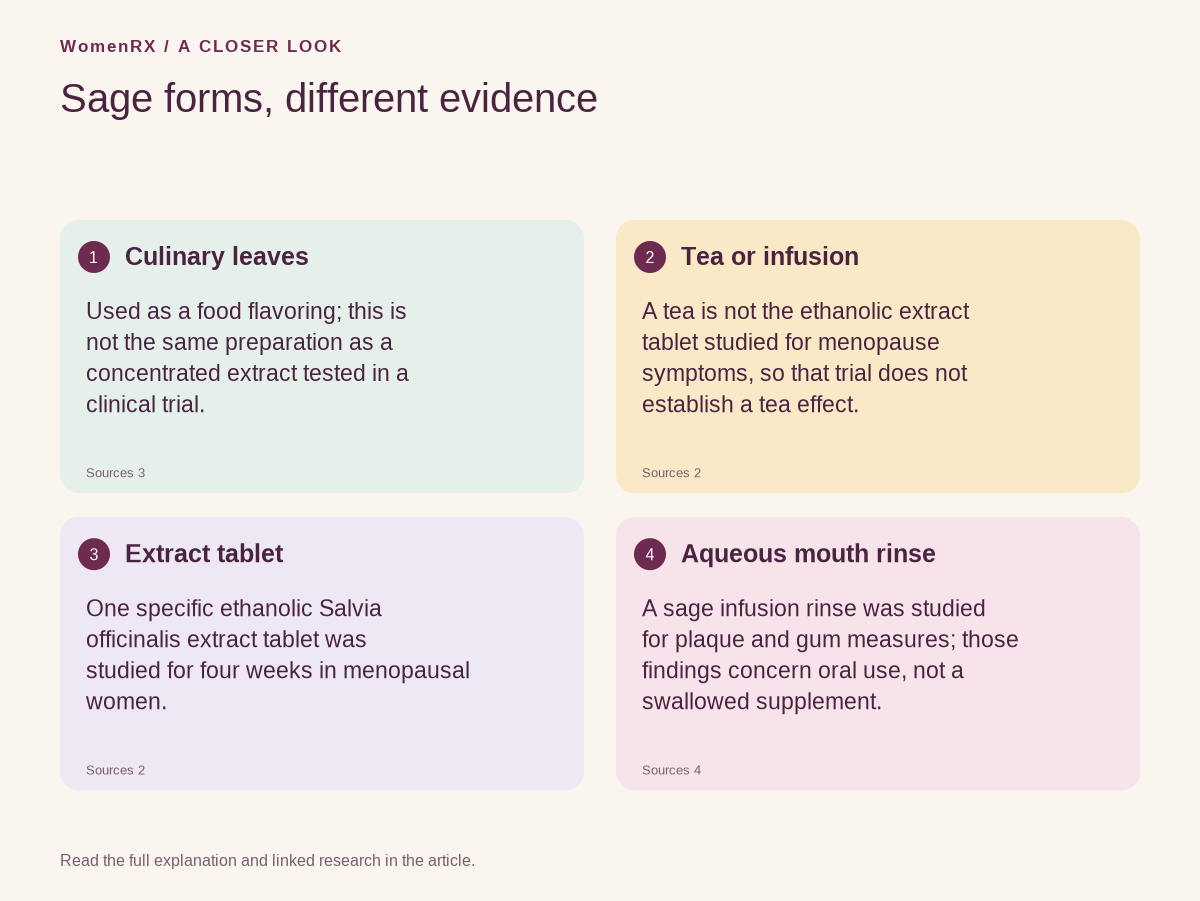
Sage forms, different evidence
Culinary leaves: Used as a food flavoring; this is not the same preparation as a concentrated extract tested in a clinical trial.3
Tea or infusion: A tea is not the ethanolic extract tablet studied for menopause symptoms, so that trial does not establish a tea effect.2
Extract tablet: One specific ethanolic Salvia officinalis extract tablet was studied for four weeks in menopausal women.2
Aqueous mouth rinse: A sage infusion rinse was studied for plaque and gum measures; those findings concern oral use, not a swallowed supplement.4
Read the figure as text
The clinical result depends on the preparation and the outcome tested; evidence for one form does not automatically transfer to another.- Culinary leaves: Used as a food flavoring; this is not the same preparation as a concentrated extract tested in a clinical trial.3
- Tea or infusion: A tea is not the ethanolic extract tablet studied for menopause symptoms, so that trial does not establish a tea effect.2
- Extract tablet: One specific ethanolic Salvia officinalis extract tablet was studied for four weeks in menopausal women.2
- Aqueous mouth rinse: A sage infusion rinse was studied for plaque and gum measures; those findings concern oral use, not a swallowed supplement.4
More questions, answered
Does the menopause research apply to sage tea?
Not directly. The trial tested a specific tablet made with an ethanolic extract of freshly harvested Salvia officinalis, not ordinary sage tea. The result doesn’t establish that tea has the same effect. 2
Does the research establish that sage is safe during pregnancy or breastfeeding?
No. A diabetes extract trial excluded pregnant and breastfeeding participants, so it couldn’t answer that safety question. 3
Sources you can check
- Improved glycemic control and lipid profile in hyperlipidemic type 2 diabetic patients consuming Salvia officinalis L. leaf extract: a randomized placebo. Controlled clinical trial.Kianbakht S, Dabaghian FH. · Complementary therapies in medicine · 2013Return to first citation
- Effectiveness of Menosan® Salvia officinalis in the treatment of a wide spectrum of menopausal complaints. A double-blind, randomized, placebo-controlled, clinical trial.Wilfried D, Nina CDG, Silvia B. · Heliyon · 2021Return to first citation
- Salvia officinalis (Sage) Leaf Extract as Add-on to Statin Therapy in Hypercholesterolemic Type 2 Diabetic Patients: a Randomized Clinical Trial.Kianbakht S, Nabati F, Abasi B. · International journal of molecular and cellular medicine · 2016Return to first citation
- Comparative Clinical Evaluation of Chamomile, Sage, and Ginger Mouthwashes in Reducing Plaque and Gingival Inflammation.Lile IE, Samoilă AOJ, Cojocariu C, Tapalagă G, Oláh NK, Stana OL, Berari A, Marian D. · Antibiotics (Basel, Switzerland) · 2026Return to first citation