How to Compare Sage Supplements by Their Labels
A detailed sage label makes products easier to compare with research, but it can’t prove a menopause benefit.
Start with the botanical name, then check the plant part, preparation, route, and any extract or constituent details. These clues help you judge whether a product resembles one studied for your reason for taking it. They don’t verify what’s in the bottle or prove it will work. A menopause trial tested a particular oral Salvia officinalis extract, not sage supplements as a category. 3
Start with the plant’s identity
Look for the full botanical name, Salvia officinalis, rather than relying on “sage” alone. Then check whether the label names the plant part, such as leaf. These details tell you what the manufacturer claims the product contains; the printed label doesn’t independently verify it.
Plant part matters when you try to match a product to research. The abstract of a menopause trial identifies freshly harvested Salvia officinalis as the source of its extract, but it doesn’t specify which plant part was used. A label that says “sage leaf extract” therefore gives you a detail that the trial abstract can’t confirm matches. 3
Match the preparation and the reason for using it
A swallowed extract tablet, an inhaled essential oil, and a mouth rinse are different preparations and routes. In a randomized trial of 80 women aged 48 to 65 described as menopausal, researchers tested an oral tablet containing an ethanolic extract of freshly harvested Salvia officinalis against placebo for four weeks. The study reported an improvement in its menopause rating scale compared with placebo. It also reported a drop in the extract group’s hot-flush severity score, though the abstract doesn’t clearly establish that this particular score change differed significantly from placebo. Those findings apply to the studied extract and timeframe, not automatically to another sage product. 3
Other sage studies show why the route and outcome deserve their own check. A trial in postmenopausal women used Salvia officinalis essential oil by inhalation and measured sexual function and satisfaction, not hot flashes after taking a supplement. Another trial used a mouth rinse prepared from a dry extract of Salvia officinalis leaves in adults receiving palliative cancer care. It assessed oral discomfort, not menopause symptoms. Neither preparation fills in the missing plant-part detail for the menopause tablet. 1 2 3
If you’re considering sage for hot flashes, the most useful comparison isn’t simply “Was sage studied?” It’s “Was this kind of preparation studied for hot flashes in people at a comparable life stage?” The menopause trial included women described as menopausal, but its abstract doesn’t give separate results for perimenopausal and postmenopausal women. 3
Treat extract claims as descriptions, not guarantees
If a label says “extract,” see whether it also identifies the plant part and how the extract was made. Look for any named constituents or standardization claim. More detail can make a product easier to compare with a study: for example, the menopause trial identifies its preparation as an ethanolic extract of freshly harvested sage. Its abstract does not establish that a different product bearing the same botanical name, or even the word “standardized,” is equivalent. 3
The same distinction applies to quality claims. If a company says its sage product is tested, ask what was tested, who did the testing, and whether the documentation covers the product or batch you’re considering. A statement about testing without those details gives you little to compare. Even well-documented identity or quality testing would answer a different question from whether the product relieves symptoms.
A useful label review leaves you with two separate judgments: whether the product is described clearly enough to compare with a studied preparation, and whether research on that preparation addresses your symptom. A clear answer to the first question isn’t a substitute for the second.
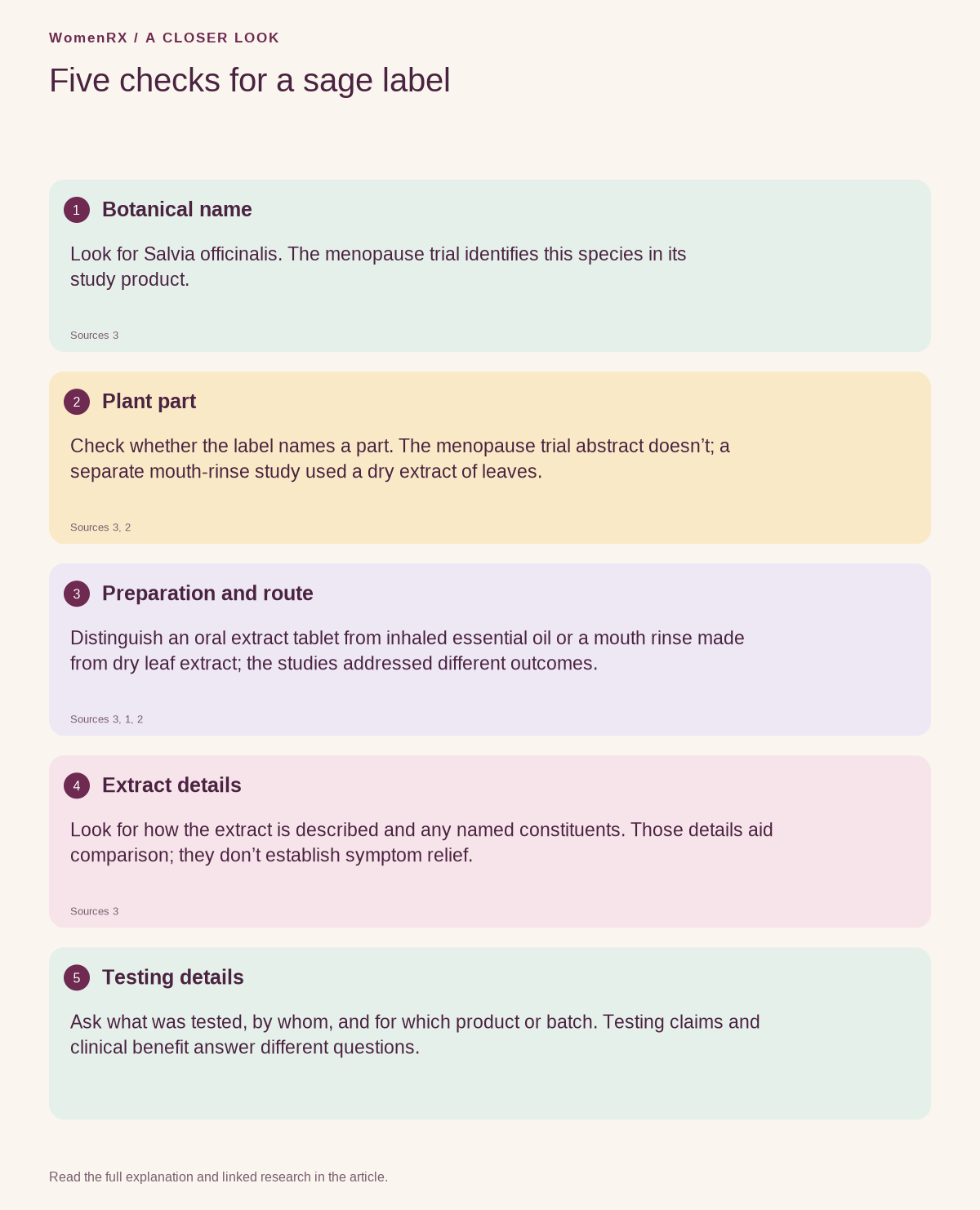
Five checks for a sage label
Botanical name: Look for Salvia officinalis. The menopause trial identifies this species in its study product.3
Plant part: Check whether the label names a part. The menopause trial abstract doesn’t; a separate mouth-rinse study used a dry extract of leaves.32
Preparation and route: Distinguish an oral extract tablet from inhaled essential oil or a mouth rinse made from dry leaf extract; the studies addressed different outcomes.312
Extract details: Look for how the extract is described and any named constituents. Those details aid comparison; they don’t establish symptom relief.3
Testing details: Ask what was tested, by whom, and for which product or batch. Testing claims and clinical benefit answer different questions.
Read the figure as text
Use these checks to see what a product claims to contain and whether you can meaningfully compare it with a study. They are not a quality score or proof of benefit.- Botanical name: Look for Salvia officinalis. The menopause trial identifies this species in its study product.3
- Plant part: Check whether the label names a part. The menopause trial abstract doesn’t; a separate mouth-rinse study used a dry extract of leaves.32
- Preparation and route: Distinguish an oral extract tablet from inhaled essential oil or a mouth rinse made from dry leaf extract; the studies addressed different outcomes.312
- Extract details: Look for how the extract is described and any named constituents. Those details aid comparison; they don’t establish symptom relief.3
- Testing details: Ask what was tested, by whom, and for which product or batch. Testing claims and clinical benefit answer different questions.
More questions, answered
Does a standardized sage extract mean it’s proven to help hot flashes?
No. Standardization describes a product characteristic; it doesn’t establish a clinical benefit. The menopause trial tested one specified ethanolic extract tablet, and its findings can’t be assumed to apply to every sage extract. 3
Sources you can check
- Effect of Salvia officinalis scent on postmenopausal women's sexual function and satisfaction: a randomized controlled trial.Heydarpour S, Sharifipour F, Heydarpour F. · BMC women's health · 2023Return to first citation
- A mouth rinse based on a tea solution of Salvia officinalis for oral discomfort in palliative cancer care: a randomized controlled trial.Monsen RE, Herlofson BB, Gay C, Fjeld KG, Hove LH, Malterud KE, Saghaug E, Slaaen J, Sundal T, Tollisen A, Lerdal A. · Supportive care in cancer : official journal of the Multinational Association of Supportive Care in Cancer · 2021Return to first citation
- Effectiveness of Menosan® Salvia officinalis in the treatment of a wide spectrum of menopausal complaints. A double-blind, randomized, placebo-controlled, clinical trial.Wilfried D, Nina CDG, Silvia B. · Heliyon · 2021Return to first citation