Psyllium for Weight or Blood Sugar: What to Expect
Psyllium can add gel-forming fiber, but evidence for weight and glucose benefits is narrower than supplement claims suggest.
Psyllium is a gel-forming soluble fiber that may be relevant if you’re trying to increase fiber intake. In selected studies of adults with overweight or obesity, it was linked with modest average weight loss; a small, short study in adults with type 2 diabetes also reported improved glucose measures. Neither result guarantees an individual benefit. Take fluid and medicine timing seriously. 3 4 1 2
Start with the goal, not the claim
Psyllium is a soluble fiber that forms a gel when hydrated. That makes it a way to add fiber, but it doesn’t make it a proven appetite suppressant or a stand-alone treatment for weight or diabetes. Its gel can increase the viscosity of digestive contents and slow the breakdown and absorption of nutrients. That mechanism helps explain why glucose effects have been studied, but a plausible mechanism isn’t proof of a meaningful result for every person. 3 4
It helps to separate three goals:
- Increasing fiber: Psyllium can contribute gel-forming soluble fiber. The studies discussed below tested supplements, not every psyllium food or product.
- Lowering blood sugar: There’s a small, short randomized trial in people who already had type 2 diabetes. That’s a signal worth understanding, not evidence that psyllium prevents diabetes or replaces diabetes care. 3
- Losing weight: A review pooling selected trials found a modest average difference in adults with overweight or obesity. That’s not a promise of weight loss for you, and it doesn’t show that psyllium works by reliably reducing hunger. 4
What the weight studies can tell you
A 2023 review and meta-analysis included six randomized controlled trials, totaling 354 adults with overweight or obesity. In those trials, participants took psyllium before meals, at an average of 10.8 grams a day, for an average of 4.8 months. Compared with control groups, psyllium users lost an average of 2.1 kilograms more; the review also reported lower average BMI and waist circumference. The studies varied in duration, and the result describes a group average, not what any one person should expect. 4
That finding is more useful than a claim based only on fullness after one meal: the review required trials designed to measure weight over at least two months. Still, six studies and 354 participants make for a limited evidence base. Psyllium may be a small adjunct for some people, but it isn’t a dependable weight-loss plan by itself. 4
What the blood-sugar study can tell you
One randomized study assigned 40 adults with type 2 diabetes to psyllium or their usual diet for eight weeks. The psyllium group received 10.5 grams daily, and the researchers reported improvements in several glucose-related measures, including fasting blood glucose and A1C. The small sample and short follow-up limit what this study can establish; it doesn’t show long-term effects, or that the same results apply to people without diabetes. 3
If you have diabetes, think of psyllium as a possible fiber addition, not a replacement for prescribed treatment or your care plan. If you use glucose-lowering medicine, ask your care team or pharmacist whether timing matters for the specific medicine you take. A review notes that soluble fibers, including psyllium, can reduce absorption of some drugs, but it doesn’t establish a specific interaction with every glucose-lowering medicine; the small trial also doesn’t establish effects across treatment combinations. 1 3
The practical precautions matter
Have enough fluid with it. Psyllium absorbs water and expands. A case report described intestinal obstruction after a person took psyllium without enough fluid; the report also discusses obstruction risks in people with certain intestinal problems or after some procedures. A case report can’t tell us how often this happens, but it illustrates why following the product directions for fluid matters. 2
If you have trouble swallowing, a known or suspected bowel narrowing or obstruction, paralytic ileus, or have had gastric banding, get individualized advice before using psyllium. Don’t try to push through worsening abdominal pain, swelling, or inability to pass stool after taking it; those symptoms warrant prompt medical attention, particularly given the reported obstruction risk. 2
Check medicine timing. Psyllium and other soluble fibers can reduce absorption of some oral medicines. The cited interaction review does not give a universal spacing interval or establish specific interactions for every medicine. Ask a pharmacist whether your medicines need to be taken at a different time; don’t guess at an interval or change a prescribed schedule on your own. 1
Pregnancy and breastfeeding deserve individual advice. The weight and glucose studies described here don’t establish effects or safety specifically during pregnancy or breastfeeding. If you’re pregnant or nursing and considering a psyllium supplement, ask your maternity clinician or pharmacist about your circumstances and other medicines rather than assuming that trial results in other adults apply to you. 3 4
A quick decision check
Psyllium may be worth discussing if your main aim is to add fiber and you can take it with adequate fluid. If your main aim is weight loss or glucose control, keep expectations modest: the weight evidence comes from a limited set of trials in adults with overweight or obesity, and the glucose evidence includes one small, short study in adults with type 2 diabetes. Before starting, check the product directions, swallowing and bowel history, and medicine timing. 2 3 4 1
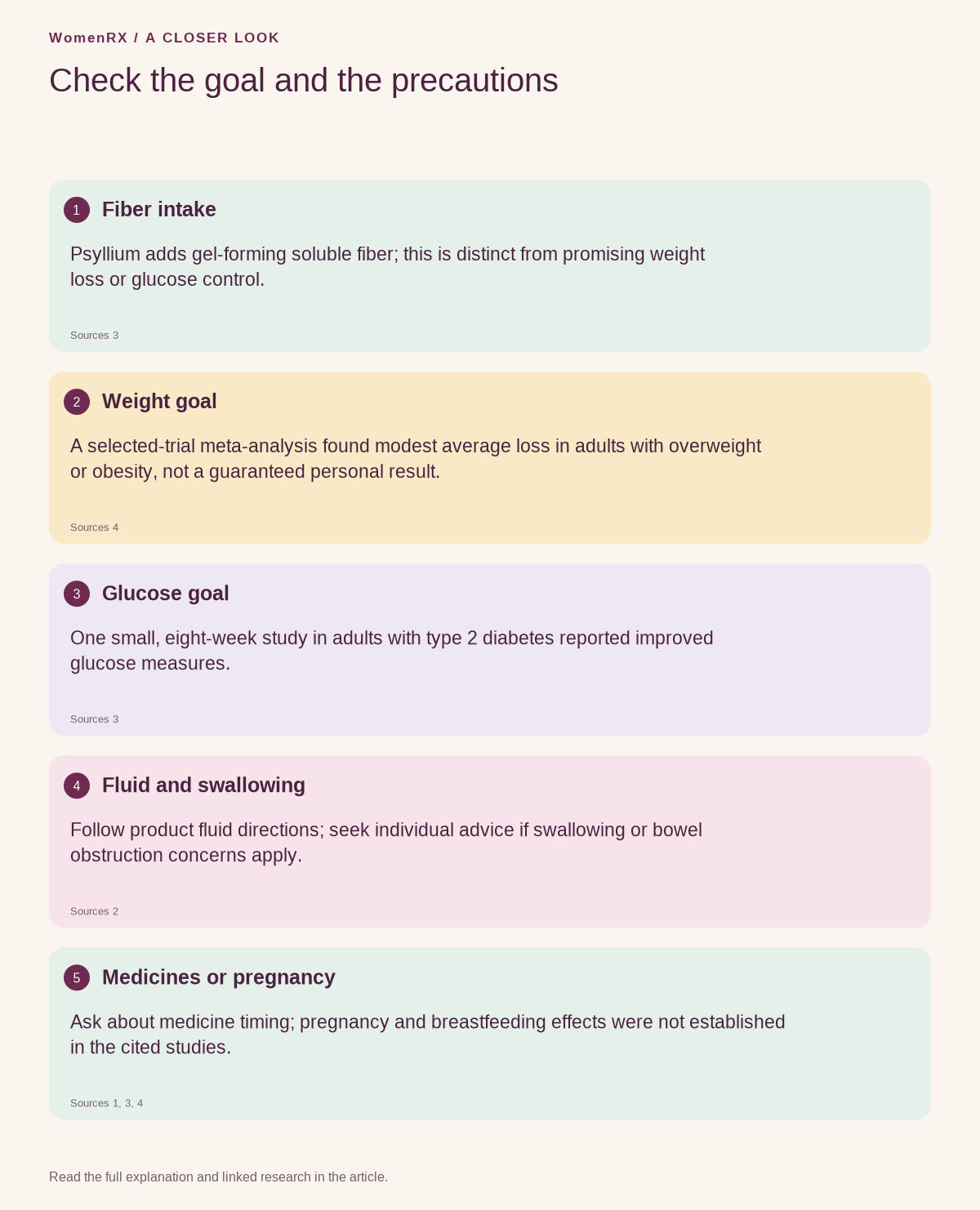
Check the goal and the precautions
Fiber intake: Psyllium adds gel-forming soluble fiber; this is distinct from promising weight loss or glucose control.3
Weight goal: A selected-trial meta-analysis found modest average loss in adults with overweight or obesity, not a guaranteed personal result.4
Glucose goal: One small, eight-week study in adults with type 2 diabetes reported improved glucose measures.3
Fluid and swallowing: Follow product fluid directions; seek individual advice if swallowing or bowel obstruction concerns apply.2
Medicines or pregnancy: Ask about medicine timing; pregnancy and breastfeeding effects were not established in the cited studies.134
Read the figure as text
Use these distinctions to decide whether psyllium fits your goal and what to check before taking it.- Fiber intake: Psyllium adds gel-forming soluble fiber; this is distinct from promising weight loss or glucose control.3
- Weight goal: A selected-trial meta-analysis found modest average loss in adults with overweight or obesity, not a guaranteed personal result.4
- Glucose goal: One small, eight-week study in adults with type 2 diabetes reported improved glucose measures.3
- Fluid and swallowing: Follow product fluid directions; seek individual advice if swallowing or bowel obstruction concerns apply.2
- Medicines or pregnancy: Ask about medicine timing; pregnancy and breastfeeding effects were not established in the cited studies.134
More questions, answered
Does psyllium work the same way for all women?
The cited weight and glucose findings do not establish whether psyllium’s effects differ by sex. Pregnancy and breastfeeding also weren’t established as study contexts, so those situations call for individualized advice. 3 4
How far apart should I take psyllium and my medicines?
The interaction review supports a concern that psyllium may reduce absorption of some medicines, but it doesn’t establish one spacing interval for all medicines. Ask a pharmacist about the specific products you take and follow their advice rather than applying a guessed rule. 1
Sources you can check
- Herb-drug interactions.Fugh-Berman A. · Lancet (London, England) · 2000Return to first citation
- Intestinal obstruction caused by a laxative drug (Psyllium): A case report and review of the literature.Hefny AF, Ayad AZ, Matev N, Bashir MO. · International journal of surgery case reports · 2018Return to first citation
- Soluble fibers from psyllium improve glycemic response and body weight among diabetes type 2 patients (randomized control trial).Abutair AS, Naser IA, Hamed AT. · Nutrition journal · 2016Return to first citation
- Psyllium is a natural nonfermented gel-forming fiber that is effective for weight loss: A comprehensive review and meta-analysis.Gibb RD, Sloan KJ, McRorie JW. · Journal of the American Association of Nurse Practitioners · 2023Return to first citation