Psyllium for LDL and Blood Sugar: What Studies Show
Psyllium has shown promising effects on LDL and glucose measures in adults with type 2 diabetes, but the studies don’t show that it can replace prescribed treatment.
Psyllium has been studied for both LDL cholesterol and blood sugar, but those are separate outcomes. A review of trials in adults with diabetes found an average LDL reduction, while fasting glucose and A1c also fell; results varied greatly between studies. One small trial added psyllium to diabetes medicines and diet advice, but the evidence doesn’t establish it as a replacement for prescribed care or show whether effects differ for women. 45
Psyllium may help improve some cholesterol and blood sugar measurements, but the evidence is most directly about adults with diabetes, not women as a distinct group. The findings are promising, especially for LDL, but studies differ enough that they can’t predict what one person will experience. 456
LDL and blood sugar are different questions
LDL is a type of cholesterol-carrying particle linked to plaque buildup in arteries. Blood glucose and A1c measure something else: glucose in the blood at a particular time, and average glucose over about three months, respectively. A change in one doesn’t prove a change in the other. 13
A 2020 review combined eight randomized trials, with 395 adults with diabetes. Its pooled estimate for LDL was a reduction of about 9 mg/dL. But the results differed substantially across studies, with very high statistical heterogeneity (I² 97%). The review also found pooled reductions in fasting blood sugar and A1c; heterogeneity was very high for those outcomes too (I² 97% and 99%, respectively). These are averages across studies, not a promise of the same change for you. 5
What the glucose studies measured
One small randomized trial followed 49 people with type 2 diabetes for eight weeks. Participants received psyllium or placebo alongside diabetes medicines and diet counseling. The study reported reductions in fasting glucose and A1c in the psyllium group. Because psyllium was added to existing care in this trial, the result doesn’t show that it can manage diabetes on its own. 4
Another 12-week trial enrolled 51 people with type 2 diabetes and chronic constipation. It reported lower fasting glucose and A1c in the psyllium group compared with placebo. That’s useful evidence for this particular group, but a trial in people who also have chronic constipation may not describe everyone considering psyllium for glucose. 7
What the cholesterol studies do, and don’t, establish
The review’s LDL finding is more specific than a broad claim that psyllium “lowers cholesterol.” In the same review, total cholesterol did not show a significant pooled change, even though LDL did. That distinction matters if you’re looking at a particular lab result. 5
A separate trial in 77 people with type 2 diabetes and constipation compared psyllium, flaxseed, and placebo. The study reported improvements in some lipid and glucose measures with psyllium compared with placebo, while flaxseed appeared to perform better overall. This is another reason not to treat one favorable result as proof of a uniform effect. 6
How it fits with prescribed care
Psyllium was tested alongside diet counseling and diabetes medicines in one trial. These findings don’t show that it can replace prescribed treatment. For high cholesterol, MedlinePlus identifies lifestyle changes and medicines as the main treatments. Don’t change or stop a prescribed medicine based on psyllium research. 4672
If you’re considering adding psyllium, useful questions for your prescriber or pharmacist include: Which result are we trying to improve, LDL, fasting glucose, or A1c? How will we tell whether my current plan is working? Does the specific psyllium product I’m considering affect how I should take any of my medicines? These trials don’t establish product-specific medication timing.
These studies don’t establish whether psyllium’s effects differ by sex or during pregnancy, postpartum, perimenopause, or postmenopause. 4567 If you’re deciding whether psyllium belongs in your plan, the most useful starting point is the specific outcome you want to address and the care you already use.
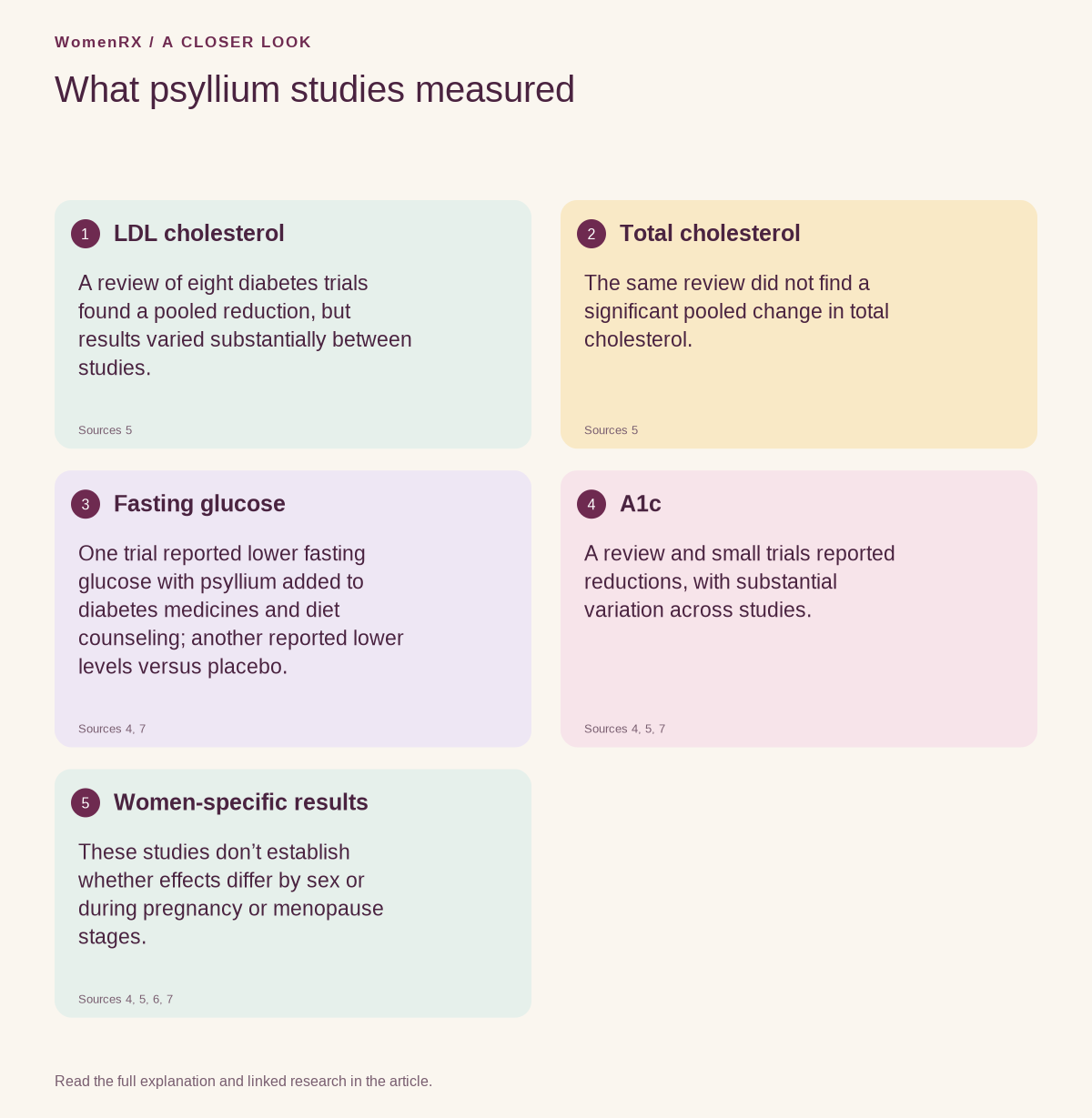
What psyllium studies measured
LDL cholesterol: A review of eight diabetes trials found a pooled reduction, but results varied substantially between studies.5
Total cholesterol: The same review did not find a significant pooled change in total cholesterol.5
Fasting glucose: One trial reported lower fasting glucose with psyllium added to diabetes medicines and diet counseling; another reported lower levels versus placebo.47
A1c: A review and small trials reported reductions, with substantial variation across studies.457
Women-specific results: These studies don’t establish whether effects differ by sex or during pregnancy or menopause stages.4567
Read the figure as text
LDL and glucose findings come from diabetes trials, but they are separate outcomes and don’t establish a women-specific effect.- LDL cholesterol: A review of eight diabetes trials found a pooled reduction, but results varied substantially between studies.5
- Total cholesterol: The same review did not find a significant pooled change in total cholesterol.5
- Fasting glucose: One trial reported lower fasting glucose with psyllium added to diabetes medicines and diet counseling; another reported lower levels versus placebo.47
- A1c: A review and small trials reported reductions, with substantial variation across studies.457
- Women-specific results: These studies don’t establish whether effects differ by sex or during pregnancy or menopause stages.4567
More questions, answered
Does psyllium lower total cholesterol as well as LDL?
Not consistently in the meta-analysis. It found a significant pooled reduction in LDL, but not in total cholesterol. Those measures shouldn’t be treated as interchangeable. 5
Can I reduce my diabetes or cholesterol medicine if I take psyllium?
These findings don’t support reducing prescribed treatment. One diabetes trial tested psyllium alongside medicines and diet counseling, not in place of them. Discuss any treatment change with the prescriber managing it. 42
Sources you can check
- Blood Glucose | Blood Sugar | Diabetes | MedlinePlusAccessed 2026-09-25Return to first citation
- How to Lower Cholesterol: MedlinePlusAccessed 2026-09-25Return to first citation
- Cholesterol | MedlinePlusAccessed 2026-09-25Return to first citation
- Psyllium decreased serum glucose and glycosylated hemoglobin significantly in diabetic outpatients.Ziai SA, Larijani B, Akhoondzadeh S, Fakhrzadeh H, Dastpak A, Bandarian F, Rezai A, Badi HN, Emami T. · Journal of ethnopharmacology · 2005Return to first citation
- The effect of psyllium consumption on weight, body mass index, lipid profile, and glucose metabolism in diabetic patients: A systematic review and dose-response meta-analysis of randomized controlled trials.Xiao Z, Chen H, Zhang Y, Deng H, Wang K, Bhagavathula AS, Almuhairi SJ, Ryan PM, Rahmani J, Dang M, Kontogiannis V, Vick A, Wei Y. · Phytotherapy research : PTR · 2020Return to first citation
- Effect of flaxseed or psyllium vs. placebo on management of constipation, weight, glycemia, and lipids: A randomized trial in constipated patients with type 2 diabetes.Soltanian N, Janghorbani M. · Clinical nutrition ESPEN · 2019Return to first citation
- Effects of psyllium vs. placebo on constipation, weight, glycemia, and lipids: A randomized trial in patients with type 2 diabetes and chronic constipation.Noureddin S, Mohsen J, Payman A. · Complementary therapies in medicine · 2018Return to first citation