Psyllium Safety: Swallowing, Bowel Symptoms, and Medicine Timing
Psyllium needs enough liquid, and trouble swallowing, unexplained bowel symptoms, or a tightly scheduled medicine can change whether it’s a good fit.
Psyllium can help with constipation, but check before using it if you have trouble swallowing, rectal bleeding, or a history of intestinal blockage.4 If your bowel symptoms are unexplained, don’t rely on psyllium alone to make sense of them.3 Follow your product’s liquid directions, and check medicine timing drug by drug. If you’re pregnant or breastfeeding, confirm that it’s suitable for you.42
Why the liquid matters
Psyllium is a bulk-forming laxative. It absorbs liquid in the intestines and swells, making stool bulkier and easier to pass. That same swelling is why preparation isn’t a minor detail: too little liquid can increase bloating and the risk of a bowel obstruction.43
Follow the directions for the product you have, rather than assuming every form is prepared alike. MedlinePlus says to mix psyllium powder or granules with 8 ounces of liquid right before use, chew wafers thoroughly, and drink at least 8 ounces of liquid when taking psyllium.4
When to pause before taking it
If swallowing is already difficult, don’t try to work around the problem by choosing a different psyllium form on your own. MedlinePlus lists difficulty swallowing and a history of intestinal blockage among the reasons to speak with a doctor or pharmacist before taking it. Rectal bleeding also belongs on that list. Those details matter more than whether psyllium is generally sold for constipation.4
If your bowel symptoms are unexplained, psyllium may change how you pass stool without explaining why your symptoms started. For example, if a change in bowel habits comes with rectal bleeding, check before using it.4 A constipation trial that found its treatments well tolerated studied selected adults with functional constipation and excluded people with suspected or diagnosed gastrointestinal disease. Its findings don’t settle what to do about symptoms with an unknown cause.3
If stomach pain, nausea, vomiting, difficulty swallowing, difficulty breathing, a rash, or itching develops after you take psyllium, MedlinePlus advises calling a doctor immediately.4
Some discomfort may be related to the way bulk-forming fiber works: insufficient liquid can increase bloating. But if significant or persistent symptoms develop after taking psyllium, don’t assume they’re just an adjustment to fiber.34
Medicine spacing depends on the medicine
Psyllium can complicate a medicine routine because soluble fibers can decrease the absorption of some drugs. That doesn’t mean every medicine has the same interaction or needs the same spacing interval.2
Here’s a concrete example: MedlinePlus says not to take digoxin, aspirin or other salicylates, or nitrofurantoin within 3 hours of psyllium. That instruction applies to those named medicines; it isn’t a rule to copy onto every prescription.4
Levothyroxine needs its own conversation. Its US prescribing information says dietary fiber may bind levothyroxine and decrease its absorption. The label gives instructions for taking levothyroxine on an empty stomach and for separating it from drugs known to interfere with absorption, but that does not establish a psyllium-specific spacing interval. If you take thyroid medicine, ask your pharmacist how psyllium would fit your particular schedule rather than moving your thyroid dose on your own.1
Bring up other regular prescriptions and over-the-counter medicines too. The useful question is specific: “Does this psyllium product affect any of my medicines, and if so, when should I take each one?” MedlinePlus advises telling your doctor and pharmacist about the medicines and supplements you use because monitoring or changes may be needed.4
Pregnancy, breastfeeding, and other reasons to check the label
If you’re pregnant, planning pregnancy, or breastfeeding, check with a clinician or pharmacist before using psyllium. MedlinePlus specifically asks people in these situations to discuss its use. A constipation trial that found its study treatments well tolerated excluded people who were pregnant, planning pregnancy, or breastfeeding, so its results don’t settle suitability for those stages.43
Also check the product directions if you need to limit sugar or sodium, and mention a psyllium allergy. When mixing powder, avoid breathing it in; MedlinePlus notes that inhaled psyllium powder can cause an allergic reaction.4
The concerns here aren’t a complete suitability screen. MedlinePlus also says to discuss diabetes, heart disease, high blood pressure, and kidney disease before taking psyllium. Check the directions for your exact product and raise any health conditions or medicines with a pharmacist or clinician, especially if swallowing is difficult, bowel symptoms are unexplained, or a medicine must stay on a reliable schedule.43
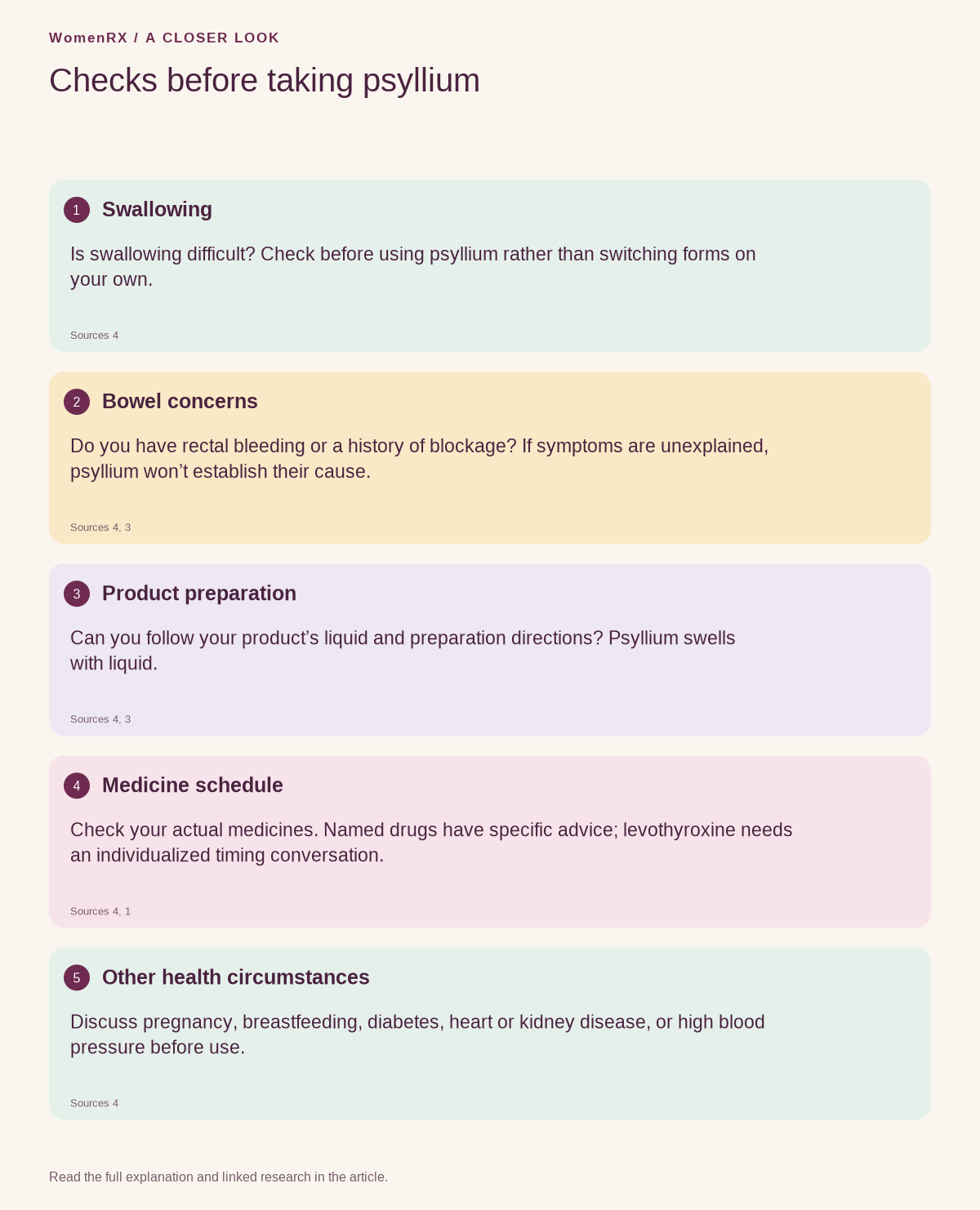
Checks before taking psyllium
Swallowing: Is swallowing difficult? Check before using psyllium rather than switching forms on your own.4
Bowel concerns: Do you have rectal bleeding or a history of blockage? If symptoms are unexplained, psyllium won’t establish their cause.43
Product preparation: Can you follow your product’s liquid and preparation directions? Psyllium swells with liquid.43
Medicine schedule: Check your actual medicines. Named drugs have specific advice; levothyroxine needs an individualized timing conversation.41
Other health circumstances: Discuss pregnancy, breastfeeding, diabetes, heart or kidney disease, or high blood pressure before use.4
Read the figure as text
These questions highlight reasons to look more closely before use; they aren’t a complete medical screen or a diagnostic score.- Swallowing: Is swallowing difficult? Check before using psyllium rather than switching forms on your own.4
- Bowel concerns: Do you have rectal bleeding or a history of blockage? If symptoms are unexplained, psyllium won’t establish their cause.43
- Product preparation: Can you follow your product’s liquid and preparation directions? Psyllium swells with liquid.43
- Medicine schedule: Check your actual medicines. Named drugs have specific advice; levothyroxine needs an individualized timing conversation.41
- Other health circumstances: Discuss pregnancy, breastfeeding, diabetes, heart or kidney disease, or high blood pressure before use.4
More questions, answered
Can I keep taking psyllium if constipation doesn’t improve?
Don’t keep extending self-treatment without checking in. MedlinePlus says not to take psyllium for longer than one week unless your doctor tells you to.4
Sources you can check
- LEVOTHYROXINE SODIUM TABLET [CARDINAL HEALTH 107, LLC] | US prescribing information and patient instructionsAccessed 2026-09-25Return to first citation
- Herb-drug interactions.Fugh-Berman A. · Lancet (London, England) · 2000Return to first citation
- Influence of Lactitol and Psyllium on Bowel Function in Constipated Indian Volunteers: A Randomized, Controlled Trial.Cheng J, Tennilä J, Stenman L, Ibarra A, Kumar M, Gupta KK, Sharma SS, Sen D, Garg S, Penurkar M, Kumar S, Ouwehand AC. · Nutrients · 2019Return to first citation
- Psyllium: MedlinePlus Drug InformationAccessed 2026-09-25Return to first citation