Psyllium Timing, Fluids, and Medicines: A Practical Guide
For constipation, the useful psyllium schedule is one that accounts for enough liquid and any medicines you take by mouth.
The constipation trials described below didn’t establish a best time of day for psyllium, and the medicine-interaction study was in rabbits, not people. 3 4 8 Look for a time when you can follow your psyllium product’s liquid directions. If you take oral medicines, ask a pharmacist whether any need to be separated from psyllium and by how long.
What timing can, and can’t, tell you
Psyllium is a bulk-forming fiber: it absorbs water and increases stool bulk, which can help bowel movements. That water-holding action is central to its use. 8
One constipation trial compared psyllium with other treatments over four weeks; it didn’t compare morning with evening. A separate study used psyllium 5 to 10 minutes before meals, but that was a protocol for adults with overweight or obesity in a three-month study of micronutrient status, not a test of the best timing for constipation. That schedule shouldn’t be treated as a general recommendation. 3 8
If your clinician or product directions give you a schedule, use that rather than borrowing one from a different study. Otherwise, look for a time when you can take the product as directed with liquid and account for your regular medicines. These studies don’t show that timing alone determines the result. 3 8
Fluids matter; use your product’s directions
Psyllium needs liquid to expand. In a case report, a man developed an incomplete bowel obstruction after taking psyllium husks without enough fluid; the report also discusses obstruction risk when people habitually drink very little. This is a serious complication described in a case report, not a measure of how often it happens. 5
Check the liquid directions for the specific product you’re using. One trial protocol mixed each 5-gram fiber sachet with at least 250 mL of water. That was the study’s method, not an amount to substitute for your product’s instructions. 3
Product form matters too. An FDA rule determined that over-the-counter psyllium laxatives in granular dosage forms were not generally recognized as safe and effective and were misbranded after reports of esophageal obstruction. The rule covered granules even when dispersed in liquid or washed down with liquid; mixing those granules with water did not remove the concern addressed by the rule. It did not apply to nongranular forms such as powders, tablets, or wafers. 6
If you can’t follow your product’s liquid directions, don’t guess at a smaller amount. Ask a pharmacist or clinician about another approach. If you have a known or suspected bowel obstruction or postoperative ileus, get clinical assessment before taking psyllium rather than treating it as a question of which psyllium product to choose. The obstruction report discusses these conditions as situations in which added bulk may be a concern; a history of surgery alone isn’t the same thing. 5
Fit psyllium around medicines, not the other way around
A study of ethinyloestradiol found that psyllium changed the rate and slightly increased the extent of absorption in female rabbits when the two were given together. That animal result can’t tell us whether the same effect occurs in people or what spacing to use for a particular medicine. 4
Neither the constipation trials nor the rabbit study establishes an interval to apply to every oral medicine and psyllium product. 4 7 8 To picture the planning, say you already take one medicine with breakfast and another at bedtime. Lunch might look like an opening for psyllium, but it’s only a possibility: check the psyllium product’s directions, including its liquid instructions, and have a pharmacist check whether either medicine needs to be separated from it and by how long. If lunch doesn’t leave the gap you’re advised to use, ask where psyllium could fit rather than changing a medicine schedule on your own.
What constipation studies actually show
In a randomized trial of 172 constipated Indian adults, participants received psyllium, lactitol, a combination, or placebo for four weeks. Bowel movements increased by 2.9 in the psyllium group and 3.7 in the placebo group; the change with psyllium was not different from placebo. No serious adverse events were reported. The trial did not test timing, and its participants were not pregnant, breastfeeding, planning pregnancy, or recently postpartum. 8
A separate analysis included 20 people with functional constipation, 18 of them women, with five people per treatment group. It found no differences between groups in measured transit times; its small size and secondary-analysis design limit what it can tell us. 7
If you’re changing how much psyllium you take, follow your product directions or the plan you were given rather than adopting a dose-change schedule from a trial. If you’re also increasing fiber in your diet, make that change gradually. 2
Pregnancy, postpartum, and when to get help
Constipation is common during pregnancy and after giving birth. The NHS advises that measures such as drinking plenty of fluids and gradually increasing dietary fiber are safe to try during pregnancy, and says a healthcare professional can suggest a suitable laxative. That guidance doesn’t establish that psyllium is right for every pregnant or postpartum person. One psyllium constipation trial excluded pregnant and breastfeeding participants and people who had given birth in the previous three months. If you’re pregnant or recently postpartum, check with your obstetric care team or pharmacist before starting it. 2 8
If your bowel habits change, MedlinePlus recommends checking with your provider. Seek prompt medical assessment if you develop worsening abdominal swelling or pain and can’t pass stool after taking psyllium; those symptoms resemble the presentation in the reported obstruction case. 1 5
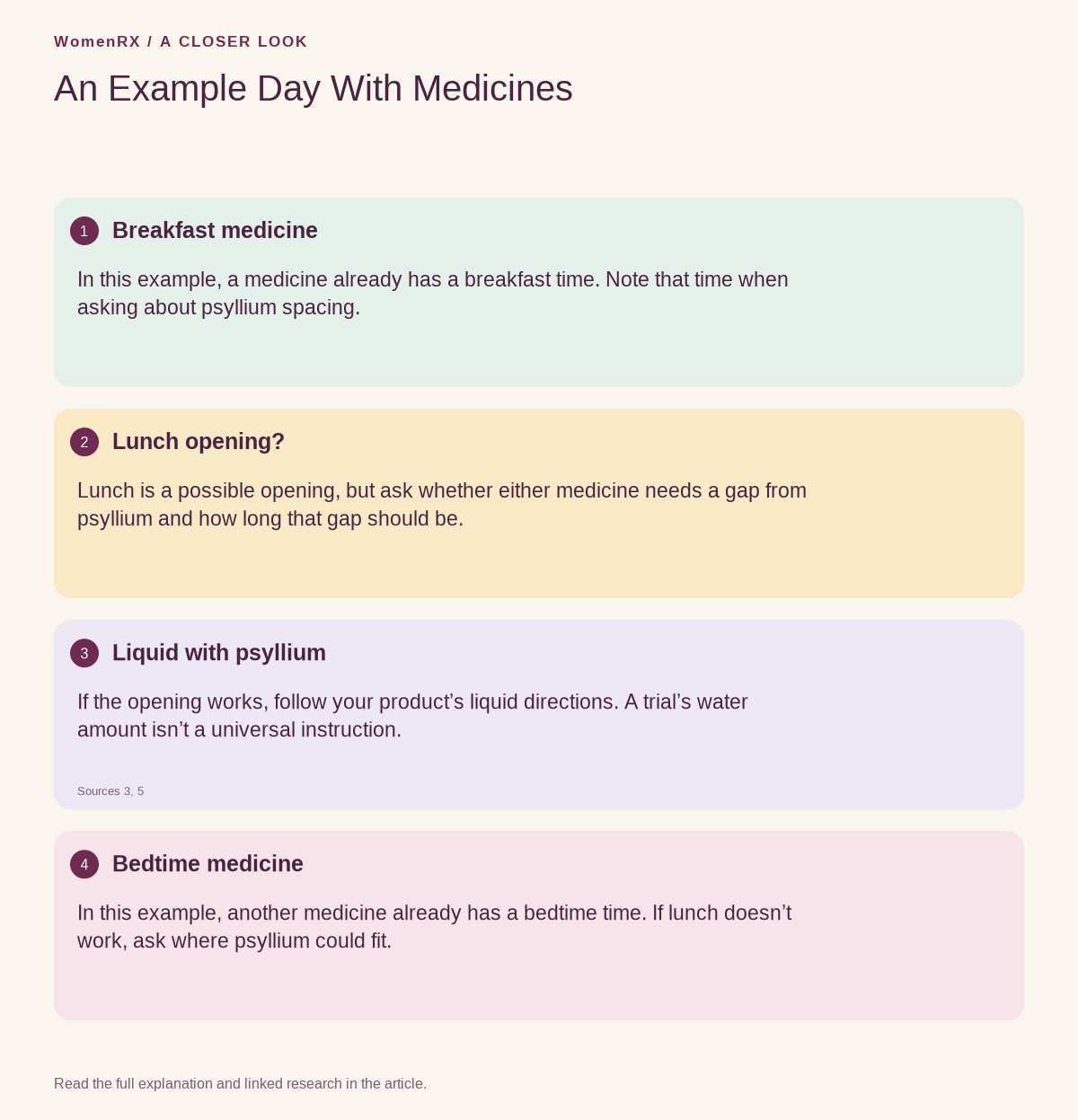
An Example Day With Medicines
Breakfast medicine: In this example, a medicine already has a breakfast time. Note that time when asking about psyllium spacing.
Lunch opening?: Lunch is a possible opening, but ask whether either medicine needs a gap from psyllium and how long that gap should be.
Liquid with psyllium: If the opening works, follow your product’s liquid directions. A trial’s water amount isn’t a universal instruction.35
Bedtime medicine: In this example, another medicine already has a bedtime time. If lunch doesn’t work, ask where psyllium could fit.
Read the figure as text
Suppose you take medicines with breakfast and at bedtime. Lunch is a possible opening for psyllium, not a recommended time or a confirmed medicine gap.- Breakfast medicine: In this example, a medicine already has a breakfast time. Note that time when asking about psyllium spacing.
- Lunch opening?: Lunch is a possible opening, but ask whether either medicine needs a gap from psyllium and how long that gap should be.
- Liquid with psyllium: If the opening works, follow your product’s liquid directions. A trial’s water amount isn’t a universal instruction.35
- Bedtime medicine: In this example, another medicine already has a bedtime time. If lunch doesn’t work, ask where psyllium could fit.
More questions, answered
Does psyllium need to be taken before meals?
A before-meal schedule was used in a study of adults with overweight or obesity, but that study didn’t test which time works best for constipation. Follow your product directions or the schedule you were given instead. 3
How much water should I mix with psyllium?
Use the liquid amount specified for your product. The at-least-250 mL amount used with a 5-gram sachet in one trial was a study protocol, not an instruction for every formulation. If you can’t follow your product’s directions, ask a pharmacist about another option. 3 5
Sources you can check
- Constipation | MedlinePlusAccessed 2026-09-25Return to first citation
- Constipation - NHSAccessed 2026-09-25Return to first citation
- Micronutrient status of individuals with overweight and obesity following 3 months' supplementation with PolyGlycopleX (PGX®) or psyllium: a randomized controlled trial.Pal S, McKay J, Ho S, Jane M, Gahler RJ, Wood S. · BMC nutrition · 2022Return to first citation
- Influence of two dietary fibers in the oral bioavailability and other pharmacokinetic parameters of ethinyloestradiol.García JJ, Fernández N, Diez MJ, Sahagún A, González A, Alonso ML, Prieto C, Calle AP, Sierra M. · Contraception · 2000Return to first citation
- Intestinal obstruction caused by a laxative drug (Psyllium): A case report and review of the literature.Hefny AF, Ayad AZ, Matev N, Bashir MO. · International journal of surgery case reports · 2018Return to first citation
- Laxative drug products for over-the-counter human use; psyllium ingredients in granular dosage forms. Final rule.Food and Drug Administration, HHS. · Federal register · 2007Return to first citation
- The effect of fiber supplementation with agave fructans or psyllium plantago in symptoms of constipation and its relation with whole and regional transit time and pH.Coss-Adame E, Arenas-Martínez JS, García-Cedillo MF, Nosthas LC, Bustillo-Armendriz G. · Neurogastroenterology and motility · 2024Return to first citation
- Influence of Lactitol and Psyllium on Bowel Function in Constipated Indian Volunteers: A Randomized, Controlled Trial.Cheng J, Tennilä J, Stenman L, Ibarra A, Kumar M, Gupta KK, Sharma SS, Sen D, Garg S, Penurkar M, Kumar S, Ouwehand AC. · Nutrients · 2019Return to first citation