Psyllium: What to Expect and How to Compare Products
Psyllium may help with constipation, but the useful test is whether your stools become easier to pass, not whether a product promises a quick result.
Psyllium can improve bowel habits, but there’s no reliable deadline for when it will work for you. In a trial of adults with chronic constipation, bowel movement frequency had improved by the first assessment at one week; that doesn’t tell us the day each person noticed a change. Check what your product calls a serving, follow its mixing directions, and watch stool comfort as well as frequency. 62
What the research can tell you about timing
If you’re starting psyllium, it’s reasonable to want to know when you’ll feel a difference. The answer depends partly on what you mean by “work”: going more often, passing a softer stool, or straining less are different changes.
In a randomized trial of adults with chronic functional constipation, the group taking ispaghula husk, another name for psyllium, averaged 1.33 bowel movements a week at the start and 5.33 at the one-week assessment. The study assessed participants at one and two weeks, so it doesn’t establish an exact day of onset. Polyethylene glycol with electrolytes produced a larger increase in that trial; the comparison does not mean psyllium cannot help. The trial included men and women but did not report a separate result for women. 6
A review of 16 randomized trials in adults with chronic constipation also found that fiber supplements improved stool frequency and consistency overall, with significant effects for psyllium in its analyses. Results varied considerably among studies. Greater improvements in frequency were apparent in studies lasting at least four weeks, but that finding is not an instruction to wait four weeks if your symptoms are troubling or changing. 5
Compare what the label actually measures
Before comparing two products, find the labeled serving and check whether an amount is identified as psyllium or as dietary fiber. Psyllium is a plant fiber, so a dietary-fiber figure may reflect fiber supplied by psyllium, not a separate ingredient. The clinical trials report specific amounts of psyllium given to participants. They don’t provide a conversion rule for retail label figures or show that products with matching figures are equivalent. 156
For example, if you’re looking at a container that lists both psyllium husk and dietary fiber, note which figure you’re using when you compare it with another label. Also check what the manufacturer calls one serving and how it says to prepare it. This is a way to keep your comparison straight, not a reason to chase a trial dose on your own.
Give the change a fair, comfortable test
Adding dietary fiber too quickly can cause gas, bloating, and cramps. A gradual change gives you room to notice whether the product agrees with you. Water and other fluids are also part of ordinary constipation self-care; psyllium in the cited trials was mixed with water. Follow the directions for the product you choose rather than copying a research protocol. 1256
Notice what happens to your usual pattern: Are stools easier to pass? Are you straining less? Has their consistency changed? You don’t need a bowel movement every day for your pattern to be normal. Frequency matters most alongside comfort and a change from what’s usual for you. 24 If bloating begins as you increase fiber, that’s useful information too. In the review of constipation trials, flatulence was higher with fiber supplements than with control treatments. 5
Psyllium isn’t a substitute for looking into a bowel change that persists or appears suddenly. Check with a clinician about a sudden change in bowel habits or abdominal pain, rather than repeatedly adjusting a supplement and assuming fiber is the whole answer. 24
Pregnancy and the weeks after birth
Constipation is common during pregnancy and after giving birth, but that doesn’t establish that psyllium works differently in either period. The adult research discussed here doesn’t give you a basis for predicting a pregnancy- or postpartum-specific response. 3456
If you’re pregnant or recently gave birth, start with the same clear question: What has changed about your stools, and what are you hoping to improve? Food, fluids, and other simple measures are part of constipation care; the NHS describes simple diet and lifestyle changes as safe to try during pregnancy. 24 If you’re considering a psyllium product, a question you can raise with your prenatal or postpartum care team is whether it fits your situation, including any guidance you’ve already received about fluids.
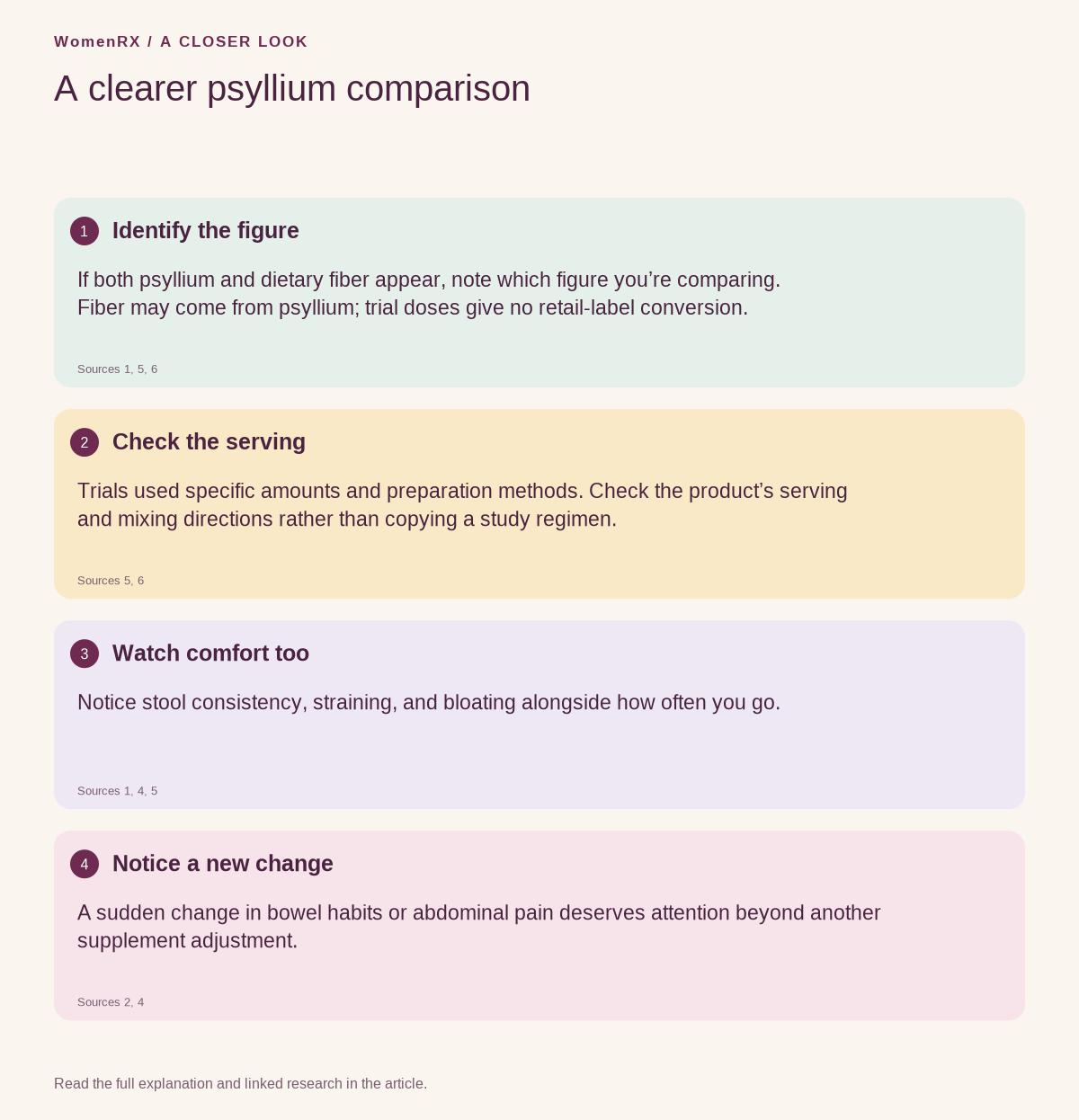
A clearer psyllium comparison
Identify the figure: If both psyllium and dietary fiber appear, note which figure you’re comparing. Fiber may come from psyllium; trial doses give no retail-label conversion.156
Check the serving: Trials used specific amounts and preparation methods. Check the product’s serving and mixing directions rather than copying a study regimen.56
Watch comfort too: Notice stool consistency, straining, and bloating alongside how often you go.145
Notice a new change: A sudden change in bowel habits or abdominal pain deserves attention beyond another supplement adjustment.24
Read the figure as text
Use these checks to compare a label and observe the bowel change you actually want.- Identify the figure: If both psyllium and dietary fiber appear, note which figure you’re comparing. Fiber may come from psyllium; trial doses give no retail-label conversion.156
- Check the serving: Trials used specific amounts and preparation methods. Check the product’s serving and mixing directions rather than copying a study regimen.56
- Watch comfort too: Notice stool consistency, straining, and bloating alongside how often you go.145
- Notice a new change: A sudden change in bowel habits or abdominal pain deserves attention beyond another supplement adjustment.24
More questions, answered
Should I judge psyllium by how often I go?
Not by frequency alone. Hard stools, pain, straining, and a change from your usual pattern matter too. You don’t have to have a bowel movement every day. 24
Sources you can check
- Dietary Fiber: MedlinePlusAccessed 2026-09-25Return to first citation
- Constipation | MedlinePlusAccessed 2026-09-25Return to first citation
- Postpartum Care: MedlinePlusAccessed 2026-09-25Return to first citation
- Constipation - NHSAccessed 2026-09-25Return to first citation
- The Effect of Fiber Supplementation on Chronic Constipation in Adults: An Updated Systematic Review and Meta-Analysis of Randomized Controlled Trials.van der Schoot A, Drysdale C, Whelan K, Dimidi E. · The American journal of clinical nutrition · 2022Return to first citation
- A Randomised, Controlled Comparison of Low-Dose Polyethylene Glycol 3350 plus Electrolytes with Ispaghula Husk in the Treatment of Adults with Chronic Functional Constipation.Wang HJ, Liang XM, Yu ZL, Zhou LY, Lin SR, Geraint M. · Clinical drug investigation · 2004Return to first citation