How to Compare Berberine Products With the Evidence
A useful berberine label comparison starts with the form and amount studied, then checks whether the research measured the outcome you care about.
Start by matching the label to your goal, not to a “blood sugar” or “hormone support” claim. A three-month study in women with PCOS used berberine hydrochloride 500 mg twice daily and measured fasting blood sugar and insulin, among other outcomes. That’s a research detail, not a suggested dose or proof that another product works. Check the product’s testing information and raise pregnancy, breastfeeding, and medicine questions separately. 6 2
First, name the outcome you’re looking for
Are you considering berberine because you have PCOS, because you’re concerned about glucose, or because a bottle promises several benefits at once? Those aren’t interchangeable reasons. Research in women with PCOS can help you assess a PCOS claim, but it doesn’t automatically show that berberine treats diabetes or helps everyone concerned about blood sugar.
One prospective randomized study assigned women with PCOS to berberine hydrochloride, metformin, or myo-inositol for three months. It measured fasting blood sugar, fasting insulin, and the fasting blood sugar-to-insulin ratio, along with body measurements, hormones, and blood lipids. The researchers reported greater changes with berberine in some body, hormonal, and lipid measures, while myo-inositol showed greater improvement in carbohydrate-metabolism measures. That distinction matters if glucose is your main reason for looking at a product: the study’s comparison doesn’t support treating a broad “blood sugar support” claim as a demonstrated benefit. 6
Other PCOS experiments have tested berberine in rats or mice. They can explore possible biological effects, but their findings aren’t results in women. The human comparison is more relevant to your decision, though it still doesn’t establish that berberine is a proven PCOS treatment. 3 4 5 6 7
Put the study details beside the label
The PCOS study used berberine hydrochloride 500 mg twice daily. That tells you what participants received; it isn’t a recommendation to take that amount. On a product label, look for the named form of berberine, the amount per serving, what counts as a serving, and any other active ingredients. If the front says “berberine” but the ingredient panel lists a plant extract or a multi-ingredient blend, don’t assume it matches the berberine hydrochloride studied. 6
For example, a label might list an amount per capsule while its suggested serving is more than one capsule. Compare like with like: the stated amount and the serving directions belong beside the study’s form and schedule. Even an exact-looking match wouldn’t show that a retail product produces the same effects. And a larger number on a label doesn’t establish a better result. 6 2
Ask what the testing actually checked
“Third-party tested” is more useful when you can tell what was tested. Look for information tied to the finished product you’d buy, rather than an unspecified ingredient or a general quality claim. Was its identity checked? Was the amount of berberine measured? Does the company make clear which product the results cover?
These questions have a practical reason behind them: supplement ingredients or amounts can differ from what labels say. Independent quality verification may help assess a product, but it does not certify that the product is safe or effective for PCOS or glucose concerns. A laboratory method can measure berberine in certain supplements; that is a different kind of evidence from a human study showing a health effect. 2 1
Keep the safety questions separate from the product claims
The PCOS study compared berberine with metformin; it did not test taking the two together or establish compatibility with your medicines. If you take a prescription medicine, especially for the same concern that’s prompting you to consider berberine, bring the complete product label and your medication list to a pharmacist or clinician. Ask: “Does this exact ingredient or blend change how we should think about my current treatment?” Don’t treat a supplement claim as a reason to replace prescribed medicine. 6
Pregnancy is another question the PCOS comparison cannot answer. If you’re pregnant or planning pregnancy, check the exact product with the clinician caring for you rather than assuming that a supplement studied in women with PCOS is suitable during pregnancy. 6
For breastfeeding, the available concern is more specific than a general warning about supplements. Goldenseal contains berberine and other alkaloids. A LactMed review reports that berberine can displace bilirubin from albumin, raising concern about newborn exposure, while the extent to which goldenseal’s components pass into breast milk is unknown. That review doesn’t measure exposure from a standalone berberine capsule, so it cannot tell you that capsule’s risk. It does give you a reason to discuss breastfeeding before using one. 2
A worthwhile product comparison ends with two separate answers: What does this bottle say it contains, and how clearly has that been checked? Then, does research in the relevant people measure the result I’m hoping for? Neither answer substitutes for the other.
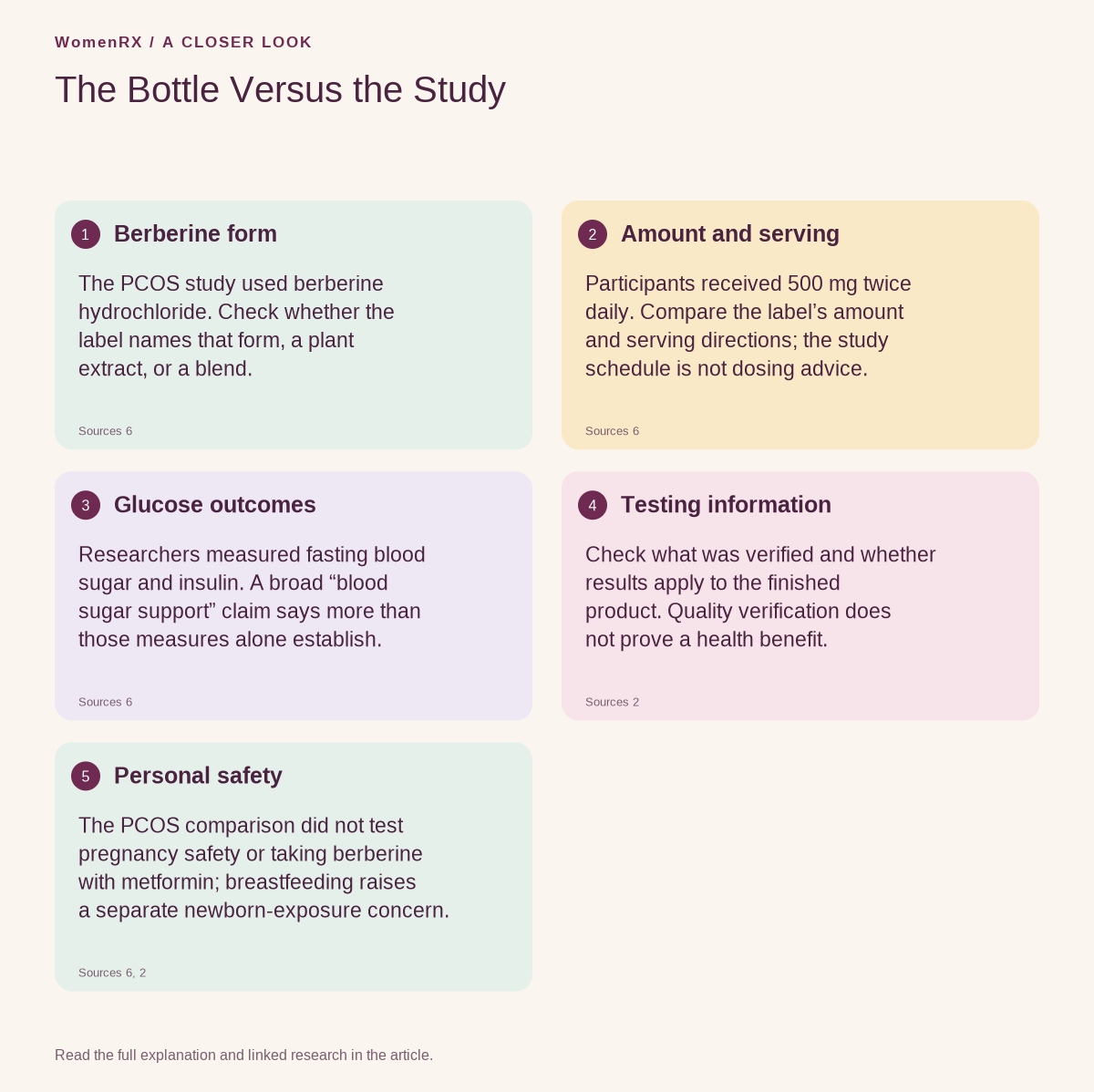
The Bottle Versus the Study
Berberine form: The PCOS study used berberine hydrochloride. Check whether the label names that form, a plant extract, or a blend.6
Amount and serving: Participants received 500 mg twice daily. Compare the label’s amount and serving directions; the study schedule is not dosing advice.6
Glucose outcomes: Researchers measured fasting blood sugar and insulin. A broad “blood sugar support” claim says more than those measures alone establish.6
Testing information: Check what was verified and whether results apply to the finished product. Quality verification does not prove a health benefit.2
Personal safety: The PCOS comparison did not test pregnancy safety or taking berberine with metformin; breastfeeding raises a separate newborn-exposure concern.62
Read the figure as text
Use these distinctions to check whether a product’s details and promises match the research you’re relying on.- Berberine form: The PCOS study used berberine hydrochloride. Check whether the label names that form, a plant extract, or a blend.6
- Amount and serving: Participants received 500 mg twice daily. Compare the label’s amount and serving directions; the study schedule is not dosing advice.6
- Glucose outcomes: Researchers measured fasting blood sugar and insulin. A broad “blood sugar support” claim says more than those measures alone establish.6
- Testing information: Check what was verified and whether results apply to the finished product. Quality verification does not prove a health benefit.2
- Personal safety: The PCOS comparison did not test pregnancy safety or taking berberine with metformin; breastfeeding raises a separate newborn-exposure concern.62
Sources you can check
- Sustainable spectrofluorimetric determination of berberine in dietary supplements via Erythrosin B Ion-Pair complexation with mechanistic investigation, Box-Behnken optimization, and green chemistry assessment.Al Shmrany H, Alqahtani A, Alqahtani T, Alshehri A, Almrasy AA. · Scientific reports · 2026Return to first citation
- Goldenseal2006Return to first citation
- Study on the mechanism of action of berberine combined with Jianpi Yishen Huazhuo formulation in treating obese polycystic ovary syndrome by activating PI3K/AKT signaling pathway.Zhang X, Ji D, Zhang Y, Du C, Liang L, Ahmad A, Feng Y, Ye G. · Gynecological endocrinology : the official journal of the International Society of Gynecological Endocrinology · 2025Return to first citation
- [Investigation of the effects and mechanisms of berberine on a mouse model of polycystic ovary syndrome: based on intestinal flora analysis].Xin G, Zhang LY, Qiu HR, Wang YC, Sui YH, Xue BG, Wang HL. · Zhonghua fu chan ke za zhi · 2024Return to first citation
- Berberine improves ovulation and endometrial receptivity in polycystic ovary syndrome.Wang Z, Nie K, Su H, Tang Y, Wang H, Xu X, Dong H. · Phytomedicine : international journal of phytotherapy and phytopharmacology · 2021Return to first citation
- Study on the Effect of Berberine, Myoinositol, and Metformin in Women with Polycystic Ovary Syndrome: A Prospective Randomised Study.Mishra N, Verma R, Jadaun P. · Cureus · 2022Return to first citation
- Protective effects of berberine in a rat model of polycystic ovary syndrome mediated via the PI3K/AKT pathway.Yu J, Ding C, Hua Z, Jiang X, Wang C. · The journal of obstetrics and gynaecology research · 2021Return to first citation