How to Compare Melatonin Products for Sleep
Start with the sleep problem you’re trying to solve, then compare release type, stated dose, timing, ingredients and product testing.
Melatonin products aren’t interchangeable. Standard and slow-release formulations deliver melatonin differently, but there isn’t a proven rule for choosing one over the other for every sleep complaint.34 Compare the stated dose, timing and added ingredients. For quality, look for testing results tied to the product and lot, not just a “tested” badge. If you’re pregnant, melatonin is not usually recommended.6
First, name the sleep problem
If you lie awake at the start of the night, you’re asking a different question from someone who falls asleep easily but wakes repeatedly. Both can be insomnia. Ongoing sleep trouble can also be connected to pain, another sleep disorder, medicines, caffeine or stress. A melatonin purchase won’t address every one of those causes.12
Melatonin is a hormone involved in the body’s sleep-wake timing. That makes timing a reasonable thing to consider when comparing products, but it doesn’t mean melatonin treats every reason you might be awake.3 For example, if snoring or interrupted breathing accompanies your poor sleep, comparing supplement labels is less useful than finding out whether another sleep disorder is involved.2
What the release type tells you, and what it doesn’t
A standard-release product and a prolonged- or slow-release product aren’t making the same delivery claim. The latter is designed to release melatonin over a longer part of the night.35 It’s tempting to translate that into a shopping rule: standard-release for falling asleep, prolonged-release for waking up. The adult insomnia evidence does not establish that simple head-to-head choice.
In a 2023 systematic review and meta-analysis of adult insomnia studies, most melatonin studies examined prolonged-release formulations. Compared with placebo, prolonged-release melatonin was associated with falling asleep about five to six minutes sooner on average, depending on whether sleep onset was measured objectively or reported by participants. That’s a modest average benefit, not a promise about an individual product or proof that prolonged-release beats standard-release melatonin.4
So use release type to understand what a package claims to deliver, not as a guaranteed match for your symptom. If waking during the night is the main issue, also consider what wakes you. Pain and interrupted breathing, for instance, call for a different line of inquiry.12
Compare dose and timing without assuming more is better
Look at the amount of melatonin per serving, not just a large number on the front of the package. Check how many tablets, gummies or drops make up that serving. This lets you compare what two labels actually propose, even though the printed amount doesn’t independently confirm the product’s contents.
Don’t assume a higher-dose product will work better for your particular sleep problem. Nor should a prescription schedule from another country be treated as directions for a US supplement. The NHS describes different doses and timing for different prescribed uses, while noting that melatonin generally takes around one to two hours to work.35 The useful shopping question is whether a product clearly states both its serving amount and its suggested timing, so you can see what you’re comparing. If you already feel tired the next day, that matters too: headache, tiredness, nausea and irritability the following day are reported side effects.3
Read past the word “melatonin”
A combination sleep product adds another decision. Check the full ingredient list rather than treating herbs or other sleep ingredients as harmless extras. The NHS cautions that taking melatonin with herbal remedies that affect sleep may make you very drowsy.3 A single-ingredient product also makes it easier to tell what you’ve chosen and whether an unwanted effect follows.
Be careful with a “best brand” claim that rests only on a label or marketing language. A label shows the stated ingredients and dose; it is not product-level verification of their contents. If a brand says its product is tested, look for an accessible report tied to the specific product and lot. Does it name the testing lab, show the measured melatonin amount alongside the label amount, and say what else was tested? A “third-party tested” badge without results leaves those questions unanswered. Even a detailed report covers only what was tested; it cannot show whether the product will help you sleep. Without current testing of specific products, there’s no sound basis for ranking brands by dose accuracy or purity. That distinction matters more than a polished package.
Pregnancy, breastfeeding and menopause change the question
If you’re pregnant, melatonin is not usually recommended because little is known about its effects on babies. If you become pregnant while taking it, discuss whether to continue or stop rather than making that decision from a product label.6
Breastfeeding is a different situation, not an automatic extension of pregnancy advice. NHS guidance says melatonin may be used while breastfeeding if the baby is healthy and a clinician agrees, but the amount of manufactured melatonin that passes into milk is unknown. It also raises concern about a baby becoming sleepy with longer use and advises against sharing a bed with your baby while taking melatonin. If your baby seems unusually sleepy or feeds less well than usual, seek advice promptly.6
If sleep has become harder during perimenopause or after menopause, don’t assume that makes a melatonin product the right answer. The reported adult insomnia results do not include women-specific or menopause-specific findings.4 Start with what’s actually disrupting your nights and days. For sleep trouble that persists or makes daily life hard to manage, addressing the underlying pattern may offer more than switching formulations; cognitive behavioral therapy is one established approach for ongoing insomnia.12
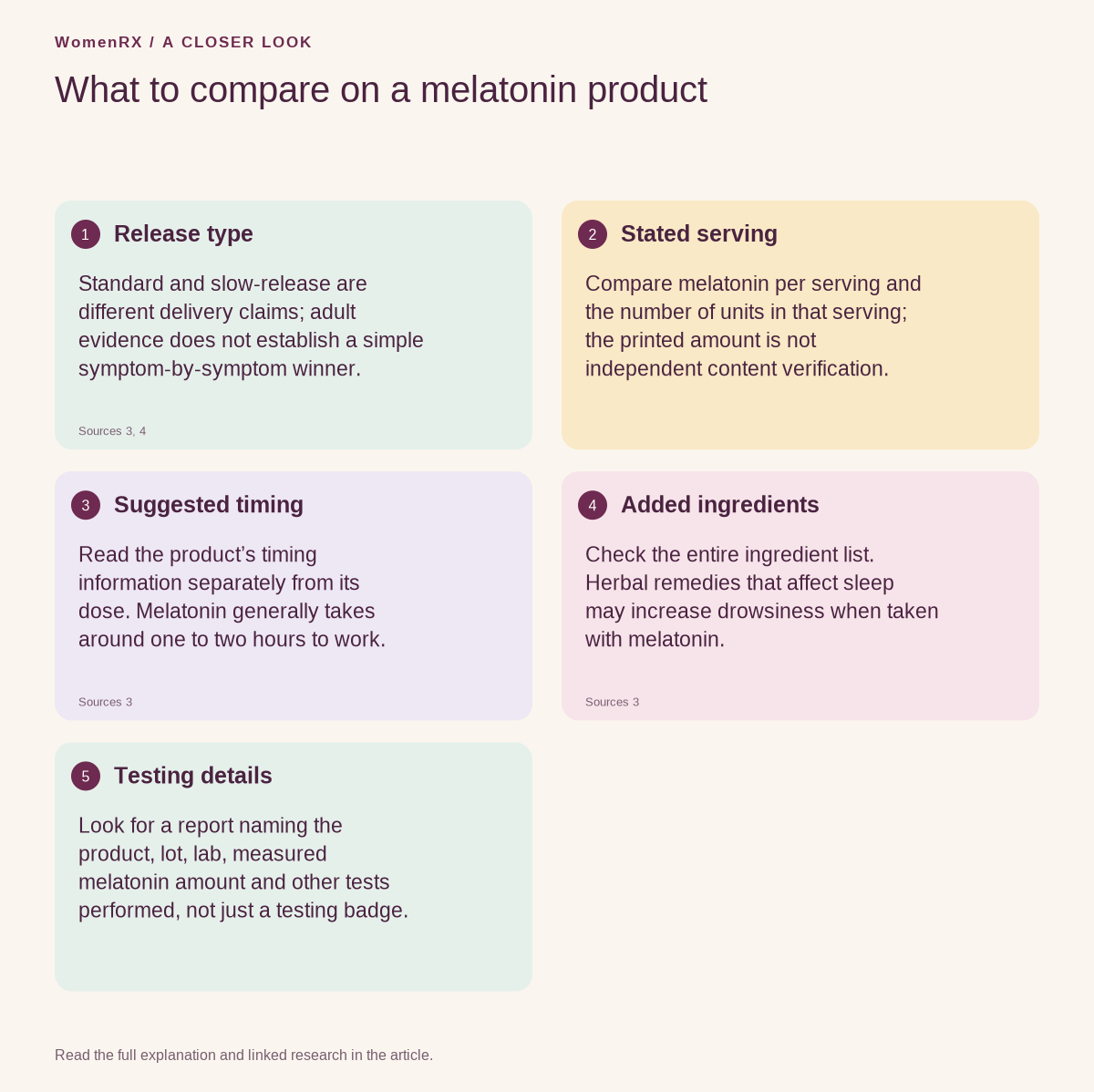
What to compare on a melatonin product
Release type: Standard and slow-release are different delivery claims; adult evidence does not establish a simple symptom-by-symptom winner.34
Stated serving: Compare melatonin per serving and the number of units in that serving; the printed amount is not independent content verification.
Suggested timing: Read the product’s timing information separately from its dose. Melatonin generally takes around one to two hours to work.3
Added ingredients: Check the entire ingredient list. Herbal remedies that affect sleep may increase drowsiness when taken with melatonin.3
Testing details: Look for a report naming the product, lot, lab, measured melatonin amount and other tests performed, not just a testing badge.
Read the figure as text
Use these distinctions to compare products without treating a package or testing claim as proof that one will work for you.- Release type: Standard and slow-release are different delivery claims; adult evidence does not establish a simple symptom-by-symptom winner.34
- Stated serving: Compare melatonin per serving and the number of units in that serving; the printed amount is not independent content verification.
- Suggested timing: Read the product’s timing information separately from its dose. Melatonin generally takes around one to two hours to work.3
- Added ingredients: Check the entire ingredient list. Herbal remedies that affect sleep may increase drowsiness when taken with melatonin.3
- Testing details: Look for a report naming the product, lot, lab, measured melatonin amount and other tests performed, not just a testing badge.
More questions, answered
Does slow-release melatonin mean it will keep me asleep?
No. Slow-release describes how melatonin is delivered, not a guaranteed result. Adult studies suggest modest average benefits for prolonged-release melatonin versus placebo, but they do not establish that it outperforms standard-release products for your particular pattern of waking.34
Sources you can check
- Insomnia | MedlinePlusAccessed 2026-09-25Return to first citation
- Insomnia - NHSAccessed 2026-09-25Return to first citation
- About melatonin - NHSAccessed 2026-09-25Return to first citation
- Efficacy of melatonin and ramelteon for the acute and long-term management of insomnia disorder in adults: A systematic review and meta-analysis.Maruani J, Reynaud E, Chambe J, Palagini L, Bourgin P, Geoffroy PA. · Journal of sleep research · 2023Return to first citation
- How and when to take melatonin - NHSAccessed 2026-09-25Return to first citation
- Pregnancy, breastfeeding and fertility while taking melatonin - NHSAccessed 2026-09-25Return to first citation