How to Compare Myo-Inositol Products for PCOS
Start with the amount of each ingredient per full daily serving, then compare that formula with the specific PCOS outcome you have in mind.
A product’s ingredient list can tell you what’s in it, but not whether it has been shown to help with your particular goal. Compare the myo-inositol amount per full daily serving, any D-chiro-inositol and added ingredients, and what testing the company documents. For PCOS, evidence varies by outcome, and a promising combination or ratio isn’t proof that a product improves fertility or pregnancy outcomes. 124
First, name the outcome you’re comparing for
“Myo-inositol for PCOS” can mean different things: a general PCOS-related concern, fertility treatment, IVF, or a pregnancy-related goal. Evidence for one setting doesn’t automatically carry over to another. A product that resembles a formula studied before IVF, for example, hasn’t thereby been shown to improve cycle symptoms or prevent pregnancy complications.
Myo-inositol research in PCOS covers varied formulations and outcomes. A 2026 scoping review included 13 studies but did not formally assess study quality or combine results quantitatively; it described the evidence as heterogeneous and some fertility findings as inconsistent. That makes the exact study population and goal worth checking before you compare a label with a study headline. 4
A label worksheet for side-by-side comparison
For each product, write down:
| Check | What to record |
|---|---|
| Myo-inositol | Amount per capsule, scoop, or sachet, and the amount in the full daily serving listed on the label. |
| D-chiro-inositol | Whether it’s included, how much, and the stated myo-inositol-to-D-chiro-inositol ratio, if provided. |
| Other ingredients | Folic acid, vitamins, antioxidants, or other active ingredients, with their amounts when listed. |
| Serving directions | How many capsules, scoops, or sachets make up the labeled daily serving. Compare the full serving, not just one unit. |
| Testing disclosure | Whether the company describes independent testing and what it covers. If it shares a certificate, check whether it identifies the product or lot and the tests performed. |
This worksheet helps you see what you’d actually be taking and where products differ. It can’t establish that a formula is effective, equivalent to one used in research, or better because it contains more ingredients. A testing statement is also only as informative as its details: a general quality claim doesn’t tell you what was tested.
Treat ratios as a formula detail, not a verdict
Combination products often draw attention to a particular ratio. But one ratio should not be treated as a proven standard for every person with PCOS or every goal. In a retrospective observational study of 92 women with PCOS preparing for IVF, researchers compared a supplement containing myo-inositol and D-chiro-inositol in a 3.6:1 ratio plus antioxidants with conventional supplementation. Some outcomes differed between groups, while the number of eggs retrieved and the proportion of mature eggs were comparable. Because the study was observational and tested a combination, it can’t show that the ratio itself caused the differences or establish that other products with the same ratio will have the same results. 1
So, when a label advertises a ratio, record it, but don’t use it as a shortcut for choosing a product. A matching ratio alone doesn’t establish a full formula match: the amounts of each form and any added ingredients matter too. And even a close formula match doesn’t prove the same result for a different PCOS goal or treatment setting. 1
Match the evidence to the reason you’re considering it
If you’re comparing products for fertility, keep in mind that a 2026 review commentary described the evidence for myo-inositol in PCOS fertility care as limited and inconclusive, and said it isn’t a first-line treatment for PCOS-related infertility. A product label can help you compare formulations; it can’t settle whether supplementation fits your fertility care or replace established treatment decisions. 3
If you’re pregnant, or planning pregnancy, that’s a separate context to review with the clinician managing your care. In a randomized trial involving 464 pregnant people with PCOS, myo-inositol with folic acid did not reduce the combined outcome of gestational diabetes, preeclampsia, or preterm birth compared with folic acid alone: the outcome occurred in 25.0% of the myo-inositol group and 26.8% of the placebo group. The tested pregnancy formula and result don’t establish that a retail product prevents these complications. 2
Put the comparison to work
Place the full daily serving, additional ingredients, and testing details for each option side by side. Then ask: “Is this the outcome I’m trying to address, and is there human research on a sufficiently similar formula in people in this situation?” If you can’t answer the second part, mark the product as not established for my goal, rather than assuming the ratio, added antioxidants, or a quality seal fills the gap.
This gives you a useful comparison without turning a product label into a treatment promise. For pregnancy planning or fertility treatment, bring the ingredient list and serving directions into the discussion with the clinician managing your care so the formula can be considered alongside your specific plan.
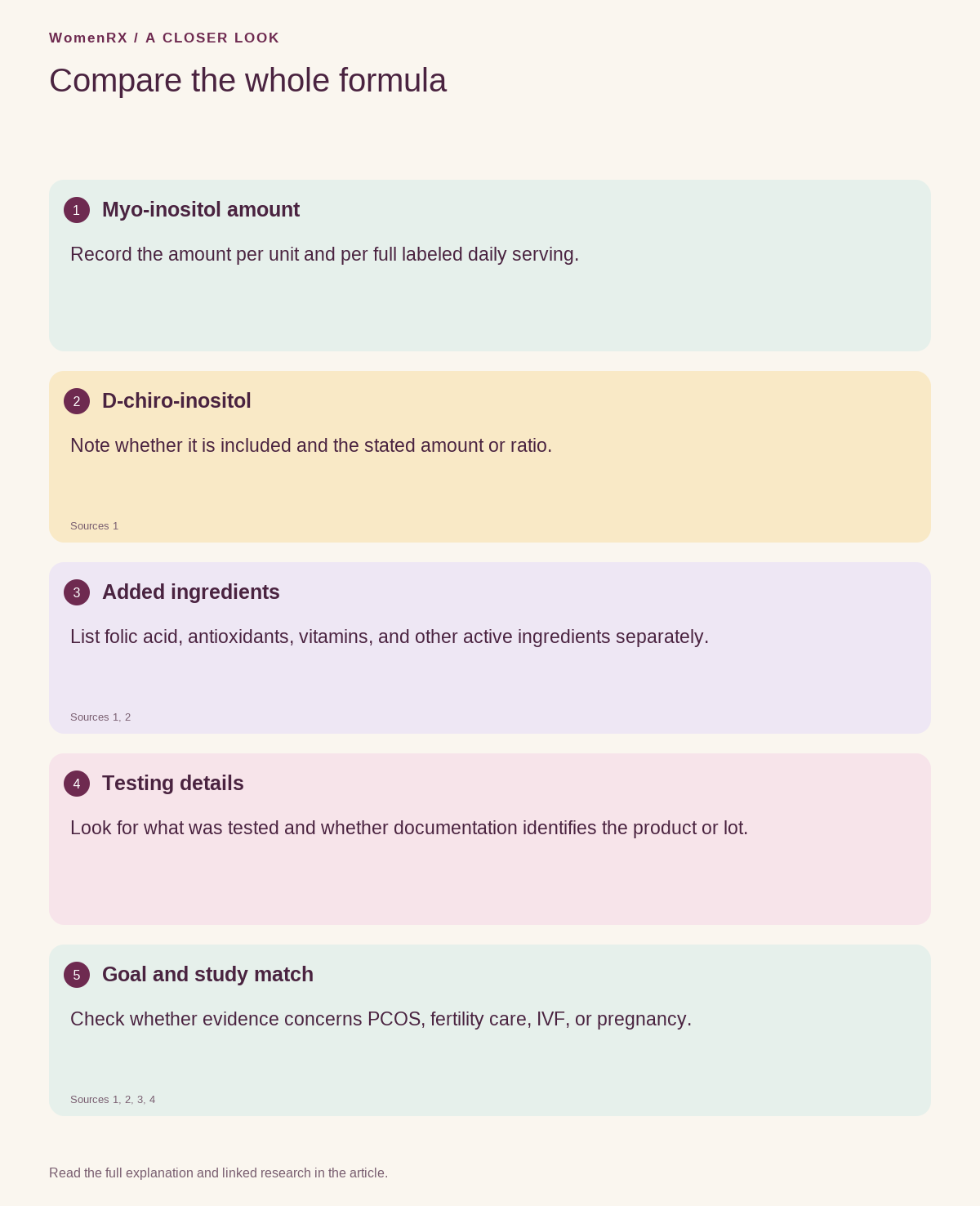
Compare the whole formula
Myo-inositol amount: Record the amount per unit and per full labeled daily serving.
D-chiro-inositol: Note whether it is included and the stated amount or ratio.1
Added ingredients: List folic acid, antioxidants, vitamins, and other active ingredients separately.12
Testing details: Look for what was tested and whether documentation identifies the product or lot.
Goal and study match: Check whether evidence concerns PCOS, fertility care, IVF, or pregnancy.1234
Read the figure as text
Use these checks to describe what a label tells you, then keep those details separate from evidence that the product helps with your particular PCOS goal.- Myo-inositol amount: Record the amount per unit and per full labeled daily serving.
- D-chiro-inositol: Note whether it is included and the stated amount or ratio.1
- Added ingredients: List folic acid, antioxidants, vitamins, and other active ingredients separately.12
- Testing details: Look for what was tested and whether documentation identifies the product or lot.
- Goal and study match: Check whether evidence concerns PCOS, fertility care, IVF, or pregnancy.1234
More questions, answered
Does a 3.6:1 myo-inositol-to-D-chiro-inositol ratio mean a product is proven for PCOS?
No. One retrospective observational IVF study tested a 3.6:1 combination that also contained antioxidants, but it can’t establish that the ratio caused the observed differences or that the formula works for other PCOS goals. 1
Should I choose a product with added folic acid if I’m pregnant?
Don’t use an added-ingredient list to assume pregnancy benefit. In a randomized trial of pregnant people with PCOS, myo-inositol plus folic acid did not reduce the combined risk of gestational diabetes, preeclampsia, or preterm birth compared with folic acid alone. Review a product’s ingredients with the clinician managing your pregnancy. 2
Sources you can check
- A 3.6:1 myo-inositol to D-chiro-inositol ratio and antioxidant-based food supplement before IVF improves fertility in women with PCOS: a pilot observational retrospective cohort study.Belchín Fernández P, Calvente V, Gómez Roso MJ, González Expósito E, Silván Bueno A, Aparicio Fluge M, Ordoñez Pérez D. · Journal of obstetrics and gynaecology : the journal of the Institute of Obstetrics and Gynaecology · 2026Return to first citation
- Myo-inositol Supplementation to Prevent Pregnancy Complications in Polycystic Ovary Syndrome: A Randomized Clinical Trial.van der Wel AWT, Frank CMC, Bout-Rebel R, Duijnhoven RG, van Bree BE, Valkenburg O, Al-Nasiry S, van Oppenraaij RHF, Vogelvang TE, Westerhuis MEMH, van de Nieuwenhof HP, Gielen SCJ... · JAMA · 2025Return to first citation
- Myo-inositol in reproductive management of women with PCOS: holy grail for medical practice or demon for scientific evidence?Palomba S, Seminara G, Aversa A. · Reproductive biomedicine online · 2026Return to first citation
- Effect of Myo-Inositol Supplementation in Polycystic Ovary Syndrome-Scoping Review.Habryka J, Ławniczek M, Krupa-Nurcek S. · Nutrients · 2026Return to first citation