When to Take D-Chiro-Inositol for PCOS
Some PCOS study abstracts report daily or twice-daily schedules, but they don’t establish that morning, night, or taking it with food works better.
The PCOS study abstracts summarized here don’t establish a best time of day for D-chiro-inositol. One study used it twice daily before IVF, while another tested daily combinations with myo-inositol; a third abstract did not specify dosing frequency. The abstracts do not describe comparisons of morning versus evening use or meal effects. Check the directions on your specific product rather than treating a study schedule as a universal instruction. 1 2 3
What PCOS studies say about schedules
The schedules described in the abstracts tell you how often some participants took a product, not what time of day is best. In one study, women with PCOS took D-chiro-inositol twice daily for three months before IVF. Its abstract describes an oxidative-stress measure in follicular fluid but does not describe a morning-versus-evening or meal comparison or specify food instructions. 1
Other research used combinations of myo-inositol and D-chiro-inositol. A randomized trial involving 11 women with PCOS undergoing ICSI compared two daily formulations over 12 weeks. Its abstract describes oocyte outcomes but does not describe a breakfast-versus-bedtime comparison. The study analyzed 172 oocytes from those 11 women, not 172 separate participants. 3
A separate randomized pilot study assigned 30 women with PCOS to a 40:1 myo-inositol/D-chiro-inositol combination or metformin for 12-16 weeks. It examined a blood marker called asprosin. Its abstract describes a treatment comparison, without specifying dosing frequency or describing a time-of-day or meal comparison. These abstracts describe particular treatment protocols, not timing tests. 2
Frequency isn’t the same as timing
“Twice daily” means a study divided use into two daily occasions. It doesn’t tell you that morning and evening are necessary, that one time is better, or that the product should be taken with a meal. Likewise, a daily study schedule doesn’t establish that taking a supplement at breakfast, at bedtime, or at the same time as another treatment changes its effects. 1 2 3
The product matters too. The pre-IVF study used D-chiro-inositol alone, while the other studies used it alongside myo-inositol. Their participants and research questions also differed. You can’t use those differences to work out which clock time is best, or assume that a schedule from one formulation applies to another. 1 2 3
That distinction matters if you’re comparing a research protocol with a bottle at home. A study’s schedule describes what its participants used for that study. It doesn’t replace the directions for your particular product, and it doesn’t show that other schedules would have the same effects.
Do not borrow a fertility-trial schedule for another product
Check the directions on your exact product for frequency and any meal instruction. Read those as directions for that product, not as evidence that taking D-chiro-inositol with food improves a PCOS outcome. For example, if your bottle says once daily but you’ve read about the twice-daily pre-IVF study, the study alone isn’t a reason to change your product’s schedule. It involved a specific formulation and a specific fertility-treatment setting. 1
If the directions don’t settle your question, ask the person who recommended the product whether they intended a particular schedule, especially if you’re using it during fertility treatment. The PCOS studies discussed here don’t establish a general morning, nighttime, or food-related rule. 1 2 3
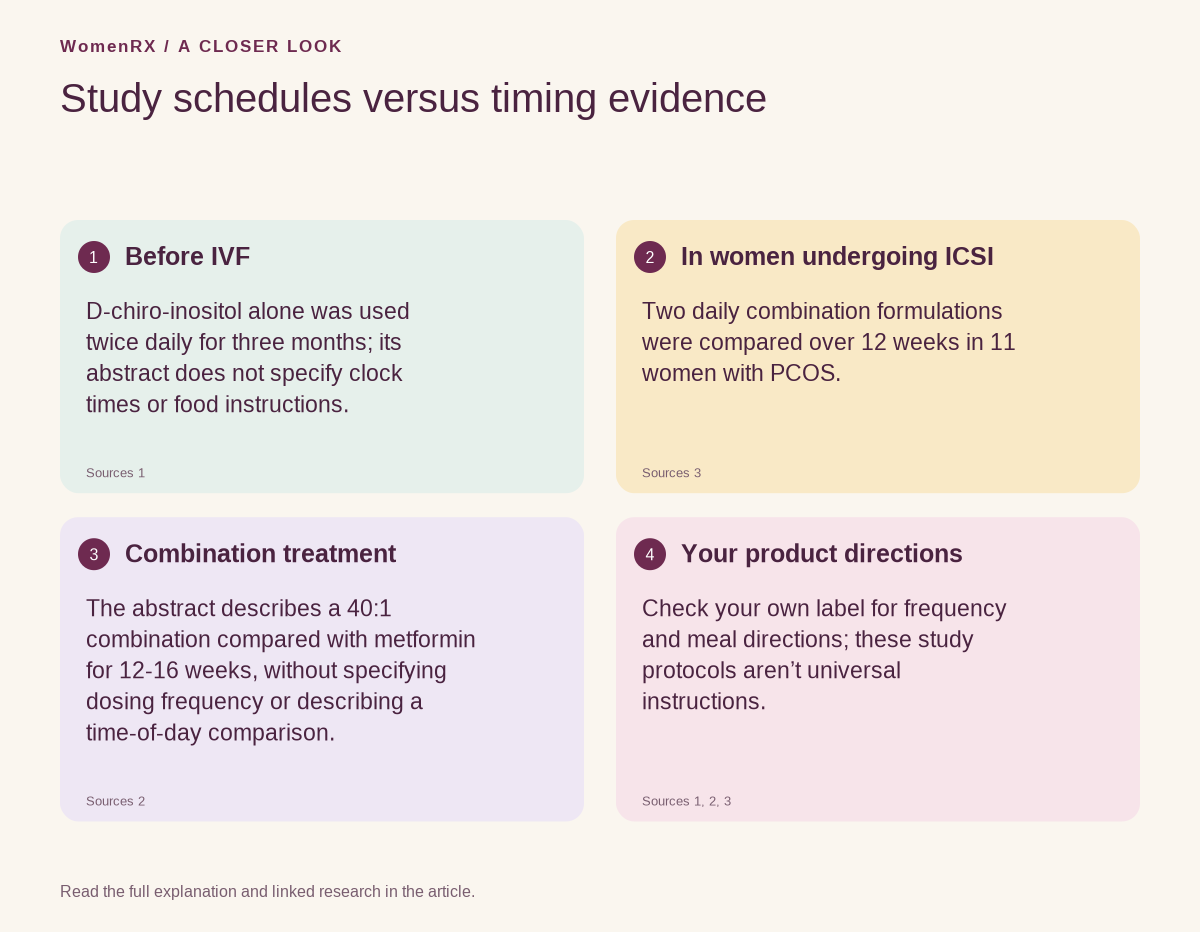
Study schedules versus timing evidence
Before IVF: D-chiro-inositol alone was used twice daily for three months; its abstract does not specify clock times or food instructions.1
In women undergoing ICSI: Two daily combination formulations were compared over 12 weeks in 11 women with PCOS.3
Combination treatment: The abstract describes a 40:1 combination compared with metformin for 12-16 weeks, without specifying dosing frequency or describing a time-of-day comparison.2
Your product directions: Check your own label for frequency and meal directions; these study protocols aren’t universal instructions.123
Read the figure as text
These PCOS abstracts describe formulations and treatment lengths. Two specify dosing frequency, but none describes whether morning, evening, or meals made a difference.- Before IVF: D-chiro-inositol alone was used twice daily for three months; its abstract does not specify clock times or food instructions.1
- In women undergoing ICSI: Two daily combination formulations were compared over 12 weeks in 11 women with PCOS.3
- Combination treatment: The abstract describes a 40:1 combination compared with metformin for 12-16 weeks, without specifying dosing frequency or describing a time-of-day comparison.2
- Your product directions: Check your own label for frequency and meal directions; these study protocols aren’t universal instructions.123
Sources you can check
- [Evaluation of the treatment with D-chiro-inositol on levels of oxidative stress in PCOS patients].De Leo V, La Marca A, Cappelli V, Stendardi A, Focarelli R, Musacchio MC, Piomboni P. · Minerva ginecologica · 2012Return to first citation
- Effect of 40:1 myo-inositol/D-chiro-inositol treatment on serum asprosin levels in polycystic ovary syndrome: a prospective randomized pilot study.Ozay OE, Ozay Y, Edebal O, Calcagno M, Ozay AC. · Ginekologia polska · 2025Return to first citation
- High dose of d-chiro-inositol improves oocyte quality in women with polycystic ovary syndrome undergoing ICSI: a randomized controlled trial.Mendoza N, Galan MI, Molina C, Mendoza-Tesarik R, Conde C, Mazheika M, Diaz-Ropero MP, Fonolla J, Tesarik J, Olivares M. · Gynecological endocrinology : the official journal of the International Society of Gynecological Endocrinology · 2020Return to first citation