Myo-Inositol for PCOS: What Studies Say About Timing
PCOS studies have tested different inositol formulas for weeks or months, but they don’t establish a best time of day to take myo-inositol.
For PCOS, studies have examined myo-inositol alone and in combinations, measuring outcomes such as ovulation, menstrual patterns, and metabolic markers. Their treatment durations and schedules describe what researchers tested, not a universal instruction. The evidence remains limited and inconclusive, and the research summarized here does not establish that taking myo-inositol at a particular time of day improves results. 2
Timing is not the same as treatment schedule
If you’re wondering whether to take myo-inositol in the morning, at night, or with food, the PCOS studies discussed here don’t compare those choices. They test formulations over a period of treatment and measure outcomes such as ovulation or metabolic markers. A schedule used in a study tells you what its participants took, not which time of day works best for you.
A systematic review informing the international PCOS guideline update included 30 trials with 2,230 participants. It assessed evidence across different inositol forms and combinations. The review found possible benefits for some metabolic measures and potential ovulation benefits from D-chiro-inositol, but inositol may not affect other outcomes. Its overall conclusion was that evidence for inositol in PCOS is limited and inconclusive. 2
That matters because “inositol” doesn’t describe one identical intervention. Myo-inositol (MI), D-chiro-inositol (DCI), and products combining them have been studied in different ways. Findings from one formula shouldn’t automatically be applied to another.
What the formulation studies actually measured
In a small open-label study, 50 women with PCOS and anovulation were randomly assigned to myo-inositol alone or myo-inositol plus alpha-lactalbumin for three months. The combination group had greater improvement in ovulation rate and menstrual-cycle duration. This is a specific comparison of two formulations, not a test of time of day, and a small study cannot establish that the combination is best for everyone. 3
A different study looked at a 40:1 MI-to-DCI combination in 46 anovulatory women with PCOS who had no insulin resistance. It was retrospective, and participants had received the combination for at least six months. Ovulation was detected after treatment in 23 of 29 normal-weight participants and 5 of 17 participants classified as overweight or obese. Because the study compared existing groups rather than randomly assigning treatment, those results don’t show that body weight caused the difference or predict an individual’s response. 5
Another report followed 283 people with PCOS who used tablets containing 550 mg of MI and 150 mg of DCI. The reported regimen was one tablet twice daily for three months. The study reported improvements in outcomes including menstrual regularity and spontaneous ovulation, as well as measures such as insulin and blood glucose. Because this was an observational treatment-pattern study, it cannot establish that the supplement caused those changes or that twice-daily use is better than another schedule. 4
These studies answer different questions. The first compares MI alone with MI plus alpha-lactalbumin; the second reports ovulation outcomes for a 40:1 combination in different weight groups; the third observes outcomes among users of a different MI-DCI tablet. None compares morning with evening or tests whether taking a product with meals changes PCOS outcomes. 3 4 5
Ovulation is not the same as pregnancy
Ovulation is a meaningful reproductive outcome, but it is not a promise of conception. PCOS can involve irregular or absent ovulation, and some people with PCOS do become pregnant. Still, a study reporting ovulation does not by itself establish a higher chance of pregnancy or a better result from fertility treatment. 1 2
If you’re considering inositol while trying to conceive, keep the specific goal in view: a change in cycle pattern, ovulation, or a fertility-treatment outcome are distinct questions. The PCOS studies described here don’t establish how to use inositol during pregnancy or as part of fertility treatment. They also don’t answer whether myo-inositol helps when used for reasons other than PCOS.
How to read a schedule on a study or label
Check the formulation, the measured outcome, and the treatment period. For example, “one tablet twice daily for three months” describes the MI-DCI regimen in one observational study; it does not establish a preferred schedule for myo-inositol alone. And a finding about ovulation with one combination doesn’t establish that another formulation will have the same effect. 3 4
The practical takeaway: current evidence summarized here doesn’t identify a best time of day for myo-inositol. It does show why formulation and outcome matter when you’re weighing what a PCOS study can tell you.
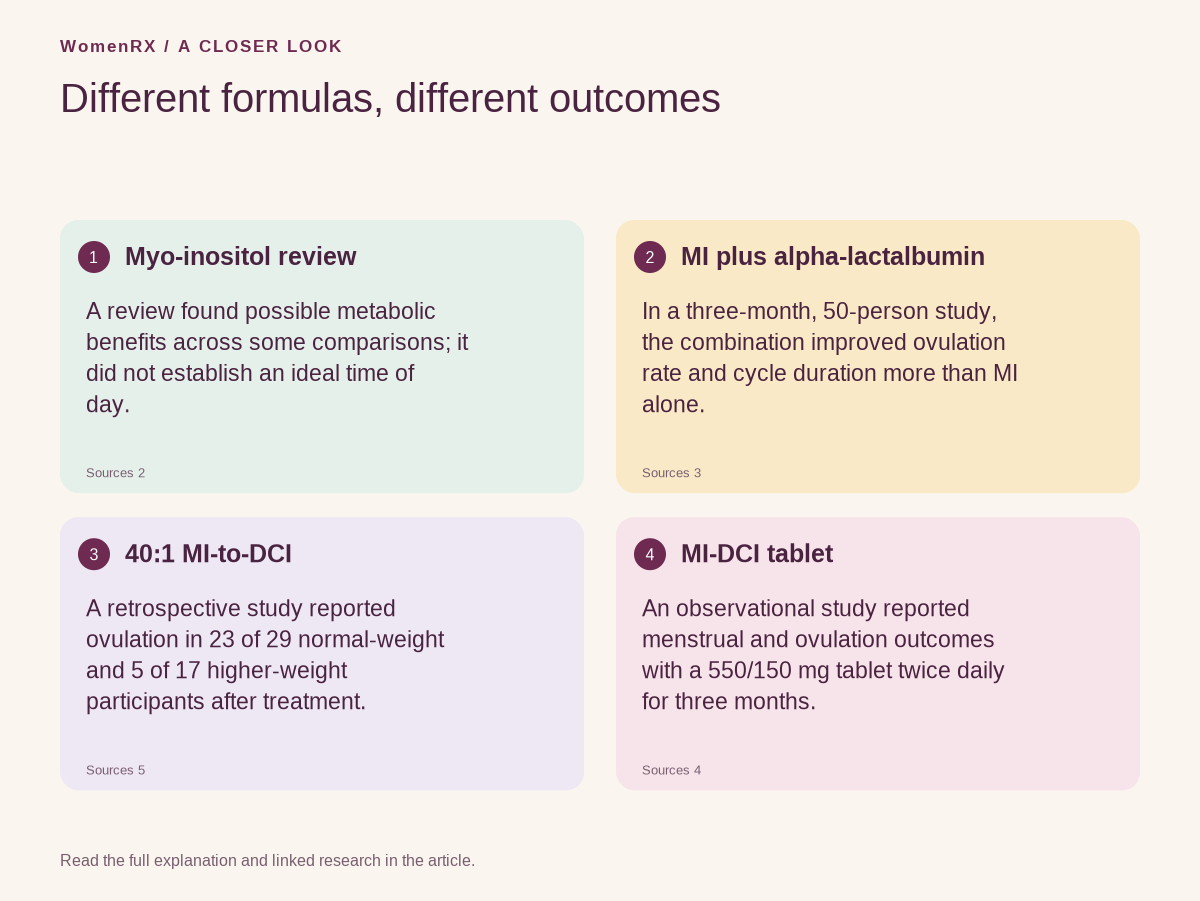
Different formulas, different outcomes
Myo-inositol review: A review found possible metabolic benefits across some comparisons; it did not establish an ideal time of day.2
MI plus alpha-lactalbumin: In a three-month, 50-person study, the combination improved ovulation rate and cycle duration more than MI alone.3
40:1 MI-to-DCI: A retrospective study reported ovulation in 23 of 29 normal-weight and 5 of 17 higher-weight participants after treatment.5
MI-DCI tablet: An observational study reported menstrual and ovulation outcomes with a 550/150 mg tablet twice daily for three months.4
Read the figure as text
These PCOS studies tested distinct formulations and measured different outcomes. Their treatment schedules are not evidence of a best time of day.- Myo-inositol review: A review found possible metabolic benefits across some comparisons; it did not establish an ideal time of day.2
- MI plus alpha-lactalbumin: In a three-month, 50-person study, the combination improved ovulation rate and cycle duration more than MI alone.3
- 40:1 MI-to-DCI: A retrospective study reported ovulation in 23 of 29 normal-weight and 5 of 17 higher-weight participants after treatment.5
- MI-DCI tablet: An observational study reported menstrual and ovulation outcomes with a 550/150 mg tablet twice daily for three months.4
More questions, answered
Does a twice-daily MI-DCI study schedule apply to myo-inositol alone?
No. That schedule describes a study of tablets containing both myo-inositol and D-chiro-inositol. It doesn’t establish the best schedule for myo-inositol alone or show that different formulas have the same effects. 4
Sources you can check
- PCOS | Polycystic Ovary Syndrome | MedlinePlusAccessed 2026-09-25Return to first citation
- Inositol for Polycystic Ovary Syndrome: A Systematic Review and Meta-analysis to Inform the 2023 Update of the International Evidence-based PCOS Guidelines.Fitz V, Graca S, Mahalingaiah S, Liu J, Lai L, Butt A, Armour M, Rao V, Naidoo D, Maunder A, Yang G, Vaddiparthi V, Witchel SF, Pena A, Spritzer PM, Li R, Tay C, Mousa A, Teede H, ... · The Journal of clinical endocrinology and metabolism · 2024Return to first citation
- Comparing the Efficacy of Myo-Inositol Plus α-Lactalbumin vs. Myo-Inositol Alone on Reproductive and Metabolic Disturbances of Polycystic Ovary Syndrome.Kamenov Z, Gateva A, Dinicola S, Unfer V. · Metabolites · 2023Return to first citation
- Management of polycystic ovary syndrome among Indian women using myo-inositol and D-chiro-inositol.Vyas L, Raiturker AP, Sud S, Goyyal P, Abhyankar M, Revankar S, Walia S. · Bioinformation · 2022Return to first citation
- May myo-inositol and d-chiro-inositol (40:1) treatment be a good option on normal-weighted polycystic ovary syndrome patients without insulin resistance?Colak E, Ozcimen EE, Tohma YA, Ceran MU. · The journal of obstetrics and gynaecology research · 2020Return to first citation