D-Chiro-Inositol Timing: What PCOS Studies Can Tell You
PCOS studies report how long people used inositol, but they don’t establish a best time of day for taking D-chiro-inositol.
There’s no best time of day for D-chiro-inositol established by the PCOS studies discussed here. Some reports describe treatment lasting weeks or months, but that’s study duration, not evidence that morning or evening works better. Before applying a result to a product, check whether researchers tested D-chiro-inositol alone, myo-inositol alone, or a combination, and what outcome they measured. 1 3 4
“When” can mean a clock time or a study period
A study that gives a supplement for three months can tell you when researchers checked the results. It can’t show whether taking it with breakfast or before bed is better unless the study compares those schedules. The PCOS reports discussed here describe treatment periods, including 12-16 weeks for one combination study and three months for another. They don’t establish a preferred time of day. 1 4
So if someone recommends D-chiro-inositol (DCI) at a particular hour, ask what evidence supports that schedule. A study’s duration, or the time point when outcomes were measured, isn’t a timing comparison.
The inositol on the label matters
Myo-inositol (MI), DCI, and products combining the two are related but distinct interventions. A systematic review prepared to inform the international PCOS guidelines assessed studies of different inositol approaches. It found limited and inconclusive evidence overall, with possible benefits for some metabolic measures and potential benefits from DCI for ovulation. Those findings don’t make results from one form interchangeable with another. 3
Combination studies need their own interpretation, too. In a small randomized pilot, 30 people with PCOS were assigned to a 40:1 MI/DCI product or metformin for 12-16 weeks. The study measured asprosin, a metabolic marker. Because the supplement contained both forms, the result can’t identify what DCI alone contributed, and a change in a marker isn’t proof of improved fertility or symptoms. 1
A separate open study followed 34 women with one PCOS phenotype who used an MI/DCI combination for three months. Some hormone and metabolic measurements changed, but there was no comparison group, and the authors said the study was too short to assess menstrual or reproductive changes. It doesn’t show that the combination works for every PCOS presentation or identify a best time of day. 4
What broader reviews say about formulations
A 2026 umbrella review found that the quality of inositol evidence varied and that none of the evidence items it assessed was high quality. Its comparison across inositol types favored MI or MI combined with folic acid for some metabolic and reproductive outcomes; it advised caution with DCI alone and found that combinations did not consistently outperform single forms. These comparisons are reasons to look closely at the exact formulation, not proof that one product is best for you. 2
That caution fits the earlier systematic review’s overall conclusion: PCOS evidence for inositol is limited and inconclusive. A possible effect on one measure, such as insulin resistance or ovulation, doesn’t guarantee an effect on cycle regularity, pregnancy, or another outcome. 3
A quick way to assess a recommendation
When comparing a supplement claim with a study, check three things:
- Form: Was it DCI alone, MI alone, or a combination?
- Outcome: Did researchers measure insulin-resistance markers, hormones, cycle regularity, ovulation, or pregnancy? These are different results.
- Timing: Did the study compare times of day, or simply report how long participants used the product?
This distinction matters especially if you’re pregnant or receiving fertility treatment. The PCOS studies described here don’t answer whether a particular inositol form or schedule is useful in those separate situations. 3
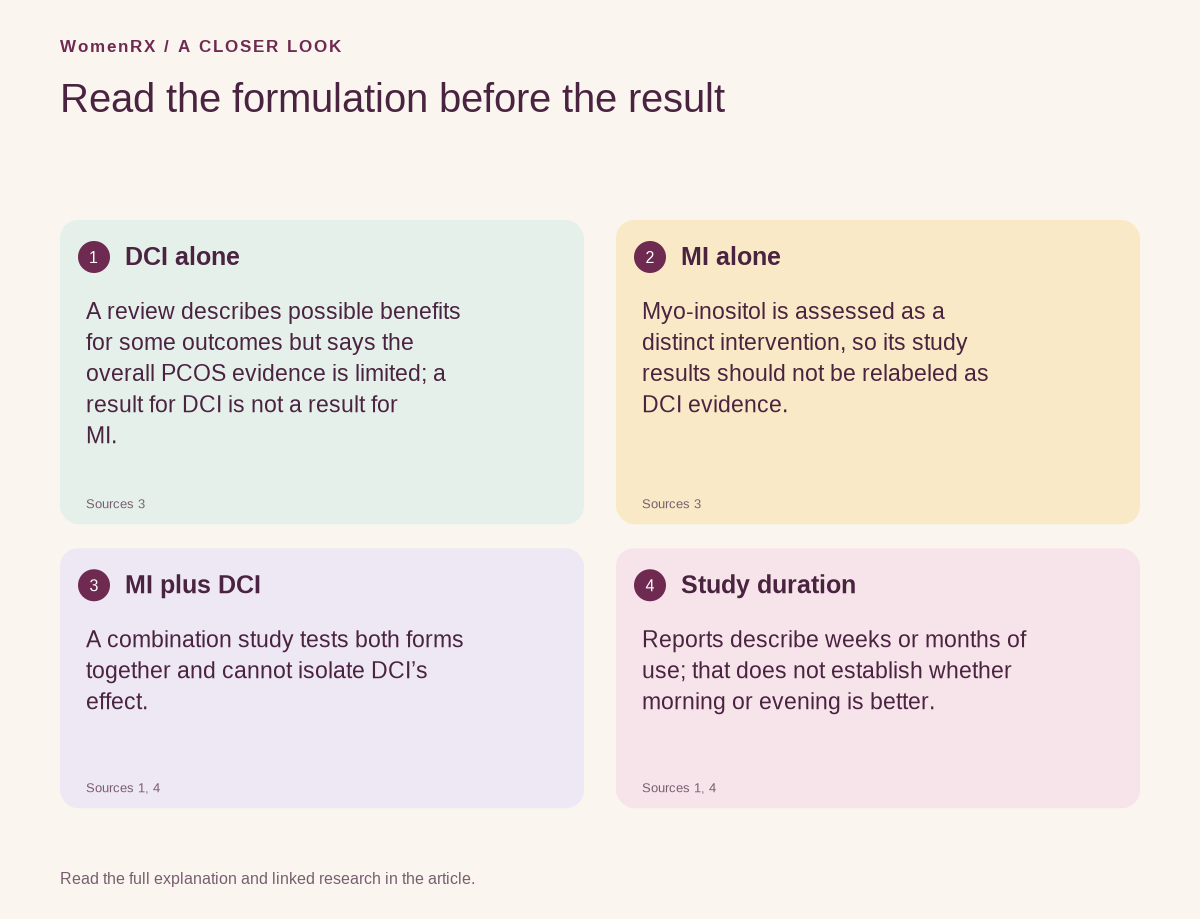
Read the formulation before the result
DCI alone: A review describes possible benefits for some outcomes but says the overall PCOS evidence is limited; a result for DCI is not a result for MI.3
MI alone: Myo-inositol is assessed as a distinct intervention, so its study results should not be relabeled as DCI evidence.3
MI plus DCI: A combination study tests both forms together and cannot isolate DCI’s effect.14
Study duration: Reports describe weeks or months of use; that does not establish whether morning or evening is better.14
Read the figure as text
The inositol form, measured outcome, and study period help explain what a PCOS result can and cannot tell you about DCI timing.- DCI alone: A review describes possible benefits for some outcomes but says the overall PCOS evidence is limited; a result for DCI is not a result for MI.3
- MI alone: Myo-inositol is assessed as a distinct intervention, so its study results should not be relabeled as DCI evidence.3
- MI plus DCI: A combination study tests both forms together and cannot isolate DCI’s effect.14
- Study duration: Reports describe weeks or months of use; that does not establish whether morning or evening is better.14
Sources you can check
- Effect of 40:1 myo-inositol/D-chiro-inositol treatment on serum asprosin levels in polycystic ovary syndrome: a prospective randomized pilot study.Ozay OE, Ozay Y, Edebal O, Calcagno M, Ozay AC. · Ginekologia polska · 2025Return to first citation
- Effects of inositol in women with polycystic ovary syndrome: an umbrella review of meta-analyses from randomized controlled trials.Duan M, Yang M, Li C, Wu X, Yin X, Zhu H. · Frontiers in endocrinology · 2026Return to first citation
- Inositol for Polycystic Ovary Syndrome: A Systematic Review and Meta-analysis to Inform the 2023 Update of the International Evidence-based PCOS Guidelines.Fitz V, Graca S, Mahalingaiah S, Liu J, Lai L, Butt A, Armour M, Rao V, Naidoo D, Maunder A, Yang G, Vaddiparthi V, Witchel SF, Pena A, Spritzer PM, Li R, Tay C, Mousa A, Teede H, ... · The Journal of clinical endocrinology and metabolism · 2024Return to first citation
- The Effects of Myo-Inositol and D-Chiro-Inositol in a Ratio 40:1 on Hormonal and Metabolic Profile in Women with Polycystic Ovary Syndrome Classified as Phenotype A by the Rotterdam Criteria and EMS-Type 1 by the EGOI Criteria.Pustotina O, Myers SH, Unfer V, Rasulova I. · Gynecologic and obstetric investigation · 2024Return to first citation