Inositol for PCOS: What the Evidence Can Tell You
Inositol may help some PCOS measures, including ovulation, but the evidence is uncertain and no single supplement formula is established as best.
Research suggests inositol may improve some metabolic and reproductive measures in people with PCOS, including ovulation, but study quality is limited and results don’t guarantee pregnancy or live birth. Before buying, check which form and how much you’d take per serving, what else is included, and whether the seller can explain its quality testing. If you’re trying to conceive or pregnant, discuss use with your care team. 2 3
What inositol might do in PCOS
PCOS can involve irregular or absent ovulation, as well as metabolic and hormone changes. Inositol supplements, most often myo-inositol or D-chiro-inositol, are studied because they may affect some of these measures. The practical question is not whether a study found any change, but whether that change is reliable and meaningful for your goal. 1 3
A 2024 systematic review of randomized trials found possible benefits for some metabolic measures and possible ovulation benefits, but concluded that evidence for using inositol to manage PCOS was limited and inconclusive. A later umbrella review found favorable pooled results for several outcomes, including ovulation, while rating much of the underlying evidence low or very low quality. Taken together, the findings are promising, not settled. 2 3
Ovulation is not the same as a baby
If you’re hoping to conceive, it helps to separate outcomes. A change in ovulation or menstrual regularity may matter, but it does not by itself show that a supplement increases your chance of pregnancy or live birth. The newer umbrella review reported positive pooled reproductive findings, but its evidence ratings were mixed and no evidence was rated high quality overall. Those results can’t promise an individual outcome. 2
Ask what outcome matters most to you: more regular cycles, ovulation, metabolic measures, or help getting pregnant. If pregnancy is your goal, ask how inositol fits with your overall fertility plan and when to consider other evaluation or treatment options. PCOS can involve ovulatory difficulties, and fertility treatments are among the available treatment approaches. 1
Choosing a product without trusting the headline
Online listings can make a formula sound more proven than it is. A few label checks can help you compare products without assuming that a particular blend is best:
- Identify the form: Does it list myo-inositol, D-chiro-inositol, or both?
- Check the amount: Can you see the amount of each ingredient per serving, rather than only a combined total or a proprietary blend?
- Read the full ingredient list: Note added ingredients, including folate or other nutrients, so you know what you’d be taking.
- Ask about quality testing: Can the manufacturer explain whether the finished product is independently tested and provide results tied to a specific lot? A seal or marketing phrase alone doesn’t tell you what was tested.
- Compare the claim with the evidence: Be cautious of promises that a ratio, brand, or formula will restore ovulation or ensure pregnancy. Current evidence doesn’t establish one universally best inositol type or combination. 2 3
These checks can make a label clearer; they can’t establish that a supplement will work for you. The trials used different inositol types and comparisons, and reviews have not settled the best formulation. One umbrella review reported some favorable subgroup findings, but also found that combination products did not consistently outperform single forms. 2 3
If you’re trying to conceive or pregnant
PCOS trials have measured reproductive outcomes, but they don’t establish whether a particular inositol product is safe or beneficial throughout pregnancy. If you’re trying to conceive, pregnant, or taking fertility treatment, bring the exact label to your clinician or pharmacist and ask how it fits your plan. This is a reason to discuss the product, not a reason to assume that all formulations have the same effects or risks. 2 3
A useful question is: “What outcome are we aiming for, and how will we decide whether this supplement is helping?” That keeps the decision tied to your priorities rather than an online promise.
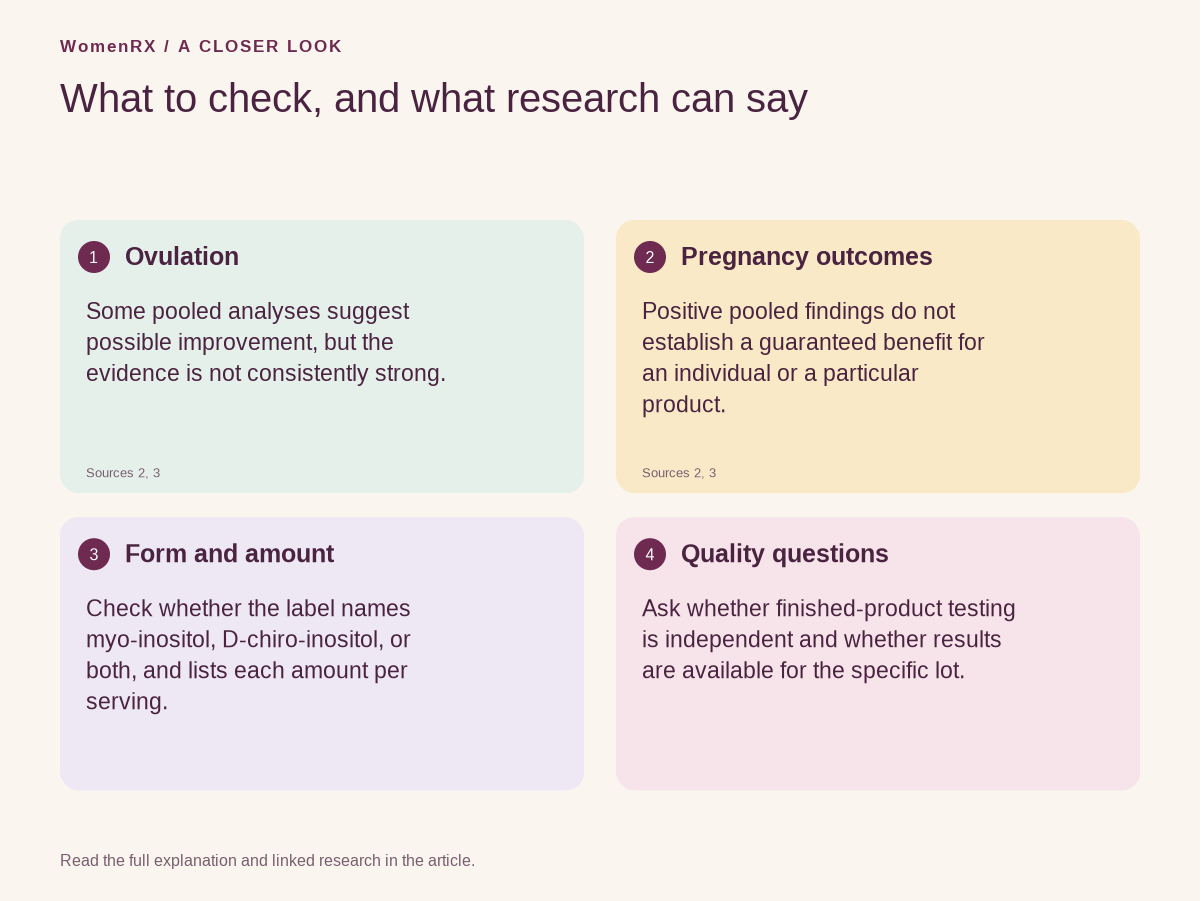
What to check, and what research can say
Ovulation: Some pooled analyses suggest possible improvement, but the evidence is not consistently strong.23
Pregnancy outcomes: Positive pooled findings do not establish a guaranteed benefit for an individual or a particular product.23
Form and amount: Check whether the label names myo-inositol, D-chiro-inositol, or both, and lists each amount per serving.
Quality questions: Ask whether finished-product testing is independent and whether results are available for the specific lot.
Read the figure as text
Separate practical label questions from the uncertain evidence on PCOS outcomes.- Ovulation: Some pooled analyses suggest possible improvement, but the evidence is not consistently strong.23
- Pregnancy outcomes: Positive pooled findings do not establish a guaranteed benefit for an individual or a particular product.23
- Form and amount: Check whether the label names myo-inositol, D-chiro-inositol, or both, and lists each amount per serving.
- Quality questions: Ask whether finished-product testing is independent and whether results are available for the specific lot.
More questions, answered
Is myo-inositol better than D-chiro-inositol for PCOS?
The evidence does not establish one universally best form or ratio. Reviews report some differences between study subgroups, but the overall evidence remains limited, and combination formulas have not consistently outperformed single forms. 2 3
Can inositol replace fertility treatment for PCOS?
The evidence does not show that inositol should replace fertility care. If you’re trying to conceive, ask how it fits with your individual plan; PCOS-related ovulatory difficulties may have other treatment options. 1 3
Sources you can check
- PCOS | Polycystic Ovary Syndrome | MedlinePlusAccessed 2026-09-25Return to first citation
- Effects of inositol in women with polycystic ovary syndrome: an umbrella review of meta-analyses from randomized controlled trials.Duan M, Yang M, Li C, Wu X, Yin X, Zhu H. · Frontiers in endocrinology · 2026Return to first citation
- Inositol for Polycystic Ovary Syndrome: A Systematic Review and Meta-analysis to Inform the 2023 Update of the International Evidence-based PCOS Guidelines.Fitz V, Graca S, Mahalingaiah S, Liu J, Lai L, Butt A, Armour M, Rao V, Naidoo D, Maunder A, Yang G, Vaddiparthi V, Witchel SF, Pena A, Spritzer PM, Li R, Tay C, Mousa A, Teede H, ... · The Journal of clinical endocrinology and metabolism · 2024Return to first citation