Should You Consider Inositol for PCOS?
Inositol may help some PCOS-related measures, but the evidence is less certain than a supplement label can make it sound.
Inositol may be worth discussing if you have PCOS and a specific goal, such as improving a metabolic measure or supporting ovulation. Research suggests possible benefits, but results differ by outcome and study, and the overall evidence is mostly low or very low certainty. It hasn’t been shown to replace individualized PCOS care, and evidence for one inositol formula doesn’t automatically apply to another. 24
Start with the outcome you care about
“Inositol for PCOS” can mean different things: a hoped-for change in insulin-related blood tests, more regular periods, or improved ovulation while trying to conceive. Those are separate outcomes, and the evidence isn’t equally strong for each. A useful first question is not simply “Does inositol work?” but “Which outcome might it help, and how certain is that finding?”
Metabolic measures: possible changes, not a settled treatment effect
Some reviews report improvements in measures such as fasting insulin or HOMA-IR, a calculated estimate of insulin resistance. An umbrella review of meta-analyses found moderate-certainty evidence for an improvement in fasting insulin with inositol. A newer umbrella review also found favorable pooled results for several metabolic measures, but judged none of its overall evidence high quality; most of its evidence items were low or very low quality. 24
That distinction matters: a change in a blood-test measure does not by itself tell you whether the supplement will improve a symptom or prevent a future health problem. Results also haven’t been consistent across reviews. A 2022 meta-analysis of 17 randomized trials involving 1,083 people with PCOS found no clinically significant improvement in most of the metabolic and other measured outcomes, and reported substantial variation between studies. 1
So, if your goal is metabolic, ask what measure you and your care team are trying to improve, and how you’ll judge whether a change is meaningful. Inositol studies don’t establish that it’s a replacement for other PCOS care. A comparison review of inositol, metformin, and other treatments focused on non-menopausal women and selected metabolic outcomes; it did not evaluate reproductive or patient-centered outcomes. 3
Cycles and ovulation: related, but not interchangeable
A more regular menstrual pattern and ovulation are not the same result. A network meta-analysis comparing oral insulin-sensitizing treatments reported improved menstrual frequency with myo-inositol plus D-chiro-inositol compared with metformin. But network analyses can combine direct and indirect comparisons, and that finding doesn’t establish that every product or person with PCOS will have the same result. 5
For ovulation, a 2023 umbrella review found a possible benefit in subfertile women with PCOS, with moderate certainty. 2 A 2026 umbrella review also reported a favorable pooled ovulation result and a higher pooled live-birth rate with inositol than with placebo or folic acid. The pooled findings shouldn’t be assumed to apply to every person with PCOS or every fertility situation, and the review found no high-quality evidence overall. The live-birth finding is encouraging, but it can’t predict an individual outcome. 4
If you’re trying to conceive, make that goal explicit when you discuss options. Evidence about a supplement and ovulation doesn’t answer every question about fertility treatment, pregnancy, or birth outcomes.
Formulation matters, and “inositol” isn’t one formula
Myo-inositol and D-chiro-inositol are different forms. Studies have examined them separately and in combinations, so results for one should not be assumed to apply to another. The newer umbrella review suggested differences between forms, but its authors also reported generally limited evidence quality and said combination therapy did not consistently outperform single forms. That isn’t enough to declare one formula best for everyone. 4
Before buying, check the product label for the specific form or forms and any added ingredients. Bring the label to the person coordinating your PCOS care and ask whether that exact product fits your goal and current treatment plan. Research findings for a study formulation don’t automatically validate every supplement sold with a PCOS claim.
Questions that make the decision more useful
You could ask:
- Which PCOS-related goal are we trying to address: a metabolic measure, cycle pattern, or ovulation?
- What result would count as meaningful for that goal?
- Does the evidence apply to the specific inositol form and combination on this label?
- How does this fit with the other care options we’re considering?
Population details vary across reviews. For example, one comparison review specified non-menopausal women and assessed selected metabolic outcomes, rather than reproductive or patient-centered outcomes. That review’s findings shouldn’t be treated as evidence about every life stage or every PCOS goal. 3
Inositol may be a reasonable topic to raise, especially when you have a clear reproductive or metabolic goal. The evidence supports a conversation, not a one-size-fits-all recommendation.
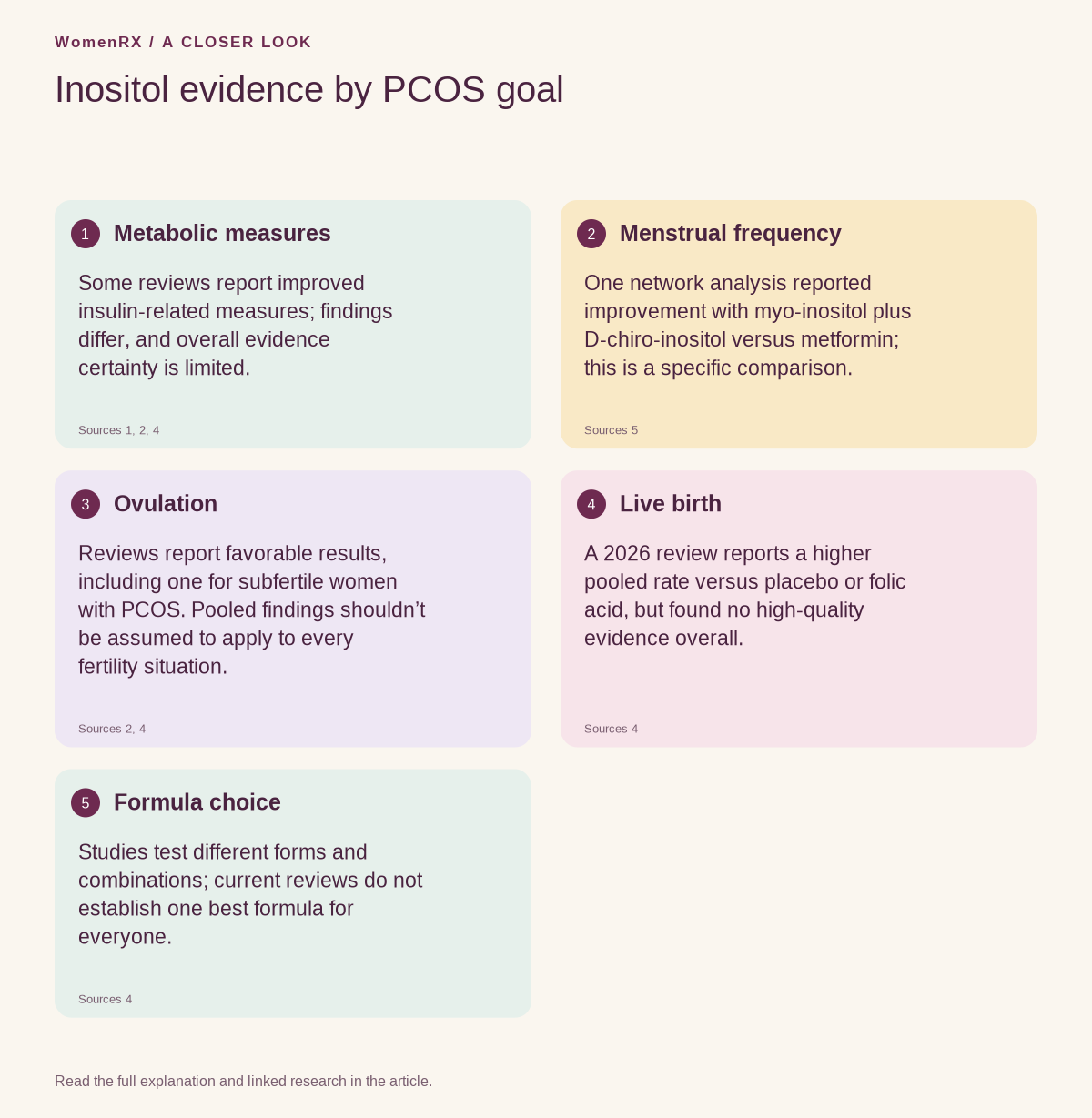
Inositol evidence by PCOS goal
Metabolic measures: Some reviews report improved insulin-related measures; findings differ, and overall evidence certainty is limited.124
Menstrual frequency: One network analysis reported improvement with myo-inositol plus D-chiro-inositol versus metformin; this is a specific comparison.5
Ovulation: Reviews report favorable results, including one for subfertile women with PCOS. Pooled findings shouldn’t be assumed to apply to every fertility situation.24
Live birth: A 2026 review reports a higher pooled rate versus placebo or folic acid, but found no high-quality evidence overall.4
Formula choice: Studies test different forms and combinations; current reviews do not establish one best formula for everyone.4
Read the figure as text
The research picture changes depending on whether your goal is a metabolic measure, menstrual frequency, ovulation, or live birth.- Metabolic measures: Some reviews report improved insulin-related measures; findings differ, and overall evidence certainty is limited.124
- Menstrual frequency: One network analysis reported improvement with myo-inositol plus D-chiro-inositol versus metformin; this is a specific comparison.5
- Ovulation: Reviews report favorable results, including one for subfertile women with PCOS. Pooled findings shouldn’t be assumed to apply to every fertility situation.24
- Live birth: A 2026 review reports a higher pooled rate versus placebo or folic acid, but found no high-quality evidence overall.4
- Formula choice: Studies test different forms and combinations; current reviews do not establish one best formula for everyone.4
More questions, answered
Does inositol help with ovulation in PCOS?
A 2023 umbrella review reported a possible increase in ovulation among subfertile women with PCOS. A separate 2026 umbrella review also reported a favorable pooled ovulation result and a higher pooled live-birth rate with inositol than with placebo or folic acid. Those pooled findings shouldn’t be assumed to apply to every person with PCOS or every fertility situation, and they don’t guarantee an individual outcome. 24
Are myo-inositol and D-chiro-inositol interchangeable?
No. They are distinct forms, and studies have tested different forms and combinations. Current review findings don’t establish one best formula for everyone, so check which form is in the product you’re considering. 4
Sources you can check
- Efficacy of Myo-inositol on Anthropometric, Metabolic, and Endocrine Outcomes in PCOS Patients: a Meta-analysis of Randomized Controlled Trial.Jethaliya H, Gajjar N, Patel V, Deshpande S, Patel R. · Reproductive sciences (Thousand Oaks, Calif.) · 2022Return to first citation
- Effects of nutrition on metabolic and endocrine outcomes in women with polycystic ovary syndrome: an umbrella review of meta-analyses of randomized controlled trials.Moslehi N, Zeraattalab-Motlagh S, Rahimi Sakak F, Shab-Bidar S, Tehrani FR, Mirmiran P. · Nutrition reviews · 2023Return to first citation
- Comparative analysis of glucagon-like peptide-1 receptor agonists, metformin, and inositol in improving anthropometric and metabolic outcomes in women with polycystic ovary syndrome: a network meta-analysis.Omarion A, Ayasa Y, Omarion Z, Jayouse B, Ayesh H. · Frontiers in endocrinology · 2026Return to first citation
- Effects of inositol in women with polycystic ovary syndrome: an umbrella review of meta-analyses from randomized controlled trials.Duan M, Yang M, Li C, Wu X, Yin X, Zhu H. · Frontiers in endocrinology · 2026Return to first citation
- Comparative efficacy of oral insulin sensitizers metformin, thiazolidinediones, inositol, and berberine in improving endocrine and metabolic profiles in women with PCOS: a network meta-analysis.Zhao H, Xing C, Zhang J, He B. · Reproductive health · 2021Return to first citation