Levothyroxine Timing, Food, and Medicine Interactions
A steady routine can help your prescribed levothyroxine work consistently, but the right timing depends on your product and what else you take.
For levothyroxine tablets, a commonly recommended routine is to take your dose on an empty stomach 30 to 60 minutes before breakfast. 6 Keep that relationship to meals consistent: food can reduce absorption, and a routine change may affect thyroid results. 1 US tablet instructions advise separating calcium and iron supplements and antacids by at least four hours. Review any timing change with your pharmacist or prescriber.
The routine matters more than a perfect clock time
For levothyroxine tablets, a commonly recommended routine is to take your dose on an empty stomach 30 to 60 minutes before breakfast. 6 Levothyroxine is absorbed differently depending on whether your stomach is fasting and what else you take around the same time. Food can reduce absorption, and a change in routine may show up in thyroid lab results. Taking your prescribed dose in a similar way each day helps make those results easier to interpret. 1
Start with the directions for your own prescription. A systematic review found that morning and bedtime use were similarly effective in the studies it assessed, but the effect of taking levothyroxine with food depended in part on the formulation. That doesn’t mean every timing plan suits every person or product. If another time of day would work better for you, ask your pharmacist or prescriber how to make the change consistently. 4
Give calcium, iron, and antacids their own place
Calcium and iron supplements can interfere with levothyroxine absorption. US tablet instructions also name antacids and advise taking levothyroxine at least four hours before or after these agents. Check what’s in products you use regularly: calcium can be found in some antacids and multivitamins, while iron is included in some multivitamins. 1 2 3
The separation is about helping levothyroxine absorb. It isn’t a reason to stop a supplement you’ve been told to take. If calcium or iron is part of your routine, a pharmacist can help you find a workable schedule that fits your other medicines, too.
Notice what happens around your dose
Food can lower levothyroxine absorption compared with taking it while fasting. US tablet information names soybeans and dietary fiber as possible influences. A systematic review also found evidence of reduced absorption with coffee, although the strength of evidence varies across foods and studies. 1 4
You don’t necessarily need to avoid these foods or drinks. What’s useful is to notice a change: perhaps you’ve started having breakfast or coffee closer to your tablet, or you’ve added a fiber or soy product near that time. Tell your prescriber if your routine has shifted, particularly when you’re reviewing a new thyroid test result. 1 4
Not every medicine interaction is a timing problem
Prescription medicines can affect levothyroxine in different ways. A systematic review identifies proton pump inhibitors, bile acid sequestrants, phosphate binders, anticonvulsants, and sex hormones among medicines with reported interactions. Because the mechanisms differ, moving every medicine four hours away from levothyroxine isn’t a reliable one-size-fits-all fix. 5
When you start or stop a medicine, ask a pharmacist to review it alongside your levothyroxine prescription, over-the-counter products, vitamins, and supplements. The useful question is specific: Does this item affect absorption, thyroid hormone levels, or my testing plan, and does its timing need to change? Don’t stop or rearrange a prescribed medicine on your own. 1 5
When thyroid results change, look at the routine too
If a thyroid test result shifts, the prescribed dose isn’t the only possible explanation. Product information identifies inadequate absorption, drug interactions, and missed doses as possible contributors to an apparent inadequate response. Think back to changes in meals, supplements, other medicines, or how you’ve been taking your tablet, and share those details when you discuss the result. Treatment decisions are based on thyroid labs and clinical response, not a single routine detail alone. 1
If you miss a dose, use the instructions that came with your prescription or ask a pharmacist what to do for your specific product. Don’t invent a catch-up schedule or change your usual dose to make up for uncertain absorption.
Pregnancy and after delivery need a timely review
Pregnancy can change levothyroxine requirements, and US tablet information calls for TSH monitoring and treatment adjustment during pregnancy. It also addresses a change in dosing after delivery. If you’re pregnant, planning a pregnancy, or have recently given birth, contact your prescriber promptly for a treatment and testing plan rather than waiting for a routine medication check. 1
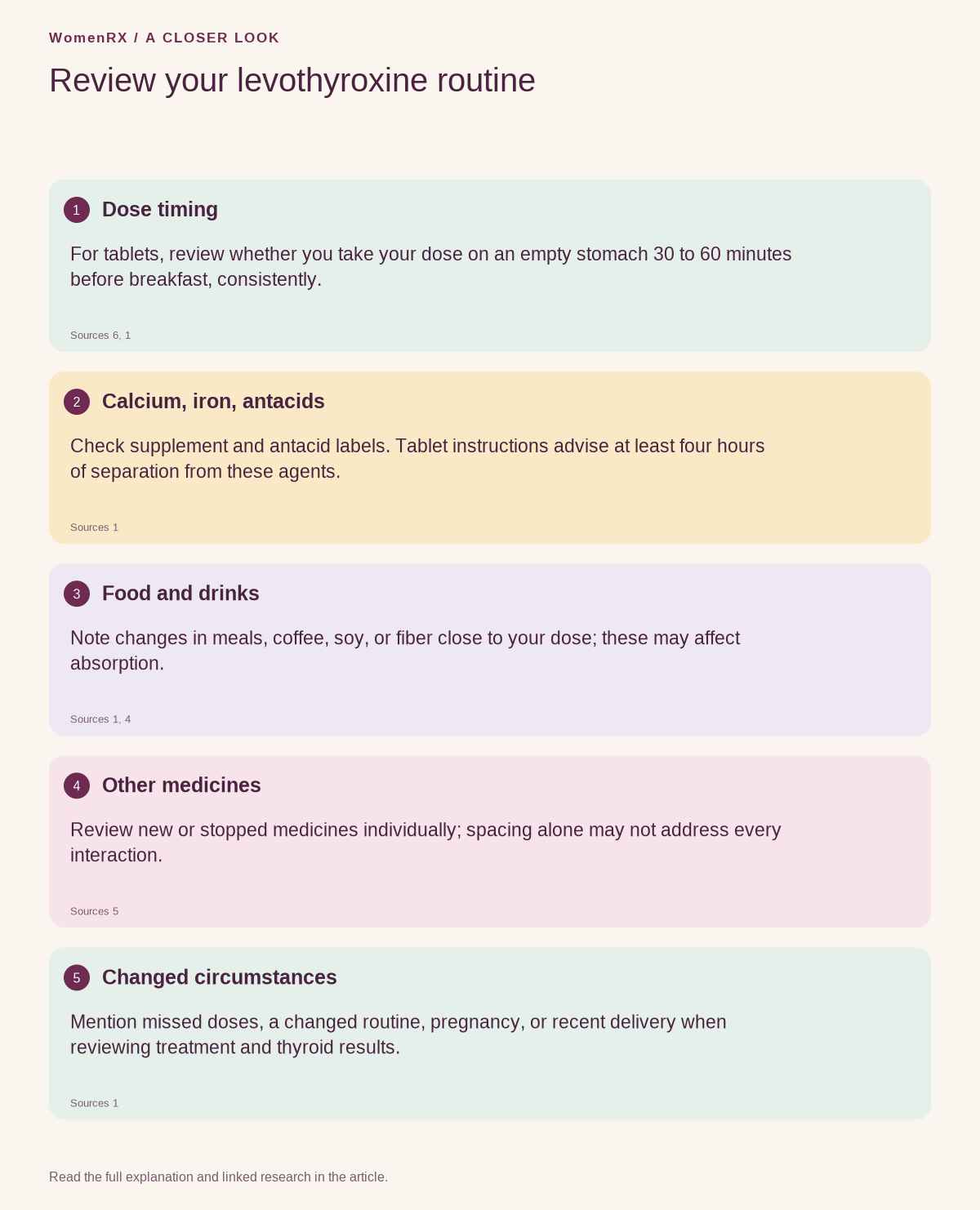
Review your levothyroxine routine
Dose timing: For tablets, review whether you take your dose on an empty stomach 30 to 60 minutes before breakfast, consistently.61
Calcium, iron, antacids: Check supplement and antacid labels. Tablet instructions advise at least four hours of separation from these agents.1
Food and drinks: Note changes in meals, coffee, soy, or fiber close to your dose; these may affect absorption.14
Other medicines: Review new or stopped medicines individually; spacing alone may not address every interaction.5
Changed circumstances: Mention missed doses, a changed routine, pregnancy, or recent delivery when reviewing treatment and thyroid results.1
Read the figure as text
These prompts help you identify changes and interactions worth reviewing with a pharmacist or prescriber.- Dose timing: For tablets, review whether you take your dose on an empty stomach 30 to 60 minutes before breakfast, consistently.61
- Calcium, iron, antacids: Check supplement and antacid labels. Tablet instructions advise at least four hours of separation from these agents.1
- Food and drinks: Note changes in meals, coffee, soy, or fiber close to your dose; these may affect absorption.14
- Other medicines: Review new or stopped medicines individually; spacing alone may not address every interaction.5
- Changed circumstances: Mention missed doses, a changed routine, pregnancy, or recent delivery when reviewing treatment and thyroid results.1
More questions, answered
Can I take levothyroxine with breakfast if that’s easier?
The commonly recommended routine for tablets is to take them on an empty stomach 30 to 60 minutes before breakfast. Food can reduce absorption, and its effect may depend on the formulation. If that routine is hard to maintain, discuss a consistent alternative with your pharmacist or prescriber, including whether follow-up thyroid testing is needed. Don’t change your dose to compensate on your own. 6 1 4
Should I separate every medicine from levothyroxine by four hours?
No single spacing rule covers every interaction. US tablet instructions advise at least four hours of separation from drugs known to interfere with absorption and specifically name calcium and iron supplements and antacids. Other medicines can affect treatment in different ways, so review each item rather than applying the same fix to all of them. 1 5
Sources you can check
- LEVOTHYROXINE SODIUM TABLET [CARDINAL HEALTH 107, LLC] | US prescribing information and patient instructionsAccessed 2026-09-25Return to first citation
- Calcium | MedlinePlusAccessed 2026-09-25Return to first citation
- Iron - Health Professional Fact SheetAccessed 2026-09-25Return to first citation
- Levothyroxine Interactions with Food and Dietary Supplements-A Systematic Review.Wiesner A, Gajewska D, Paśko P. · Pharmaceuticals (Basel, Switzerland) · 2021Return to first citation
- Medications and Food Interfering with the Bioavailability of Levothyroxine: A Systematic Review.Liu H, Lu M, Hu J, Fu G, Feng Q, Sun S, Chen C. · Therapeutics and clinical risk management · 2023Return to first citation
- Breakfast Habits in Patients Using Levothyroxine: Patient Experiences and Preferences.Willems JIA, van Twist DJL, Luu IHY, Bianchi R, Peeters RP, Tummers-de Lind van Wijngaarden RFA. · Journal of the Endocrine Society · 2024Return to first citation