Supplements After 60: Check Need, Duplicates, and Interactions
A supplement makes more sense when it fills a specific need than when it’s chosen just because you’re over 60.
Before adding a supplement, compare what you eat and take with a diagnosed need, then check every product against your prescription and over-the-counter medicines. Age alone doesn’t tell you which supplements you need. After menopause, calcium matters for bone health, but food, antacids, multivitamins, and separate supplements can all contribute to your total. A pharmacist can help review the full list for overlaps and potential interactions. 1 2
Start with the reason, not the bottle
A supplement is worth reviewing when there’s a specific reason to consider it: a diagnosed deficiency, a health condition, a dietary gap, or a recommendation tied to your care. Turning 60, by itself, doesn’t establish that you need a multivitamin or a particular nutrient.
Make a list of everything you use regularly, not only products labeled “supplement.” Include prescriptions, over-the-counter medicines, vitamins, minerals, herbs, powders, and products taken only occasionally. Bring the containers or clear photos of the labels to a pharmacist or clinician. Older adults commonly use supplements alongside other products, which makes a complete list more useful than reviewing one bottle at a time. 6 7
Look for overlap before adding anything
Check the active ingredients and amounts in each product. A nutrient may appear in a multivitamin, a separate supplement, a combination product, or an over-the-counter medicine. Calcium, for example, is found in foods and supplements and is also present in some medicines, including certain antacids. Add those sources to the conversation rather than assuming the supplement label shows your full intake. 1
After menopause, calcium needs are higher than for younger adult women: the NIH fact sheet gives a recommended dietary allowance of 1,200 mg a day for women over 50. That figure refers to total calcium intake, not a suggested supplement amount. Food can contribute, and whether a supplement is useful depends on what you already get and your individual circumstances. 1 2
Vitamin D helps the body absorb calcium and supports bone mineralization. But that role doesn’t mean every woman over 60 needs a separate vitamin D product. Consider your food and existing products, and ask whether there’s a specific reason to supplement rather than stacking a new product on top of a multivitamin. 3 4
Treat interactions as a product-specific check
Supplements can interact with medicines; “natural” doesn’t mean interaction-free. In a repeated cross-sectional study of adults 50 and older in Tehran, researchers identified potential interactions that included vitamin E with aspirin and magnesium or potassium with blood-pressure medicines. These were potential interactions in that study, not proof that every person taking one of these combinations will be harmed. The findings are a reason to have a pharmacist check your particular products and medicines, not a complete interaction guide. 5
Include nonprescription medicines and products you take only now and then. A review based only on your prescriptions can miss other ingredients in the mix. If you have several chronic conditions or take several medicines, make that clear during the review; the Tehran study found potential interactions were more common among participants with multiple health conditions, though it cannot estimate your personal risk. 5
Make the review easy to act on
Bring a written list or the actual packages. For each product, note what you take it for and how often you use it. Ask which products duplicate ingredients, which have a clear reason to continue, and whether any pairing needs a change or closer review. If swallowing pills is difficult or you have a concern about absorption, mention it and ask whether the product form matters; don’t assume a tablet can be crushed or substituted without checking.
The useful outcome isn’t necessarily a longer supplement routine. It’s a clear explanation of what each product is for, how it fits with your medicines and diet, and which questions need an answer before you add, stop, or change something.
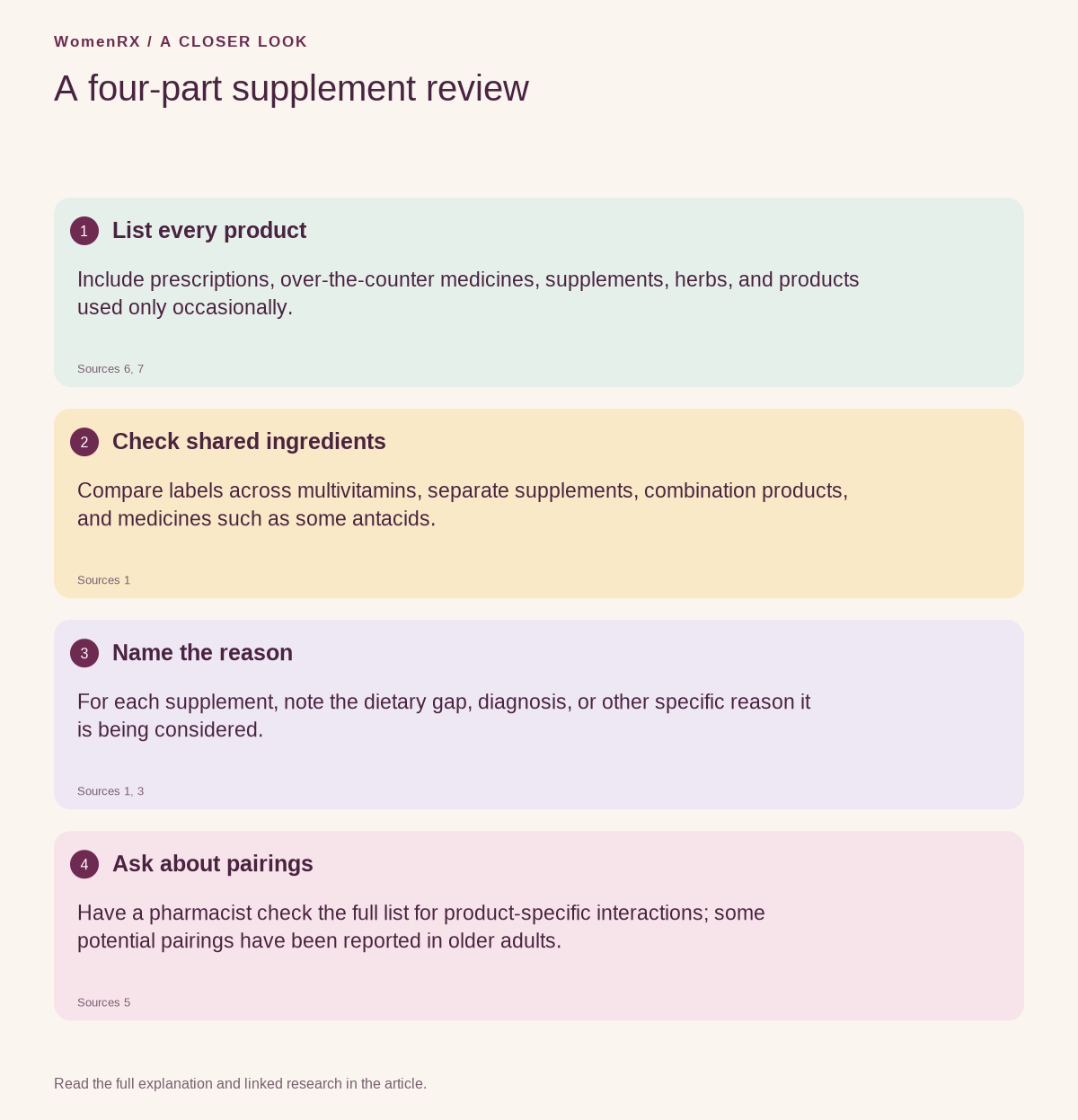
A four-part supplement review
List every product: Include prescriptions, over-the-counter medicines, supplements, herbs, and products used only occasionally.67
Check shared ingredients: Compare labels across multivitamins, separate supplements, combination products, and medicines such as some antacids.1
Name the reason: For each supplement, note the dietary gap, diagnosis, or other specific reason it is being considered.13
Ask about pairings: Have a pharmacist check the full list for product-specific interactions; some potential pairings have been reported in older adults.5
Read the figure as text
Use this checklist to make a product-by-product review more complete, including overlaps and questions that need an individual answer.- List every product: Include prescriptions, over-the-counter medicines, supplements, herbs, and products used only occasionally.67
- Check shared ingredients: Compare labels across multivitamins, separate supplements, combination products, and medicines such as some antacids.1
- Name the reason: For each supplement, note the dietary gap, diagnosis, or other specific reason it is being considered.13
- Ask about pairings: Have a pharmacist check the full list for product-specific interactions; some potential pairings have been reported in older adults.5
More questions, answered
Does being postmenopausal mean I should take calcium?
No. Calcium is important for bones, and the recommended total intake is higher for women over 50, but that total includes food and other sources. Whether a supplement is needed depends on your overall intake and circumstances. 1 2
Should I bring over-the-counter products to a supplement review?
Yes. Include nonprescription medicines, antacids, vitamins, minerals, herbs, and occasional products. Some medicines contain nutrients, and a pharmacist needs the whole list to check for overlap and potential interactions. 1 5
Sources you can check
- Calcium - Health Professional Fact SheetAccessed 2026-09-25Return to first citation
- Calcium | MedlinePlusAccessed 2026-09-25Return to first citation
- Vitamin D - Health Professional Fact SheetAccessed 2026-09-25Return to first citation
- Vitamin D: MedlinePlusAccessed 2026-09-25Return to first citation
- Trends and determinants of dietary supplement use and potential drug- supplement interactions in older adults: a 16-years follow-up in the Tehran lipid and glucose study.Bahadoran Z, Nozari Z, Azizi F. · Aging clinical and experimental research · 2026Return to first citation
- Use of prescription and over-the-counter medications and dietary supplements among older adults in the United States.Qato DM, Alexander GC, Conti RM, Johnson M, Schumm P, Lindau ST. · JAMA · 2008Return to first citation
- Dietary supplement and complementary and alternative medicine use among older adults in Australia and the United States.Fravel MA, Ernst ME, Gilmartin-Thomas J, Woods RL, Orchard SG, Owen AJ, ASPirin in Reducing Events in the Elderly Investigator Group. · Journal of the American Geriatrics Society · 2023Return to first citation