Postpartum Supplements: What to Keep, Check, or Skip
Your current prenatal vitamin isn’t automatically the right answer after birth; start by checking what it contains and what your recovery, diet, and breastfeeding plans call for.
You don’t automatically need a new supplement after birth, and breastfeeding alone doesn’t show that you need iron. Before continuing or adding a product, check your prenatal’s Supplement Facts panel. Blood loss or known anemia may make iron worth discussing as a treatment question; breastfeeding makes iodine intake worth reviewing, especially if you eat few iodine-rich foods. 1 2 3
Start with the product you already have
If you’re taking a prenatal vitamin, look at its Supplement Facts panel before buying anything else. Check whether it contains iron and iodine, and how much. Iron products can contain different amounts of elemental iron, which is listed on the panel. Comparing labels can help you avoid adding a second product without first knowing what’s already in the one you take. 1
There isn’t enough information here to say every woman should continue a prenatal after birth, or that everyone should stop. A more useful question is whether the product fits your current needs. Blood loss, a diagnosis of anemia, food choices, and breastfeeding all point to different parts of that discussion.
Treat possible iron deficiency as its own question
Blood loss can contribute to low iron. Iron-deficiency anemia may cause fatigue, shortness of breath, or difficulty concentrating, but those symptoms alone don’t show that iron is the cause. 2
If you had substantial blood loss or were told you had anemia, ask whether your iron status needs to be assessed or treated. That’s different from taking iron simply because you’ve given birth. A randomized trial of 114 lactating women found that iron supplementation affected hemoglobin and some iron-status measures over about three and a half months. It does not establish that every breastfeeding woman needs an iron supplement. 4
Check the amount before taking more iron. Higher supplemental amounts can cause stomach side effects: NIH’s Office of Dietary Supplements notes nausea and constipation with 45 mg per day or more. Too much iron can also be harmful. 1 2
Breastfeeding puts iodine on the checklist
The recommended iodine intake is higher during lactation than during pregnancy: 290 micrograms per day for lactating women, compared with 220 micrograms during pregnancy. These are total daily intake recommendations, not instructions to add a supplement on top of your diet. 3
Seafood, eggs, dairy, and seaweed are iodine sources; plant-based milk substitutes tend to contain relatively little. If you eat few or none of the main iodine-containing foods, check whether your current vitamin includes iodine and ask whether your overall intake needs attention. Don’t assume a product is suitable just because it says “prenatal” or “postpartum” on the label. 3
A quick route to the next decision
- You already take a prenatal: Read the label first. Note its iron and iodine amounts before deciding whether to continue it or add anything. 1 3
- You had substantial blood loss or a diagnosis of anemia: Ask whether iron status should be assessed and whether treatment is appropriate. 2
- You’re breastfeeding: Review iodine from both food and your current vitamin; lactation has a higher recommended iodine intake than pregnancy. 3
- Your diet excludes common iodine sources: Mention the foods you avoid and check the iodine amount in your current product. 3
A focused question might be: “Given my blood loss, diet, and breastfeeding plans, does this vitamin still fit, or should we check a specific nutrient?” That keeps routine nutrition separate from treatment for a problem such as iron deficiency.
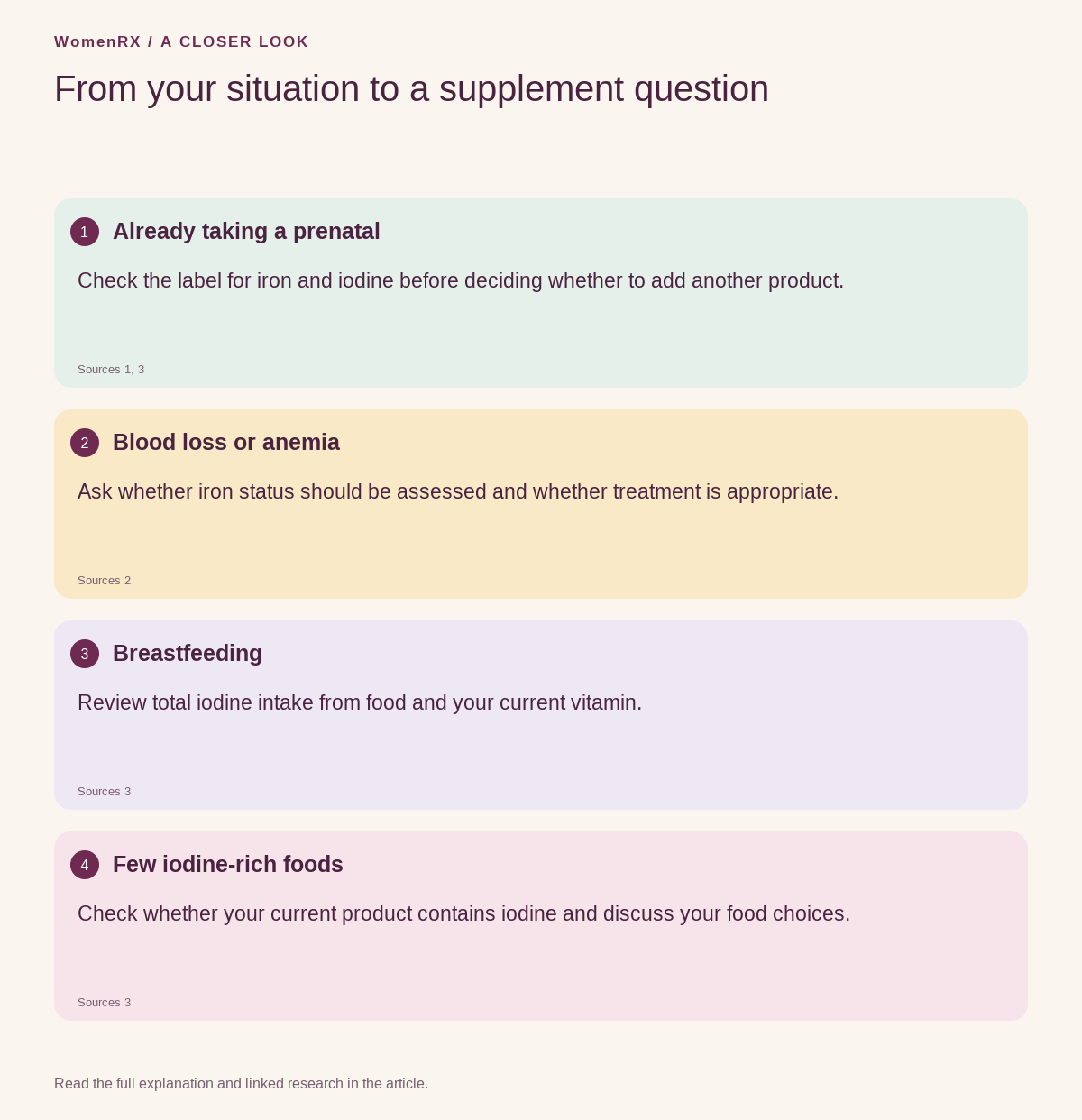
From your situation to a supplement question
Already taking a prenatal: Check the label for iron and iodine before deciding whether to add another product.13
Blood loss or anemia: Ask whether iron status should be assessed and whether treatment is appropriate.2
Breastfeeding: Review total iodine intake from food and your current vitamin.3
Few iodine-rich foods: Check whether your current product contains iodine and discuss your food choices.3
Read the figure as text
Use the situation that fits you to identify what to check before continuing or adding a supplement.- Already taking a prenatal: Check the label for iron and iodine before deciding whether to add another product.13
- Blood loss or anemia: Ask whether iron status should be assessed and whether treatment is appropriate.2
- Breastfeeding: Review total iodine intake from food and your current vitamin.3
- Few iodine-rich foods: Check whether your current product contains iodine and discuss your food choices.3
More questions, answered
Does breastfeeding mean I need an iron supplement?
Not by itself. A randomized trial involving 114 lactating women found changes in hemoglobin and some iron-status measures with iron supplementation, but it does not show that every breastfeeding woman needs iron. Blood loss or a known anemia diagnosis makes iron a more specific question to discuss. 2 4
Sources you can check
- Iron - Health Professional Fact SheetAccessed 2026-09-25Return to first citation
- Iron: MedlinePlusAccessed 2026-09-25Return to first citation
- Iodine - Health Professional Fact SheetAccessed 2026-09-25Return to first citation
- Effect of iron supplementation during lactation on maternal iron status and oxidative stress: A randomized controlled trial.Jorgensen JM, Yang Z, Lönnerdal B, Chantry CJ, Dewey KG. · Maternal & child nutrition · 2017Return to first citation