Dizziness Around Menopause: Check the Cause Before Supplements
Spinning, faintness, and unsteadiness can point to different causes, so the pattern matters more than guessing at a supplement.
Don’t start iron, magnesium, vitamin B12, or another supplement just because dizziness has appeared around menopause. First describe what it feels like, when it happens, and whether it comes with other symptoms. Heavy periods can raise the chance of low iron, but dizziness alone can’t show that iron is the cause; blood tests are used to assess iron status. 123
First, name the sensation
“Dizzy” can mean feeling faint or lightheaded, being off-balance, or feeling as if you or the room is spinning. That spinning sensation is called vertigo. These aren’t interchangeable descriptions, and none identifies the cause by itself. 1
Notice the pattern as well as the feeling. Does it happen when you stand up? Is it a spinning sensation, or more like unsteadiness? Did it begin after starting a prescription medicine? Has it returned, or come with changes in your pulse? These details can help distinguish possibilities. A sudden blood-pressure drop when standing, an inner-ear problem, and a medicine side effect are among the causes described in dizziness guidance. 1
While you feel dizzy, sit or lie down until it passes and get up slowly. Avoid driving, climbing, or other activities that could be dangerous during an episode. 1
When iron belongs in the conversation
Changing periods can matter if they’ve become heavy: heavy periods are a risk factor for low iron. Iron-deficiency anemia can cause symptoms such as fatigue, weakness, and difficulty concentrating, but those symptoms don’t establish that iron is behind your dizziness. 23
Iron status is assessed with blood tests. Hemoglobin and hematocrit are commonly used, and a clinician may also consider ferritin, which reflects iron stores. Ferritin can be affected by inflammation, so more than one measure may be needed to assess iron status. 2
That’s why taking iron based on dizziness alone can miss the point. Low iron may need treatment, but excess iron can also cause harm. Iron supplements can cause nausea and constipation, and too much iron can cause additional problems, including abdominal pain and vomiting. If your periods are heavy or you’re concerned about low iron, ask whether testing is appropriate before taking an iron supplement. 23
Menopause is context, not a diagnosis
Dizziness occurring during perimenopause or menopause doesn’t, by itself, establish that menopause is causing it. Consider the whole pattern: whether your periods have become heavy, whether you recently started a medicine, whether standing brings on faintness, and whether the episode feels like spinning or loss of balance. Those clues point to different questions, not a diagnosis. 13
The same cause-first approach applies before trying magnesium, vitamin B12, or another supplement. Dizziness alone doesn’t tell you that you have a nutrient deficiency or that a supplement will address the cause. Magnesium deficiency is uncommon in otherwise healthy people, although some health conditions and medicines can contribute to it. 4
When to seek medical advice
Get medical advice if dizziness doesn’t go away or keeps coming back. Also seek advice if it comes with pulse changes, fainting or collapsing, headaches, nausea or vomiting, or difficulty with balance. Hearing changes, ringing in the ears, double or blurred vision, trouble speaking, or numbness or weakness in your face, arms, or legs are also reasons to seek advice. 1
If you’re describing the episodes to a clinician, it can help to say what the sensation is, what you were doing when it began, whether standing or a new medicine seems connected, and whether you’ve had heavy bleeding or changes in your pulse, hearing, or vision. That’s more useful than treating every kind of dizziness as the same problem.
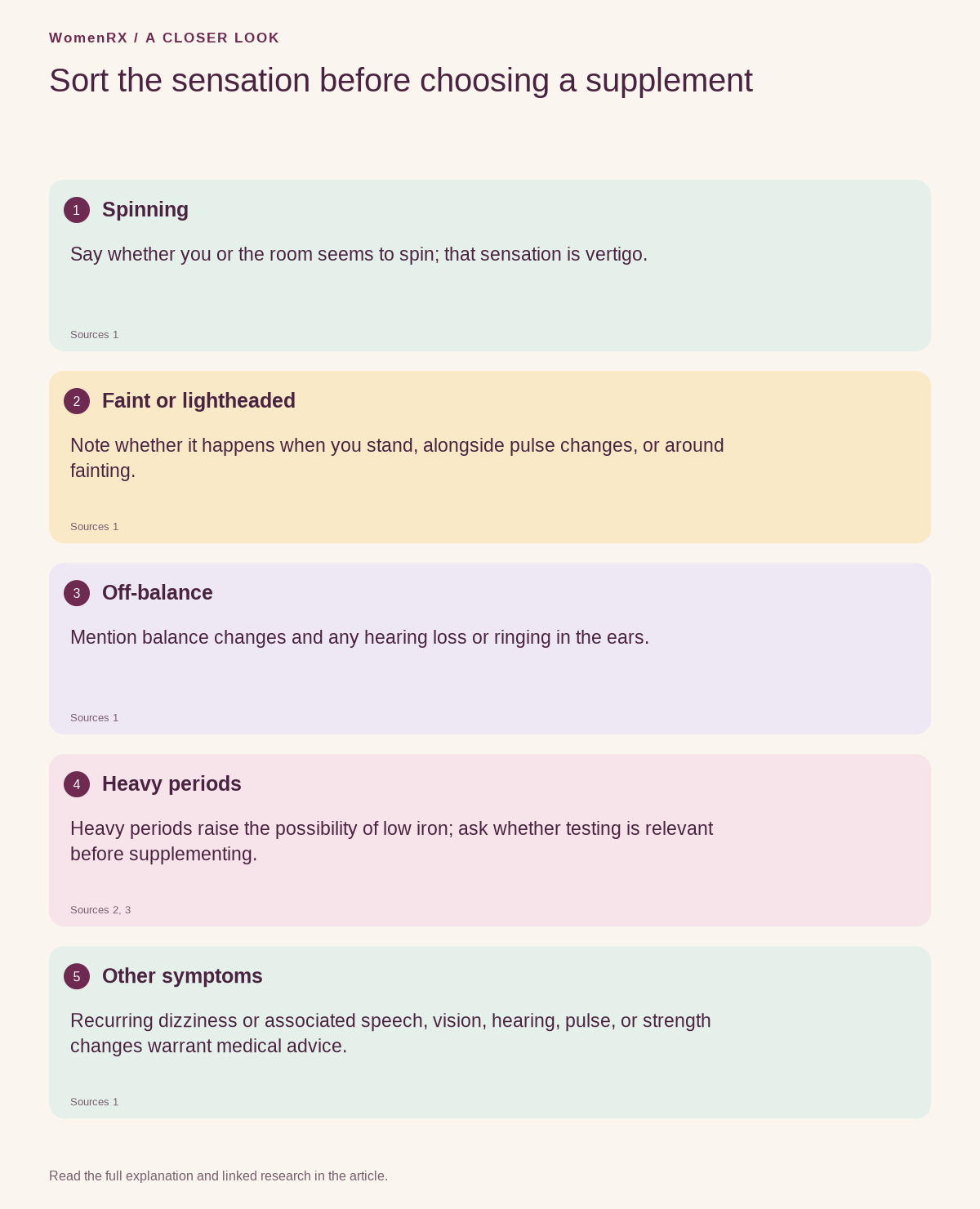
Sort the sensation before choosing a supplement
Spinning: Say whether you or the room seems to spin; that sensation is vertigo.1
Faint or lightheaded: Note whether it happens when you stand, alongside pulse changes, or around fainting.1
Off-balance: Mention balance changes and any hearing loss or ringing in the ears.1
Heavy periods: Heavy periods raise the possibility of low iron; ask whether testing is relevant before supplementing.23
Other symptoms: Recurring dizziness or associated speech, vision, hearing, pulse, or strength changes warrant medical advice.1
Read the figure as text
Use the sensation and its pattern to describe an episode and guide the next question. This flow does not diagnose the cause.- Spinning: Say whether you or the room seems to spin; that sensation is vertigo.1
- Faint or lightheaded: Note whether it happens when you stand, alongside pulse changes, or around fainting.1
- Off-balance: Mention balance changes and any hearing loss or ringing in the ears.1
- Heavy periods: Heavy periods raise the possibility of low iron; ask whether testing is relevant before supplementing.23
- Other symptoms: Recurring dizziness or associated speech, vision, hearing, pulse, or strength changes warrant medical advice.1
More questions, answered
Can heavy periods around perimenopause lead to low iron?
Heavy periods are a risk factor for low iron, but they don’t prove that iron deficiency is causing dizziness. Blood tests, which may include hemoglobin and ferritin, are used to assess iron status. 23
Does magnesium deficiency commonly cause dizziness?
The available information doesn’t establish magnesium deficiency as a common cause of dizziness. Symptomatic deficiency is uncommon in otherwise healthy people, though certain conditions and medicines can contribute to it. Dizziness alone isn’t a reason to assume you need a magnesium supplement. 4
Sources you can check
- Dizziness - NHSAccessed 2026-09-25Return to first citation
- Iron - Health Professional Fact SheetAccessed 2026-09-25Return to first citation
- Iron: MedlinePlusAccessed 2026-09-25Return to first citation
- Magnesium - Health Professional Fact SheetAccessed 2026-09-25Return to first citation