Electric-Shock Sensations Around Menopause: Do Supplements Help?
A brief jolt or tingle is worth describing clearly before deciding whether a nutrient supplement makes sense.
A shock-like feeling that starts around menopause isn’t necessarily caused by menopause. Vitamin B12 deficiency can cause tingling or numbness, even without anemia, but that doesn’t mean B12 is the answer to every unexplained jolt. Where the feeling occurs, whether it’s changing, and your medicines or other exposures can help determine whether a deficiency needs assessment before you try a supplement. 1 5
What the feeling can and can’t tell you
An electric-shock sensation describes what you feel, not what’s causing it. It might be a split-second jolt in one spot, or you might mean tingling that lingers in your hands or feet. Those patterns are worth distinguishing. Noticing the sensation during perimenopause or after menopause gives you a timeframe, but it doesn’t establish a hormonal cause.
Menopause treatment guidance identifies hormone therapy as an effective treatment for hot flashes and night sweats, as well as certain vaginal and urinary symptoms. It does not establish a treatment for unexplained electric-shock sensations. 4 Before choosing a supplement marketed for menopause or “nerve health,” it’s more useful to work out whether there’s a reason to suspect a nutrient problem at all.
Where B12 fits
Vitamin B12 deficiency can cause numbness and tingling in the hands and feet. Those nerve symptoms can appear without anemia, so being told you aren’t anemic doesn’t by itself settle the question. 1 A brief shock in one location, though, isn’t enough to identify B12 deficiency.
Your history helps put B12 in context. Low dietary intake is one possible cause, but absorption matters too. Gastrointestinal surgery, pernicious anemia, and prolonged use of medicines such as metformin or proton pump inhibitors are among the factors associated with B12 deficiency. 1 Nitrous oxide use is another relevant detail to mention: a review of published case reports and case series describes functional B12 deficiency and neurological symptoms after recreational exposure. Because these were reports of affected people, they cannot tell you how likely that outcome is for any individual. 5
If your symptoms and history raise concern, testing can be more informative than trying B12 and watching for a change. A clinician may use methylmalonic acid, or MMA, to help clarify a borderline B12 blood result. MMA also rises with impaired kidney function and tends to be higher in older adults, so it needs interpretation in context. 1
What about magnesium or a B-complex supplement?
Worsening magnesium deficiency can involve numbness or tingling. But symptomatic deficiency from low dietary intake alone is uncommon in otherwise healthy people; certain health conditions, losses, or medicines can make it more plausible. 2 Even a magnesium blood result has limits because the commonly used serum test does not closely reflect the body’s total magnesium stores. 2
Vitamin B6 is another ingredient you may see in a “nerve support” or B-complex product. Isolated B6 deficiency is uncommon, and the deficiency information does not identify B6 as a treatment for unexplained shock-like feelings. 3 A symptom that several deficiencies can accompany doesn’t tell you which nutrient, if any, you need.
What to share at an appointment
You don’t need a perfect description. A few concrete details can make the conversation more useful:
- The pattern: Where do you feel it? Is it a single jolt or ongoing tingling? How long does it last, and is it spreading or becoming more frequent?
- Other changes: Mention numbness, weakness, or changes in balance or walking. Progressive sensory symptoms alongside weakness or walking difficulty need assessment rather than a supplement trial; this combination has been described in serious B12-related neurological illness. 1 5
- Relevant context: Bring your medicine and supplement list. Mention a change in diet, digestive or gastrointestinal surgery history, and any nitrous oxide use. Metformin and proton pump inhibitors are specifically relevant to B12 risk. 1 5
These details won’t diagnose the sensation on their own. They help make the next decision more precise: whether a deficiency is plausible enough to investigate, instead of assuming menopause or choosing a supplement by its label.
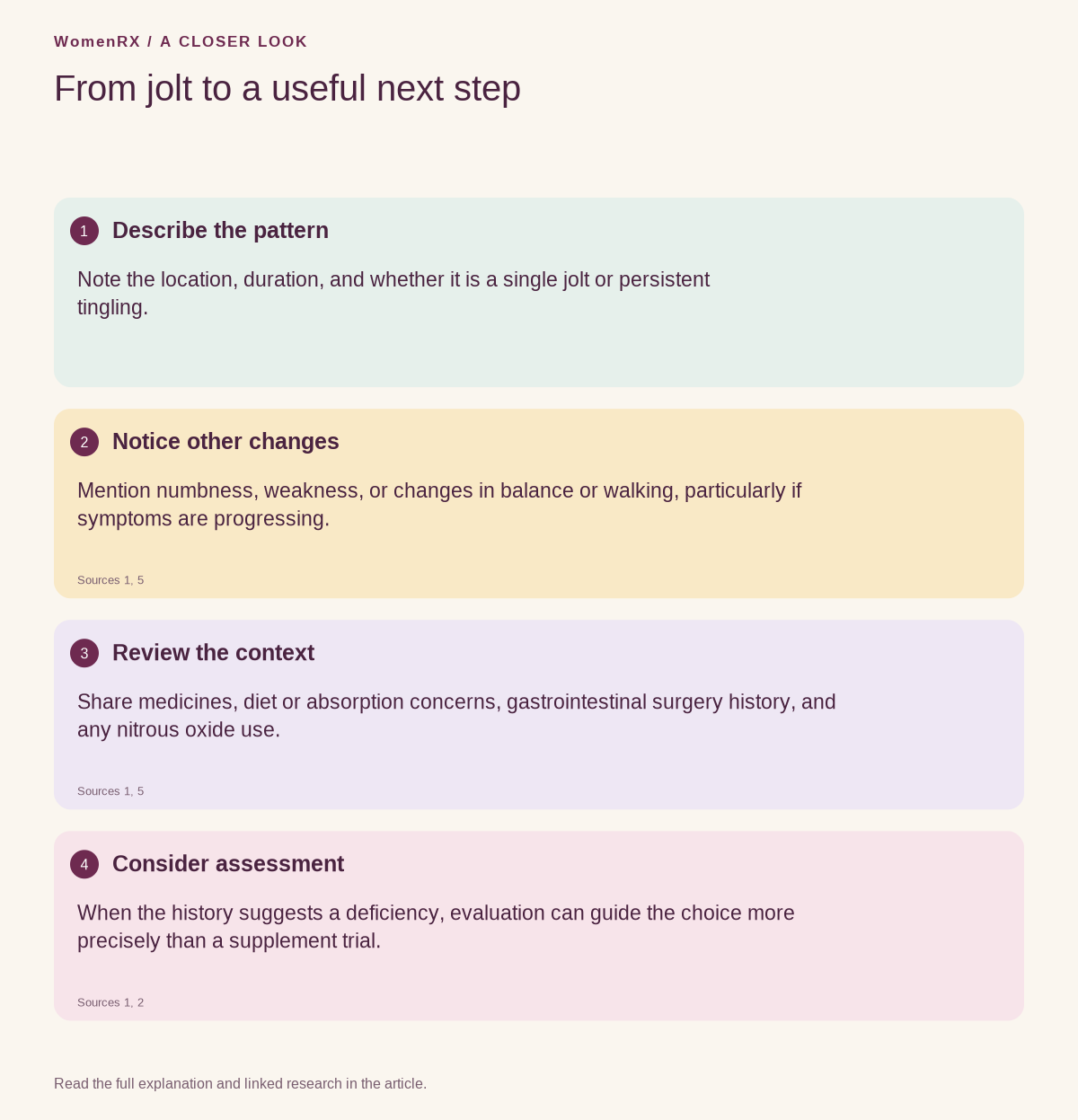
From jolt to a useful next step
Describe the pattern: Note the location, duration, and whether it is a single jolt or persistent tingling.
Notice other changes: Mention numbness, weakness, or changes in balance or walking, particularly if symptoms are progressing.15
Review the context: Share medicines, diet or absorption concerns, gastrointestinal surgery history, and any nitrous oxide use.15
Consider assessment: When the history suggests a deficiency, evaluation can guide the choice more precisely than a supplement trial.12
Read the figure as text
The same sequence covered in the article helps separate a symptom description from a reason to investigate a deficiency.- Describe the pattern: Note the location, duration, and whether it is a single jolt or persistent tingling.
- Notice other changes: Mention numbness, weakness, or changes in balance or walking, particularly if symptoms are progressing.15
- Review the context: Share medicines, diet or absorption concerns, gastrointestinal surgery history, and any nitrous oxide use.15
- Consider assessment: When the history suggests a deficiency, evaluation can guide the choice more precisely than a supplement trial.12
Sources you can check
- Vitamin B12 - Health Professional Fact SheetAccessed 2026-09-25Return to first citation
- Magnesium - Health Professional Fact SheetAccessed 2026-09-25Return to first citation
- Vitamin B6 - Health Professional Fact SheetAccessed 2026-09-25Return to first citation
- The 2022 hormone therapy position statement of The North American Menopause Society.“The 2022 Hormone Therapy Position Statement of The North American Menopause Society” Advisory Panel. · Menopause (New York, N.Y.) · 2022Return to first citation
- The Toxic Legacy of Recreational Nitrous Oxide Use: A Systematic Review and Meta-Analysis of Multisystem Complications From Functional Vitamin B12 Deficiency.Tikaria R, Kapp A, Shook S, Wang L. · Cureus · 2026Return to first citation