Electric-Shock Sensations Around Menopause: What to Check First
Tingling or brief zaps have been reported during the menopause transition, but the sensation alone can’t show that hormones are the cause.
Some menopause symptom studies have recorded limb tingling or paresthesia, but they don’t establish that hormones cause electric-shock sensations. Notice where the feeling occurs, how long it lasts, what seems to bring it on, and whether you also have numbness or changes in balance or hand coordination. New difficulty with hand coordination or walking deserves prompt medical assessment. 2 3
A menopause connection is possible, not proven
Paresthesia is a broad word for unusual sensations such as tingling, prickling, or numbness. A large prospective study of women attending a menopause clinic in China included limb pain and paresthesia among the symptoms it tracked. That shows these sensations have been reported in a menopause-related setting. It doesn’t show that menopause caused them, and it didn’t specifically study brief electric-shock feelings. 3
That distinction matters: being in perimenopause or postmenopause can be relevant context, but it shouldn’t automatically explain a new sensation. Nerves, the spine, vitamin deficiencies, and other health factors may also need consideration. The pattern and accompanying symptoms give a clinician more useful information than the word “zaps” by itself.
Describe the pattern, not just the feeling
Before an appointment, jot down a few details when an episode happens. You don’t need to identify a cause or keep an elaborate diary. For example, you might write: “Brief zaps in two fingertips, several times today; no weakness; noticed after holding my neck turned.” That’s an example of the kind of description that may help, not a diagnostic pattern.
Include:
- Where it happens: one spot, one side, both hands or feet, or a larger area.
- What it feels like: tingling, burning, numbness, pins and needles, or a quick shock-like jolt.
- How it behaves: how long each episode lasts, how often it returns, and whether the area is changing.
- What else is happening: numbness that lingers, weakness, neck pain, trouble with balance, or difficulty with small hand movements.
- What has changed: new medicines or supplements, or a position or activity you noticed around the time it occurs. A connection in time is useful to report, but doesn’t prove a cause.
If symptoms are in an arm or hand, say whether you also have neck symptoms and whether the sensation travels or stays in one place. Neck pain, reduced hand dexterity, and gait or balance problems can be relevant to assessment of problems affecting the spinal cord in the neck. 2
A few checks can help separate possibilities
Vitamin B12 deficiency is one possible cause of numbness or tingling in the hands and feet. Those neurological symptoms can occur even without anemia, so the absence of anemia wouldn’t rule out a B12 problem. B12 status is usually assessed with a blood test; when a result is borderline, a clinician may use methylmalonic acid testing to help clarify it. 1
That doesn’t mean you should assume you’re deficient or start a supplement based on tingling alone. A sensation can’t identify your B12 level, and test interpretation depends on the result and clinical context. Mention your diet, relevant health history, and medicines; the NIH fact sheet notes that deficiency can also relate to difficulty absorbing B12 or prolonged use of certain medicines. 1
Neck or spinal-cord problems are another reason the associated pattern matters. In a review of degenerative cervical myelopathy, common features included reduced manual dexterity, gait instability, and neck pain. These symptoms don’t prove that you have a spinal condition, but they make it especially useful to describe changes in coordination or walking rather than reporting tingling alone. 2
What the remedy studies can, and can’t, tell you
Some small studies of perimenopausal women have reported changes in paresthesia scores as part of broader menopause symptom assessments. One randomized trial in China compared gua sha plus conventional treatment with conventional treatment alone; another studied health education with diet and exercise supervision. These findings don’t establish that either approach treats unexplained electric-shock sensations specifically, or that the sensations were caused by menopause. 4 5
So far, those studies aren’t a reason to reach for a supplement or a particular “natural remedy” for zaps. A more useful first move is to describe the pattern and consider whether an assessment, including a check for B12 deficiency or other causes, is appropriate.
When not to wait and see
Arrange prompt medical assessment if the sensations come with declining hand coordination or trouble walking or keeping your balance. These features can matter because spinal-cord conditions may involve dexterity and gait changes, and early diagnosis can help reduce neurological decline. 2
If the sensation is brief and isolated, record what happened and whether it returns. If it persists, spreads, or changes, include that progression when you seek advice. The goal isn’t to diagnose yourself; it’s to make sure the explanation isn’t chosen just because the symptom appeared around menopause.
What to describe about a zap
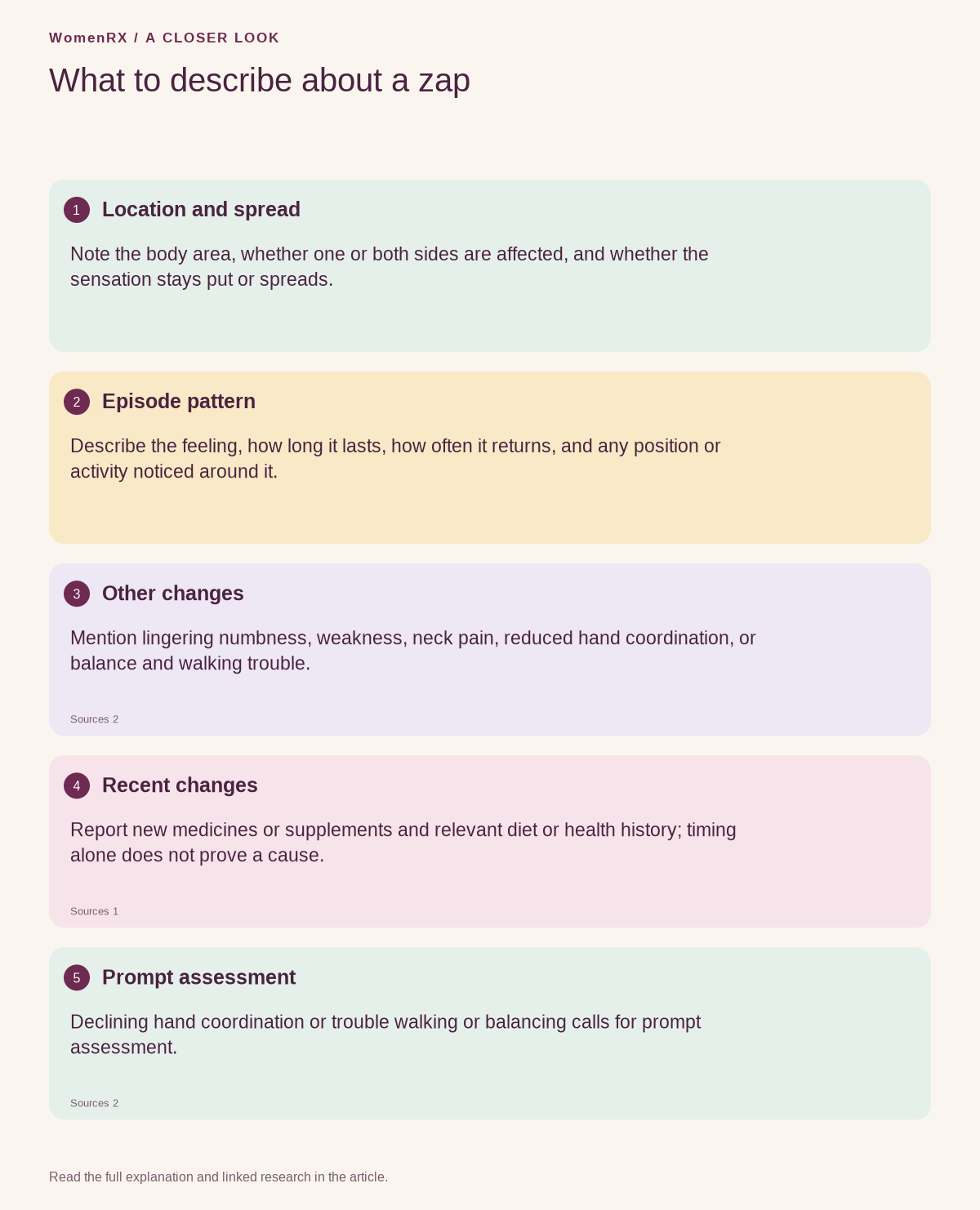
Location and spread: Note the body area, whether one or both sides are affected, and whether the sensation stays put or spreads.
Episode pattern: Describe the feeling, how long it lasts, how often it returns, and any position or activity noticed around it.
Other changes: Mention lingering numbness, weakness, neck pain, reduced hand coordination, or balance and walking trouble.2
Recent changes: Report new medicines or supplements and relevant diet or health history; timing alone does not prove a cause.1
Prompt assessment: Declining hand coordination or trouble walking or balancing calls for prompt assessment.2
Read the figure as text
Use these details to explain the sensation and any changes that could affect how it is assessed.- Location and spread: Note the body area, whether one or both sides are affected, and whether the sensation stays put or spreads.
- Episode pattern: Describe the feeling, how long it lasts, how often it returns, and any position or activity noticed around it.
- Other changes: Mention lingering numbness, weakness, neck pain, reduced hand coordination, or balance and walking trouble.2
- Recent changes: Report new medicines or supplements and relevant diet or health history; timing alone does not prove a cause.1
- Prompt assessment: Declining hand coordination or trouble walking or balancing calls for prompt assessment.2
More questions, answered
Can a B12 deficiency cause tingling without anemia?
Yes. Vitamin B12 deficiency can cause numbness or tingling in the hands and feet even when anemia isn’t present. A symptom alone can’t establish a deficiency; blood testing assesses B12 status, and methylmalonic acid may help clarify a borderline result. 1
Do studies show that a natural remedy stops menopause-related zaps?
Small studies have reported changes in paresthesia as part of broader menopause symptom measures, but they don’t establish a remedy for isolated electric-shock sensations or prove that those sensations are caused by menopause. 4 5
Sources you can check
- Vitamin B12 - Health Professional Fact SheetAccessed 2026-09-25Return to first citation
- Degenerative Cervical Myelopathy: A Concept Review and Clinical Approach.Gallagher DO, Taghlabi KM, Bondar K, Saifi C. · Clinical spine surgery · 2024Return to first citation
- Menopausal symptoms among Chinese peri- and postmenopausal women: a large prospective single-center cohort study.Zhang L, Ruan X, Cui Y, Gu M, Mueck AO. · Gynecological endocrinology : the official journal of the International Society of Gynecological Endocrinology · 2021Return to first citation
- Effect of Gua sha therapy on perimenopausal syndrome: a randomized controlled trial.Meng F, Duan PB, Zhu J, Lou QQ, Fang ZH, An HL, Liu LY, Hu Y, Hu Q. · Menopause (New York, N.Y.) · 2017Return to first citation
- Effect of health education combining diet and exercise supervision in Chinese women with perimenopausal symptoms: a randomized controlled trial.Xi S, Mao L, Chen X, Bai W. · Climacteric : the journal of the International Menopause Society · 2017Return to first citation