Perimenopause and Electric-Shock Sensations: What the Evidence Says
Some menopause studies record tingling or altered sensation, but they don’t establish brief electric shocks as a menopause symptom or explain what’s causing yours.
Shock-like sensations are a description, not a diagnosis. Studies of Chinese women in the menopause transition have recorded broader symptoms such as paresthesia or limb pain, but they don’t show that electric-shock sensations are caused by perimenopause. Nerve problems can have several causes. Note where and when the zaps happen, what else you feel, and whether they’re changing; seek prompt assessment for rapidly worsening symptoms or weakness. 1 2 3
What the menopause research can and can’t tell you
A brief zap, tingle, prickling feeling, or patch of reduced sensation can be described as an altered sensation, or paresthesia. That word describes what you feel; it doesn’t identify the cause. 3
Menopause research has recorded paresthesia and limb pain among other symptoms. One large community study in China assessed more than 51,000 women across menopause stages; another study followed 4,063 women attending a menopause clinic and included limb pain or paresthesia in its symptom questionnaire. These findings show that altered sensations have been reported in women during this life stage. They don’t establish that the menopause transition causes electric-shock sensations. The studies grouped symptoms broadly rather than investigating brief zaps specifically. 1 2
So if this is happening to you, it’s reasonable to mention your cycle and other menopause-related changes, but don’t assume they explain the sensation.
Sensations can come from different parts of the nerve pathway
Tingling or reduced sensation can arise from a problem anywhere along the sensory pathway, and the cause isn’t always obvious from the feeling alone. A review of sensations in the hands and feet describes nerve entrapment, such as carpal tunnel syndrome, and peripheral neuropathy as possible causes; diabetes and vitamin B12 deficiency are among the conditions associated with peripheral neuropathy. These are examples, not a diagnosis of what’s happening to you. 3
The pattern can help a clinician decide what to assess. Sensations limited to particular fingers may lead to different questions than symptoms affecting both feet, spreading up a limb, or occurring in several areas. Whether there is weakness alongside the sensation matters too. You can’t use a pattern at home to rule out a neurological cause, but describing it clearly is useful. 3
Make the sensation easier to describe
For a few episodes, jot down what you notice. It doesn’t need to become a detailed diary or a test you have to pass.
- Where is it? Name the body part and side. Does it stay in one spot or move?
- When does it happen? Note when it began, how long an episode lasts, and whether it keeps returning.
- What seems connected? Record what you were doing just before it started and whether anything seems to ease it. A pattern is useful to report, even if you’re unsure it’s a trigger.
- What else is happening? Note numbness, pain, weakness, or other new symptoms. Include any recent medication or supplement changes as part of the timeline; that alone doesn’t show they’re the cause.
- Is it changing? Say whether it is becoming more frequent, spreading, or affecting movement or everyday tasks.
This information can help distinguish an occasional, stable sensation from one that is spreading or changing. It won’t identify the cause by itself.
When to seek medical assessment
Arrange prompt medical assessment if the sensation is rapidly worsening, severe, affecting several areas, or accompanied by weakness. A review of hand-and-foot sensory symptoms flags acute onset, rapid progression, severe or asymmetric symptoms, symptoms affecting areas closer to the body, multiple affected areas, and prominent weakness as features that need particular attention. 3
If the sensation is recurring or concerning but isn’t changing quickly, bring it up at a regular medical visit rather than writing it off as menopause. Share the location, timing, associated symptoms, and any medication changes. The goal isn’t to diagnose yourself; it’s to give a clear account that helps guide assessment.
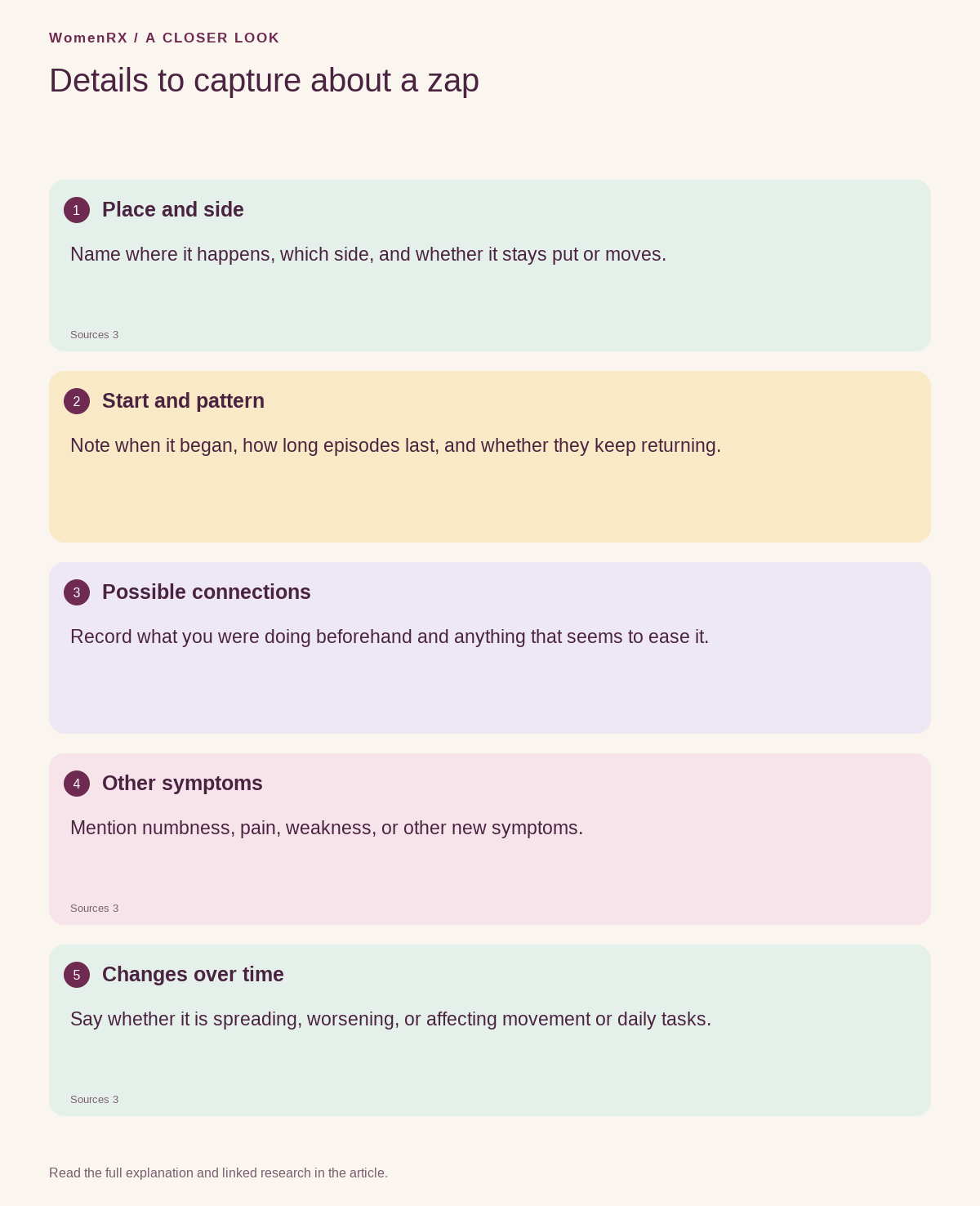
Details to capture about a zap
Place and side: Name where it happens, which side, and whether it stays put or moves.3
Start and pattern: Note when it began, how long episodes last, and whether they keep returning.
Possible connections: Record what you were doing beforehand and anything that seems to ease it.
Other symptoms: Mention numbness, pain, weakness, or other new symptoms.3
Changes over time: Say whether it is spreading, worsening, or affecting movement or daily tasks.3
Read the figure as text
These prompts can help you describe the sensation clearly. They are not a diagnostic checklist.- Place and side: Name where it happens, which side, and whether it stays put or moves.3
- Start and pattern: Note when it began, how long episodes last, and whether they keep returning.
- Possible connections: Record what you were doing beforehand and anything that seems to ease it.
- Other symptoms: Mention numbness, pain, weakness, or other new symptoms.3
- Changes over time: Say whether it is spreading, worsening, or affecting movement or daily tasks.3
Sources you can check
- A survey of menopausal symptoms in Chinese community women based on the STRAW+10 staging system.Wang J, Yang Y, Yang Y, Sun Z, Chen Y, Zheng R. · Menopause (New York, N.Y.) · 2025Return to first citation
- Menopausal symptoms among Chinese peri- and postmenopausal women: a large prospective single-center cohort study.Zhang L, Ruan X, Cui Y, Gu M, Mueck AO. · Gynecological endocrinology : the official journal of the International Society of Gynecological Endocrinology · 2021Return to first citation
- Acroparesthesias: An Overview.Slouma M, Ben Dhia S, Cheour E, Gharsallah I. · Current rheumatology reviews · 2024Return to first citation