Electric-Shock Sensations in Perimenopause: What Needs Assessment?
A menopause-clinic study recorded limb pain or paresthesia, but it did not specifically examine electric-shock sensations or establish a hormonal cause.
A menopause-clinic study recorded limb pain or paresthesia, but it did not specifically examine electric-shock sensations or establish a hormonal cause. Notice where the feeling occurs, how long it lasts, and whether it comes with numbness, weakness, pain, or other changes. Sudden face, arm, or leg weakness or numbness, especially on one side, or sudden trouble speaking needs emergency attention. 3 4
Is it a menopause symptom?
Unusual sensations can happen during the menopausal years, but that doesn’t tell you why they’re happening. In a two-year study of 4,063 women attending a menopause clinic in China, researchers recorded limb pain or paresthesia, a medical term that includes tingling and altered sensation. It was one of several symptom categories, and the study did not establish that menopause caused it or examine electric-shock sensations specifically. The clinic-based findings also may not represent all women. 3
So, it’s reasonable to notice whether the feeling changes alongside other menopause symptoms, but don’t assume that timing proves a hormonal cause. A shock-like sensation can have more than one explanation. Sensory nerves carry messages about touch, pain, and temperature; nerve problems can involve tingling, numbness, burning or sharp pain, and sometimes weakness. Peripheral neuropathy is one possible nerve-related explanation, and diabetes, some medicines, and alcohol are among its potential causes. These examples don’t identify what’s causing your sensation; that takes an assessment of the whole pattern and your health history. 1 2
What details help make sense of it?
The sensation’s pattern is more useful than the label “electric shock.” If it happens again, jot down:
- Where: one finger, a hand, a foot, one side of your body, or several areas?
- When and how long: Did it begin suddenly or gradually? How long did each spell last, and has it happened again?
- What it feels like: A quick zap, pins and needles, burning, pain, or numbness?
- What comes with it: Any weakness, trouble with balance, changes in vision, confusion, or trouble speaking?
- What was going on: What you were doing, whether a position or movement seemed to bring it on, and any recent medicine changes.
This is a practical record, not a diagnostic test. Sensory symptoms can vary depending on which nerves are involved, and nerve symptoms may develop quickly or slowly. For example, tingling limited to the fingers is a different pattern from numbness with weakness or symptoms affecting one side of the face and body. The difference helps describe what’s happening; it doesn’t prove a cause. 2
When to seek help
Call 911 for sudden stroke-like symptoms. These include sudden numbness or weakness of the face, arm, or leg, especially on one side; sudden confusion or trouble speaking; sudden trouble seeing; sudden trouble walking, dizziness, or loss of balance; or a sudden severe headache with no known cause. Don’t wait to see if these symptoms pass. 4
Arrange an assessment for possible nerve symptoms. Pain, tingling, or reduced sensation in the feet, as well as weakness or loss of balance, are reasons to contact your primary care clinician. NHS guidance recommends assessment for these early signs of peripheral neuropathy. That doesn’t mean you have neuropathy, but it does mean the symptoms shouldn’t be automatically attributed to menopause. 1
If it was a brief, isolated sensation and you feel well now, record what happened and whether it recurs. That observation can help you describe the pattern if you need an assessment. But a sudden symptom that matches the stroke signs above belongs in the emergency category, even if you suspect it might be menopause-related.
Where the sensation leads next
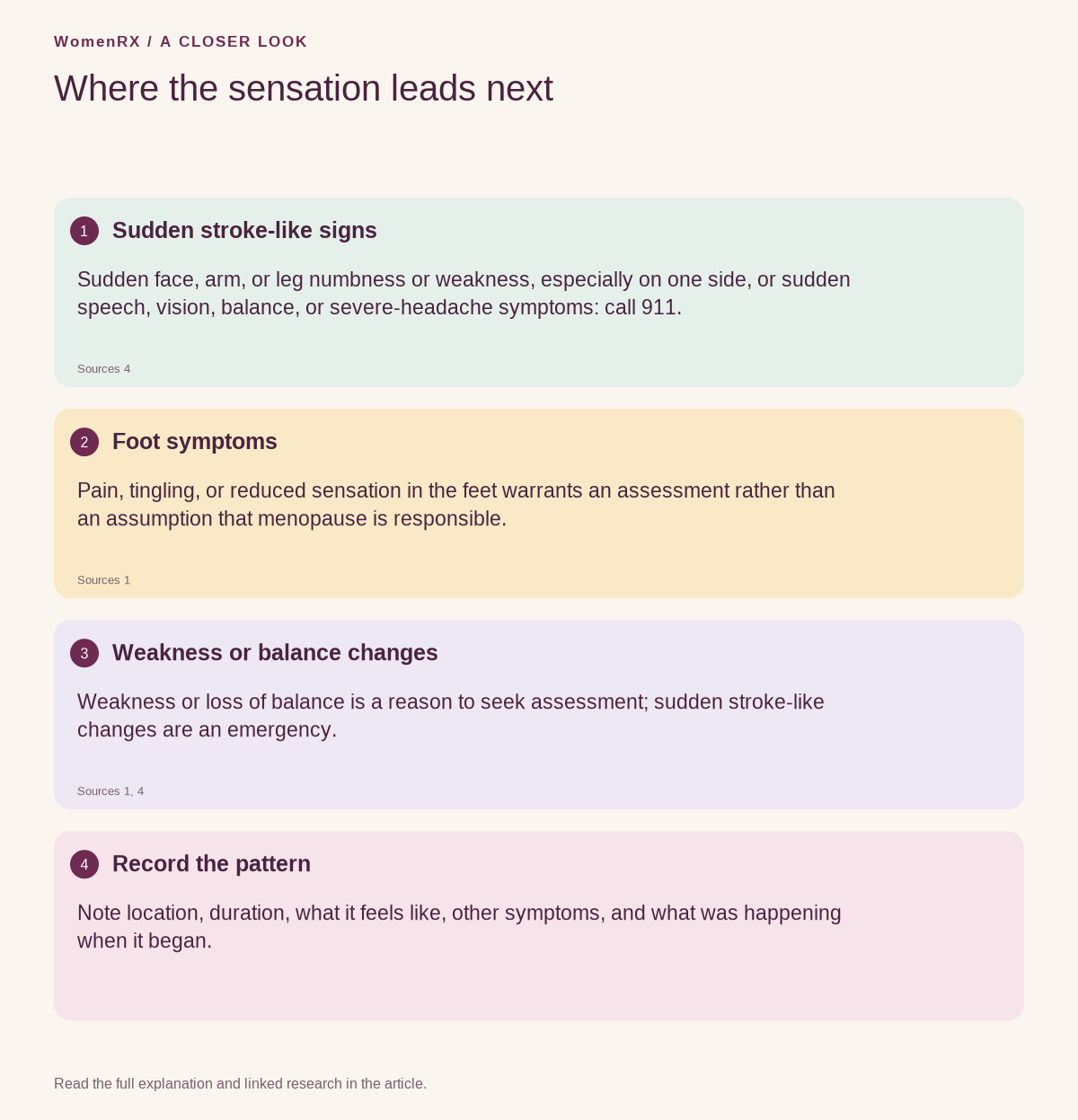
Sudden stroke-like signs: Sudden face, arm, or leg numbness or weakness, especially on one side, or sudden speech, vision, balance, or severe-headache symptoms: call 911.4
Foot symptoms: Pain, tingling, or reduced sensation in the feet warrants an assessment rather than an assumption that menopause is responsible.1
Weakness or balance changes: Weakness or loss of balance is a reason to seek assessment; sudden stroke-like changes are an emergency.14
Record the pattern: Note location, duration, what it feels like, other symptoms, and what was happening when it began.
Read the figure as text
Use the pattern to choose a next step, not to diagnose the cause.- Sudden stroke-like signs: Sudden face, arm, or leg numbness or weakness, especially on one side, or sudden speech, vision, balance, or severe-headache symptoms: call 911.4
- Foot symptoms: Pain, tingling, or reduced sensation in the feet warrants an assessment rather than an assumption that menopause is responsible.1
- Weakness or balance changes: Weakness or loss of balance is a reason to seek assessment; sudden stroke-like changes are an emergency.14
- Record the pattern: Note location, duration, what it feels like, other symptoms, and what was happening when it began.
Sources you can check
- Peripheral neuropathy - NHSAccessed 2026-09-25Return to first citation
- Peripheral neuropathy - Symptoms - NHSAccessed 2026-09-25Return to first citation
- Menopausal symptoms among Chinese peri- and postmenopausal women: a large prospective single-center cohort study.Zhang L, Ruan X, Cui Y, Gu M, Mueck AO. · Gynecological endocrinology : the official journal of the International Society of Gynecological Endocrinology · 2021Return to first citation
- Sociodemographic and Geographic Variation in Awareness of Stroke Signs and Symptoms Among Adults - United States, 2017.Jackson SL, Legvold B, Vahratian A, Blackwell DL, Fang J, Gillespie C, Hayes D, Loustalot F. · MMWR. Morbidity and mortality weekly report · 2020Return to first citation