Electric-Shock Sensations in Perimenopause: What’s Known
Menopause studies include reports of paresthesia, but they don’t establish what causes a shock-like feeling.
Some menopause studies record paresthesia, a broad term for altered sensations such as tingling. A large survey reported it among symptoms with high severity in one menopause-transition stage, and a small trial measured it on a symptom scale. Those findings don’t explain electric-shock sensations specifically or prove that hormones cause them. Note the sensation’s location, timing, duration, and pattern to describe it clearly.
A brief jolt, tingle, or buzzing feeling can be hard to describe, especially if it happens alongside changes in your periods or other menopause symptoms. Menopause research does include paresthesia, a broad term for altered sensation. But the reported findings don’t tell us whether electric-shock sensations have a distinct relationship to perimenopause or what causes a particular person’s symptoms.
What the studies report
A large survey of women in Chinese communities used the STRAW+10 system to group participants by menopause stage. Paresthesia was among the symptoms reported as most severe in stage -2. That tells us it appeared in the survey’s symptom findings; it doesn’t show that menopause caused it or explain what participants meant by the sensation. 2
A randomized study enrolled 60 Chinese women with perimenopausal symptoms. It measured paresthesia as part of a broader symptom index. After 12 weeks, the group receiving health education with diet and exercise supervision had lower paresthesia scores than the control group. Because the program combined several elements and reported a questionnaire score, it can’t tell us which element mattered or whether it would help electric-shock sensations specifically. 1
Taken together, these studies document paresthesia in menopause-related research. They don’t establish a direct hormonal cause for shock-like feelings. “Paresthesia” is also broader than one person’s description of a jolt, so it’s useful to explain your own experience rather than rely on the label alone.
The sensation can have more than one context
Paresthesia isn’t a menopause-specific description. For example, a cross-sectional study of 643 postmenopausal women in Colombia examined symptoms related to thyroid function and menopause timing; it reported paresthesia among the manifestations in women with subclinical hypothyroidism. That study doesn’t show that thyroid changes explain a particular sensation, and its participants weren’t perimenopausal women seeking an explanation for electric shocks. It’s a reminder that a symptom word alone doesn’t identify its cause. 3
Make the description useful
You don’t need to figure out the cause before discussing the sensation. A few concrete details can make your account clearer:
- Where it happens: Name the body area and whether it affects one side, both sides, or moves.
- What it feels like: Describe it in your own words, such as a quick jolt, pins and needles, burning, or numbness.
- When and how long: Note when it occurs, how long it lasts, and whether it comes and goes or stays.
- What changes it: Record what you were doing when it started and whether anything seems to bring it on or ease it.
- What comes with it: Note other symptoms at the same time, and whether the sensation is becoming more frequent, lasting longer, or changing.
If it persists, worsens, or keeps affecting the same area, include that clearly when you discuss it with a clinician. The point of keeping notes is not to prove the sensation is hormonal. It’s to make sure the pattern itself is part of the conversation.
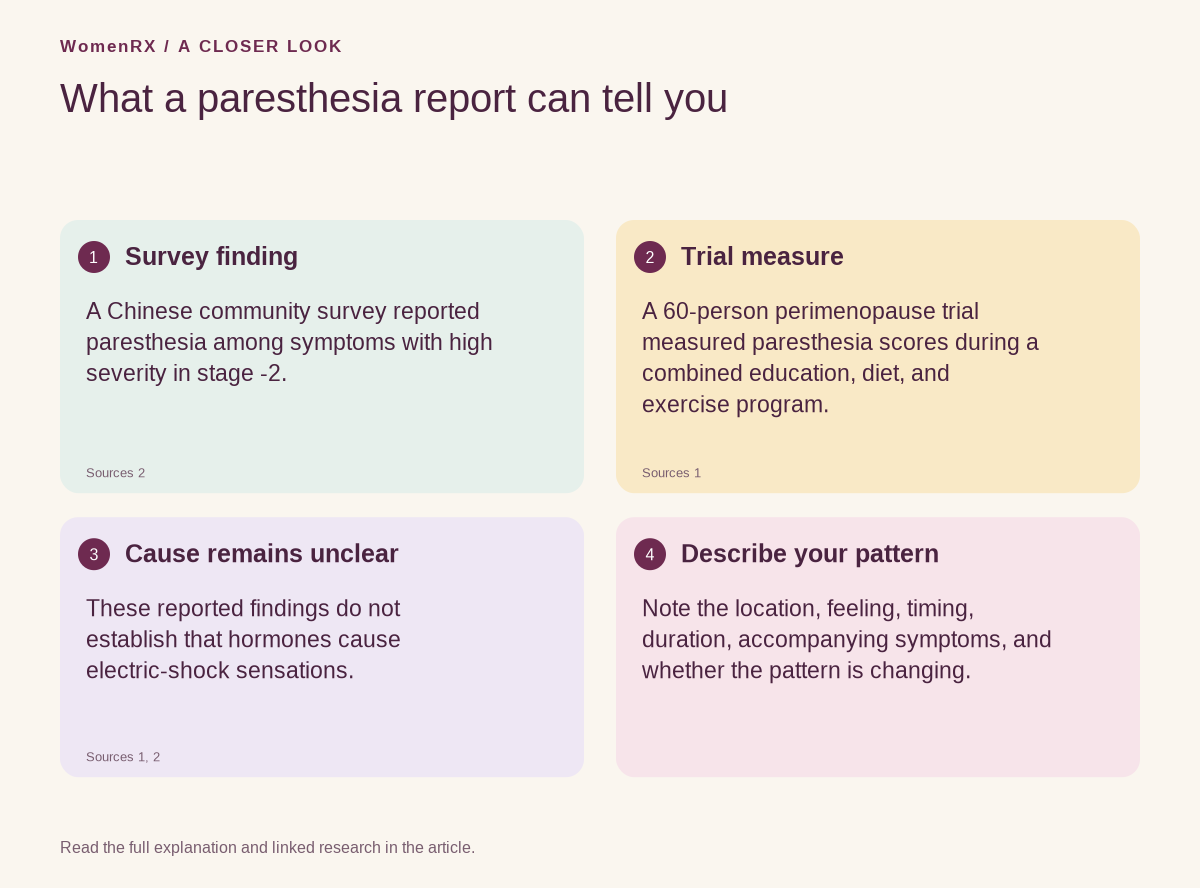
What a paresthesia report can tell you
Survey finding: A Chinese community survey reported paresthesia among symptoms with high severity in stage -2.2
Trial measure: A 60-person perimenopause trial measured paresthesia scores during a combined education, diet, and exercise program.1
Cause remains unclear: These reported findings do not establish that hormones cause electric-shock sensations.12
Describe your pattern: Note the location, feeling, timing, duration, accompanying symptoms, and whether the pattern is changing.
Read the figure as text
This evidence map separates what menopause studies report from what those reports can establish, then highlights details that help describe an individual sensation.- Survey finding: A Chinese community survey reported paresthesia among symptoms with high severity in stage -2.2
- Trial measure: A 60-person perimenopause trial measured paresthesia scores during a combined education, diet, and exercise program.1
- Cause remains unclear: These reported findings do not establish that hormones cause electric-shock sensations.12
- Describe your pattern: Note the location, feeling, timing, duration, accompanying symptoms, and whether the pattern is changing.
Sources you can check
- Effect of health education combining diet and exercise supervision in Chinese women with perimenopausal symptoms: a randomized controlled trial.Xi S, Mao L, Chen X, Bai W. · Climacteric : the journal of the International Menopause Society · 2017Return to first citation
- A survey of menopausal symptoms in Chinese community women based on the STRAW+10 staging system.Wang J, Yang Y, Yang Y, Sun Z, Chen Y, Zheng R. · Menopause (New York, N.Y.) · 2025Return to first citation
- Possible association between subclinical hypothyroidism and age at menopause in Colombian women.Monterrosa-Castro Á, Monterrosa-Blanco A, Sánchez-Zarza S. · Gynecological endocrinology : the official journal of the International Society of Gynecological Endocrinology · 2024Return to first citation