Electric-Shock Feelings and Perimenopause: What We Know
Altered sensations have been reported around menopause, but the cited survey cannot establish a cause or timetable for electric-shock feelings.
The cited menopause survey recorded paresthesia, a broad altered-sensation category, but did not identify electric-shock feelings or track how long they lasted. It does not establish electric shocks as a perimenopause symptom, and their timing alone cannot show that hormone changes caused them. Where you feel it, whether it keeps returning, and whether numbness, weakness, or balance changes come with it matter more than trying to predict when it will stop. 64
What the cited menopause survey records
If you feel a sudden jolt or zap, it’s reasonable to wonder whether perimenopause is involved, especially if other changes are happening at the same time. The cited menopause survey cannot establish a cause or duration for electric-shock sensations in perimenopause.
A large survey of women aged 35 to 60 in Chinese communities included paresthesia, a broad category of altered sensation, among the symptoms it assessed across menopause stages. It also assessed formication separately. The survey found that the most severe ratings for both occurred at stage -2. But it didn’t isolate electric-shock feelings, follow individual episodes to see how long they lasted, or show that menopause caused them. It can tell us that women reported altered sensations, not whether a particular zap is hormonal. 6
That distinction matters when you’re deciding what to do next. A symptom arriving during perimenopause may be related, coincidental, or part of another condition that deserves attention. The survey offers no countdown for when these jolts might end.
The pattern tells you more than the label
Try to describe what electric shock means in your case. Is it a split-second jolt, repeated bursts, or a sensation that stays? Is it always in the same fingers, or does it affect both feet? Does the area also feel numb, less able to sense temperature, or weak? These details help distinguish one pattern of altered sensation from another. They aren’t a way to diagnose yourself. 4
For example, peripheral neuropathy affects nerves outside the brain and spinal cord and can cause tingling or numbness in the hands or feet. Its causes include diabetes, certain medicines, and excess alcohol use. A problem involving one peripheral nerve can instead produce altered sensation or weakness in a more limited area, such as the fingers. These possibilities don’t mean you have nerve damage. They explain why location and accompanying changes are worth mentioning rather than assuming every new sensation is part of menopause. 34
A useful set of details to bring to an appointment:
- Place: Point to the exact area. Is it one spot, one side, or both hands or feet?
- Pattern: Say when it started, whether it comes and goes, and whether it’s changing.
- What comes with it: Note numbness, trouble feeling temperature, weakness, or changes in balance or coordination.
- Relevant context: Mention diabetes if you have it and any medicines you take, since these can matter when looking into nerve symptoms. 34
This isn’t a diagnostic checklist. It’s a clearer description than “I think it’s menopause,” and it gives someone assessing the symptom more to work with.
When not to wait for it to pass
Arrange a medical assessment for new or recurring altered sensations, particularly if you’re also noticing numbness or weakness. Finding the cause of peripheral nerve symptoms early can improve the chance of limiting damage in some cases. If balance or coordination problems come on suddenly, seek urgent medical attention rather than waiting for a routine visit: sudden neurological changes can have causes that need prompt evaluation. 32
You don’t need to prove that a sensation is unrelated to menopause before bringing it up. Perimenopause is useful context, but the pattern of the symptom and what accompanies it are the better starting points.
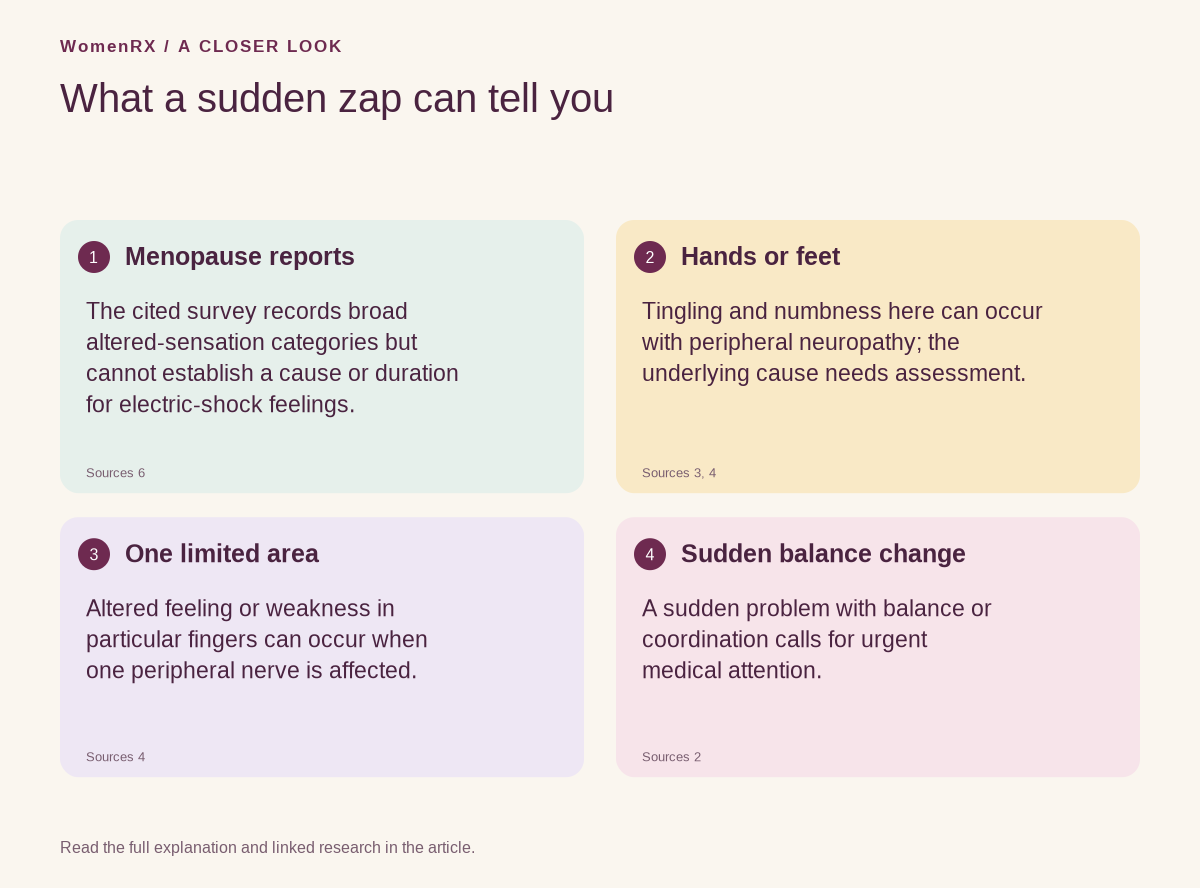
What a sudden zap can tell you
Menopause reports: The cited survey records broad altered-sensation categories but cannot establish a cause or duration for electric-shock feelings.6
Hands or feet: Tingling and numbness here can occur with peripheral neuropathy; the underlying cause needs assessment.34
One limited area: Altered feeling or weakness in particular fingers can occur when one peripheral nerve is affected.4
Sudden balance change: A sudden problem with balance or coordination calls for urgent medical attention.2
Read the figure as text
The distinction between a reported symptom, a possible alternative, and a sign that changes urgency.- Menopause reports: The cited survey records broad altered-sensation categories but cannot establish a cause or duration for electric-shock feelings.6
- Hands or feet: Tingling and numbness here can occur with peripheral neuropathy; the underlying cause needs assessment.34
- One limited area: Altered feeling or weakness in particular fingers can occur when one peripheral nerve is affected.4
- Sudden balance change: A sudden problem with balance or coordination calls for urgent medical attention.2
More questions, answered
Does an electric-shock feeling mean I have MS?
No single sensation establishes multiple sclerosis (MS). MS affects the brain and spinal cord, and its symptoms vary with the nerves affected; similar symptoms can also have many other causes. A clinician can assess the full pattern if you have recurring symptoms or other neurological changes. 12
Would a menopause supplement treat the zaps?
There’s no good basis here for treating an electric-shock feeling as a proven hormone-related symptom. In a review of soy-isoflavone studies in perimenopausal women, researchers found no significant treatment effect for the broader category of paresthesia. That result doesn’t test treatment of electric-shock sensations specifically. 5
Sources you can check
- Multiple Sclerosis | MS | MedlinePlusAccessed 2026-09-25Return to first citation
- Multiple sclerosis - NHSAccessed 2026-09-25Return to first citation
- Peripheral neuropathy - NHSAccessed 2026-09-25Return to first citation
- Peripheral neuropathy - Symptoms - NHSAccessed 2026-09-25Return to first citation
- Effects of soy isoflavones on menopausal symptoms in perimenopausal women: a systematic review and meta-analysis.Luan H, Liu Q, Guo Y, Fan H, A S, Lin J. · PeerJ · 2025Return to first citation
- A survey of menopausal symptoms in Chinese community women based on the STRAW+10 staging system.Wang J, Yang Y, Yang Y, Sun Z, Chen Y, Zheng R. · Menopause (New York, N.Y.) · 2025Return to first citation