Electric-Shock Sensations Around Menopause: What to Do
Menopause timing alone can’t explain brief zaps or tingling; the pattern and any new weakness or speech changes help guide what to do next.
If these sensations come with sudden numbness or weakness on one side, facial drooping, or trouble speaking or understanding, seek emergency care now rather than waiting to see if they pass. For recurring tingling or altered sensation, especially with weakness or balance problems, arrange a medical review. Note where it happens, how long it lasts, possible triggers, and medicine changes. 145
Start with the pattern, not the menopause label
If you first notice a brief jolt or tingling sensation around the menopause transition, its timing doesn’t identify its cause. Nerve symptoms can have different patterns: some affect a particular area, while peripheral neuropathy can involve the hands or feet and may include tingling, reduced sensation, weakness, or balance problems. Some medicines can also contribute to peripheral nerve symptoms. 12
The details help make the next step clearer. As a practical example, a sensation confined to a few fingers is different from a new change affecting one whole side of the body. That pattern alone can’t diagnose the cause, but it’s useful information to share when you seek care.
Use a short, useful symptom record
For each episode, jot down:
- Where: one spot, particular fingers or toes, a whole limb, or one side of your body.
- When and how long: when it began, whether it started suddenly, and how long the sensation lasted.
- What was happening: for example, a particular hand or body position, repetitive activity, or another noticeable trigger. Record what you observe rather than assuming the trigger explains it.
- What came with it: any numbness, weakness, trouble with balance or coordination, facial changes, or speech difficulty.
- Medicine changes: list medicines you take and any recent start, stop, or dose change. Some medicines are among the possible causes of peripheral neuropathy. 1
This isn’t a diagnostic score or a reason to wait for more episodes. It’s a compact way to describe the pattern, including whether it’s changing or spreading.
Know when not to wait
Seek emergency care now for sudden numbness or weakness on one side, facial drooping, or difficulty speaking or understanding speech. These are recognized stroke warning symptoms. Don’t wait to see if they resolve. Research on responses to stroke symptoms supports a timely emergency response, though recognizing a symptom doesn’t always mean people seek help promptly. 45
Arrange a medical review for recurring tingling or loss of sensation, or if symptoms come with weakness or balance problems. Peripheral neuropathy is one possible explanation for such symptoms, but it has multiple possible causes, including diabetes and certain medicines. Identifying the cause matters because management depends on it. 12
If a particular medicine may be involved, bring its name and the timing of any change to the review. Some medicine-related neuropathy may improve if the medicine is stopped. 3
What the menopause connection can, and can’t, tell you
Noticing zaps during the menopause transition is useful context, but it doesn’t confirm that menopause caused them or that menopause treatment will address them. Focus first on whether symptoms are sudden or recurring, where they occur, whether sensation or strength has changed, and whether there are warning signs such as one-sided weakness or speech trouble.
The practical distinction is simple: sudden stroke-like symptoms call for emergency care; recurring sensory changes deserve medical review; and a symptom record can help explain the pattern without presuming its cause.
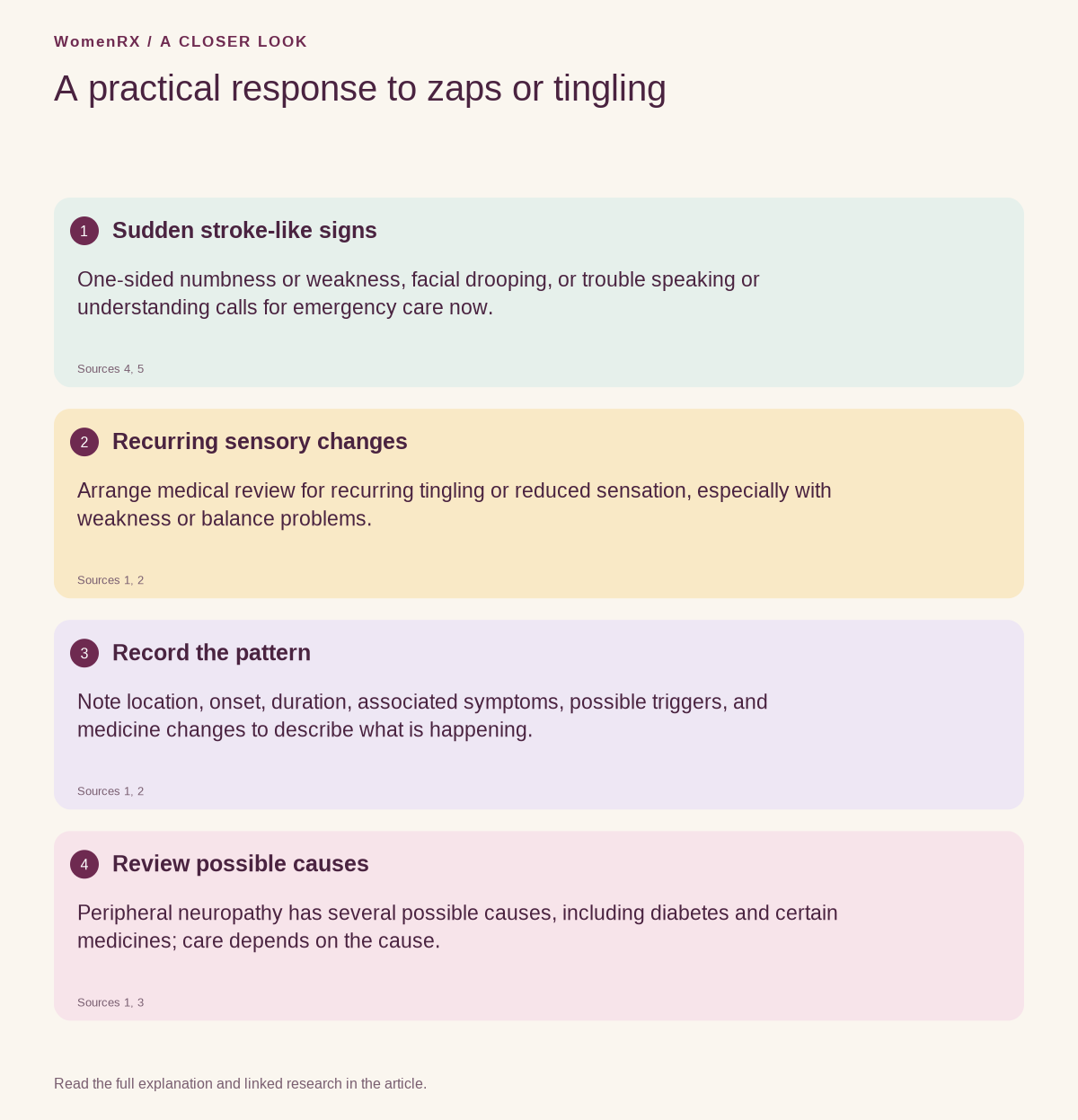
A practical response to zaps or tingling
Sudden stroke-like signs: One-sided numbness or weakness, facial drooping, or trouble speaking or understanding calls for emergency care now.45
Recurring sensory changes: Arrange medical review for recurring tingling or reduced sensation, especially with weakness or balance problems.12
Record the pattern: Note location, onset, duration, associated symptoms, possible triggers, and medicine changes to describe what is happening.12
Review possible causes: Peripheral neuropathy has several possible causes, including diabetes and certain medicines; care depends on the cause.13
Read the figure as text
Use the associated symptoms to choose a next step; the pattern record helps describe recurring sensations but does not diagnose them.- Sudden stroke-like signs: One-sided numbness or weakness, facial drooping, or trouble speaking or understanding calls for emergency care now.45
- Recurring sensory changes: Arrange medical review for recurring tingling or reduced sensation, especially with weakness or balance problems.12
- Record the pattern: Note location, onset, duration, associated symptoms, possible triggers, and medicine changes to describe what is happening.12
- Review possible causes: Peripheral neuropathy has several possible causes, including diabetes and certain medicines; care depends on the cause.13
More questions, answered
Does tingling in a particular area always mean neuropathy?
No. Nerve symptoms can vary by the nerve involved, and tingling has more than one possible cause. A pattern can be useful to describe, but it can’t confirm a diagnosis by itself. 12
Sources you can check
- Peripheral neuropathy - NHSAccessed 2026-09-25Return to first citation
- Peripheral neuropathy - Symptoms - NHSAccessed 2026-09-25Return to first citation
- Peripheral neuropathy - Treatment - NHSAccessed 2026-09-25Return to first citation
- Global Awareness and Response to Early Symptoms of Acute Stroke: A Systematic Literature Review.Vatsalis T, Papadopoulos D, Georgousopoulou V, Bostantzis P, Rudolf J. · Cureus · 2025Return to first citation
- Response to symptoms of stroke in the UK: a systematic review.Lecouturier J, Murtagh MJ, Thomson RG, Ford GA, White M, Eccles M, Rodgers H. · BMC health services research · 2010Return to first citation