Electric-Shock Sensations and Menopause: What’s Known
Paresthesia is reported in some menopause studies, but those reports don’t show that changing hormones cause brief zaps.
Brief zaps, tingling, or pins-and-needles sensations have been recorded in studies of perimenopause and menopause, often under the broad term paresthesia. That’s evidence the sensations are reported, not proof that estrogen changes cause them. The studies don’t define electric-shock episodes closely or establish a hormone-based explanation; other health causes, including thyroid conditions, shouldn’t be ruled out by timing alone. 2 4 5
A reported symptom isn’t proof of a hormone cause
A quick jolt, fizz, or tingling feeling can seem connected to perimenopause if it begins around the same time as changes in periods, sleep, or hot flashes. Researchers may group sensations like these under paresthesia, a broad term for altered sensations such as tingling or pins and needles. But recording paresthesia in a menopause symptom study doesn’t show that menopause hormones caused it.
A large community survey in China assessed symptoms across reproductive-aging stages. Among women classified in one perimenopausal stage, 0.50% were reported to have severe paresthesia. That figure is about severe symptoms in that particular survey, not the prevalence of all brief electric-shock sensations among women, and it doesn’t identify their cause. 4
The distinction matters because a symptom questionnaire usually captures whether someone reports a sensation or how severe it feels. It doesn’t necessarily establish what the sensation was like, when it happened, or what triggered it. These studies don’t define brief zaps as a distinct outcome.
What the treatment studies can tell us
One randomized trial enrolled 80 women with perimenopausal symptoms; 75 completed it. After eight weeks, the group receiving gua sha alongside conventional treatment had a greater reduction in paresthesia scores than the group receiving conventional treatment alone. The study also found no significant difference between groups in measured estrogen, follicle-stimulating hormone, or luteinizing hormone. 2
That result doesn’t prove hormones are unrelated to paresthesia. The trial wasn’t designed to test whether hormone changes bring on electric-shock sensations, and a difference in symptom scores doesn’t establish the reason for that change. It also doesn’t show that gua sha treats the cause of zaps.
Another randomized study of women with perimenopausal symptoms reported lower paresthesia scores after a combined program of health education, diet supervision, and exercise supervision. Because the program combined several elements and measured symptoms, it can’t isolate a hormone explanation either. 3
Taken together, these studies show that paresthesia can appear in menopause research and that symptom scores can change during interventions. They don’t show that falling estrogen causes the sensations. The missing piece is research that clearly defines these episodes and tests whether changes in hormones track with them over time.
Keep other explanations in view
The menopause symptom studies don’t determine whether a participant’s sensations came from menopause or another health issue. A small cross-sectional study offers one reason not to assume the cause: among the postmenopausal women it classified as having subclinical hypothyroidism, paresthesia was reported as a common hypothyroidism-related manifestation. Because this was an observational study in a specific group, it doesn’t prove thyroid changes caused any one person’s symptoms or show how common paresthesia is in the general population. 5
If sensations keep returning or persist, it’s reasonable to have them assessed rather than deciding they’re hormonal based on timing. Describe what you feel and where, how often it happens, and whether it’s changing. That information can help guide consideration of causes beyond menopause; it can’t diagnose the cause on its own.
What this means for hormone therapy
The North American Menopause Society’s 2022 position statement describes hormone therapy as an effective treatment for vasomotor symptoms and genitourinary syndrome of menopause. The statement summary doesn’t establish electric-shock sensations as a hormone-caused symptom or a treatment reason. A zap by itself therefore isn’t evidence that estrogen is low or that hormone therapy is the right response. 1
The clearest answer is modest: paresthesia has been reported in menopause research, but a cause-and-effect link between hormone changes and brief electric-shock sensations has not been demonstrated by these studies. That leaves room for menopause to be part of the picture without treating it as the explanation by default.
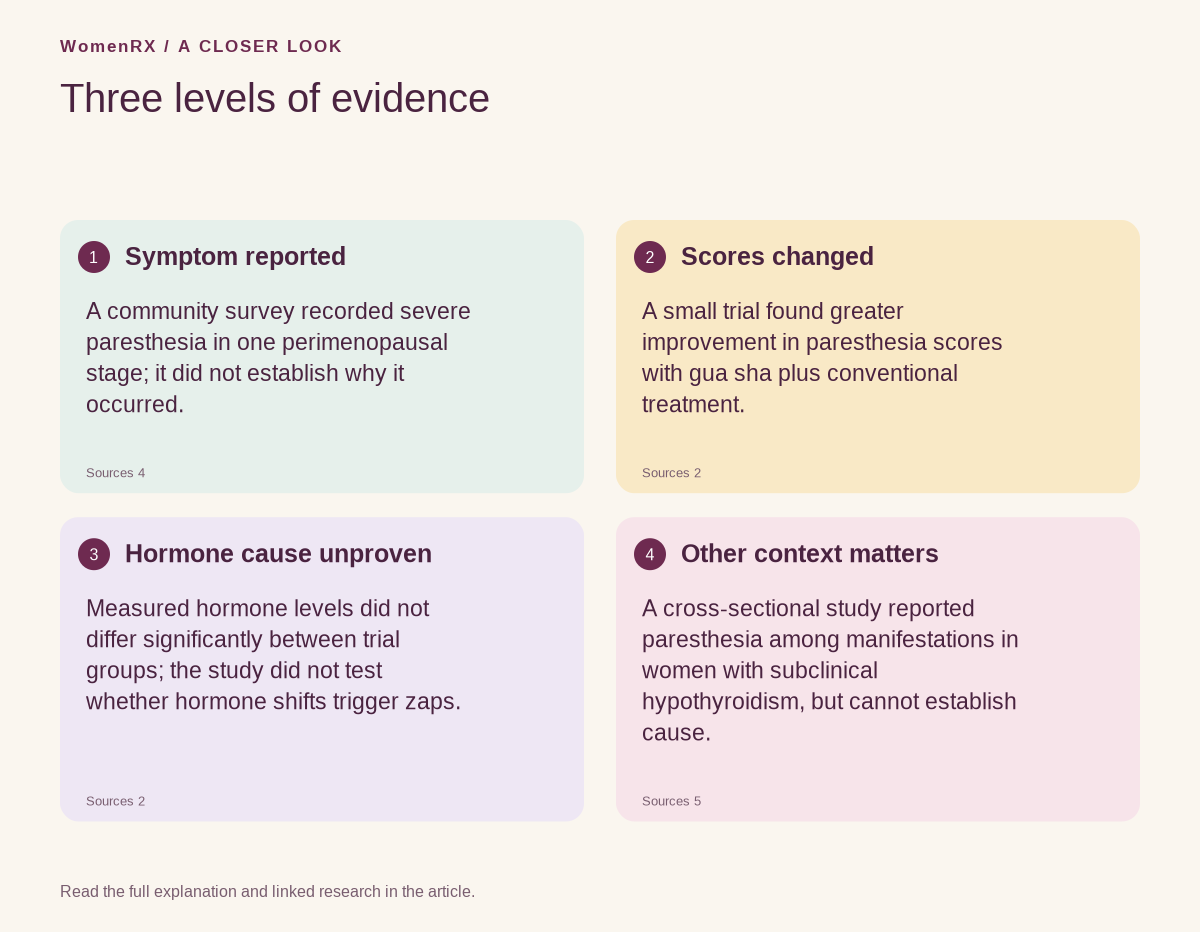
Three levels of evidence
Symptom reported: A community survey recorded severe paresthesia in one perimenopausal stage; it did not establish why it occurred.4
Scores changed: A small trial found greater improvement in paresthesia scores with gua sha plus conventional treatment.2
Hormone cause unproven: Measured hormone levels did not differ significantly between trial groups; the study did not test whether hormone shifts trigger zaps.2
Other context matters: A cross-sectional study reported paresthesia among manifestations in women with subclinical hypothyroidism, but cannot establish cause.5
Read the figure as text
A symptom report, a change in a symptom score, and proof of a hormone cause are different kinds of findings.- Symptom reported: A community survey recorded severe paresthesia in one perimenopausal stage; it did not establish why it occurred.4
- Scores changed: A small trial found greater improvement in paresthesia scores with gua sha plus conventional treatment.2
- Hormone cause unproven: Measured hormone levels did not differ significantly between trial groups; the study did not test whether hormone shifts trigger zaps.2
- Other context matters: A cross-sectional study reported paresthesia among manifestations in women with subclinical hypothyroidism, but cannot establish cause.5
Sources you can check
- The 2022 hormone therapy position statement of The North American Menopause Society.“The 2022 Hormone Therapy Position Statement of The North American Menopause Society” Advisory Panel. · Menopause (New York, N.Y.) · 2022Return to first citation
- Effect of Gua sha therapy on perimenopausal syndrome: a randomized controlled trial.Meng F, Duan PB, Zhu J, Lou QQ, Fang ZH, An HL, Liu LY, Hu Y, Hu Q. · Menopause (New York, N.Y.) · 2017Return to first citation
- Effect of health education combining diet and exercise supervision in Chinese women with perimenopausal symptoms: a randomized controlled trial.Xi S, Mao L, Chen X, Bai W. · Climacteric : the journal of the International Menopause Society · 2017Return to first citation
- A survey of menopausal symptoms in Chinese community women based on the STRAW+10 staging system.Wang J, Yang Y, Yang Y, Sun Z, Chen Y, Zheng R. · Menopause (New York, N.Y.) · 2025Return to first citation
- Possible association between subclinical hypothyroidism and age at menopause in Colombian women.Monterrosa-Castro Á, Monterrosa-Blanco A, Sánchez-Zarza S. · Gynecological endocrinology : the official journal of the International Society of Gynecological Endocrinology · 2024Return to first citation