Dizziness Around Menopause: What It Could Mean
Whether you feel spinning, faintness, or unsteadiness matters more than whether you’re near menopause.
Menopause alone isn’t a safe explanation for dizziness. Spinning can point toward an inner-ear problem or migraine; feeling faint when you stand may involve a blood-pressure drop, medicines, or another cause. Get emergency help for sudden or severe dizziness with vision changes, slurred speech, or weakness, or for vertigo with hearing loss. If episodes keep returning, arrange an appointment to find out why. 123
First, check for signs that shouldn’t wait
Get emergency help if sudden or severe dizziness comes with vision problems, slurred speech, or weakness. Get emergency help for vertigo with hearing loss, too. Don’t assume it’s an ear problem because the room seems to spin: dizziness and vertigo can also occur with stroke. 125
Vertigo with a severe headache, being sick or feeling very sick, or a very high temperature or feeling hot, cold, or shivery needs urgent assessment. If dizziness comes with fainting, collapsing, or a change in your pulse, make an appointment to discuss it. 23
While you’re dizzy, sit or lie down and avoid driving, climbing, or using machinery. Those steps reduce the immediate risk of a fall or accident; they don’t tell you what caused the episode. 23
What does “dizzy” feel like to you?
The room spins, especially when you turn your head or roll over. That’s vertigo. Brief episodes brought on by particular head movements can fit benign paroxysmal positional vertigo, or BPPV, an inner-ear condition. A clinician can check for it with a positional test. Migraine is another possible cause of vertigo, particularly when episodes come with features such as headache or sensitivity to light or sound. The pattern is a clue, not a diagnosis. 126
You feel woozy or close to fainting when you get up. A drop in blood pressure on standing is one possibility. Dehydration and medicine effects are others. For example, if the feeling began after a new prescription or happens mainly when you rise from bed, those details help direct the assessment. 13
You’re unsteady rather than spinning or faint. Inner-ear problems can affect balance, sometimes alongside ringing in an ear. Persistent or recurring imbalance deserves an appointment, even if you can still get through the day. 13
These categories overlap. Describe the sensation in your own words, then add what you were doing when it started, whether moving your head or standing brings it on, and whether you noticed ringing in an ear, headache, fainting, or a pulse change. That account is more useful than trying to decide for yourself which diagnosis fits. 123
Where menopause fits, and where it doesn’t
Dizziness may happen during perimenopause or after menopause, but its timing doesn’t establish a hormonal cause. If you have hot flashes alongside dizziness, mention both rather than using one to explain the other. 413
Iron-deficiency anemia is one possible cause of dizziness that may need to be considered. Also mention any recently started or changed medicines, including treatment for menopause symptoms: medicines can cause dizziness, and the timing may be a useful clue. 32
Do “natural” menopause remedies help dizziness?
Menopause-treatment guidance assesses supplements and herbs for hot flashes, not as treatments for dizziness. It does not recommend them for hot flashes, and that assessment cannot establish whether they help vertigo or faintness. 4
A product labeled “natural” can also have side effects or interact with medicines. If you’re considering one, bring its name and ingredients to a pharmacist or clinician, especially if you already take medication. More useful next steps depend on the cause: a positional inner-ear problem, recurrent migraine-like episodes, and lightheadedness on standing call for different assessments and may have different treatments. 78123
If dizziness won’t go away, keeps returning, or interferes with daily life, make an appointment. You can describe one specific episode, including its trigger and accompanying symptoms, rather than trying to arrive with an answer. 12
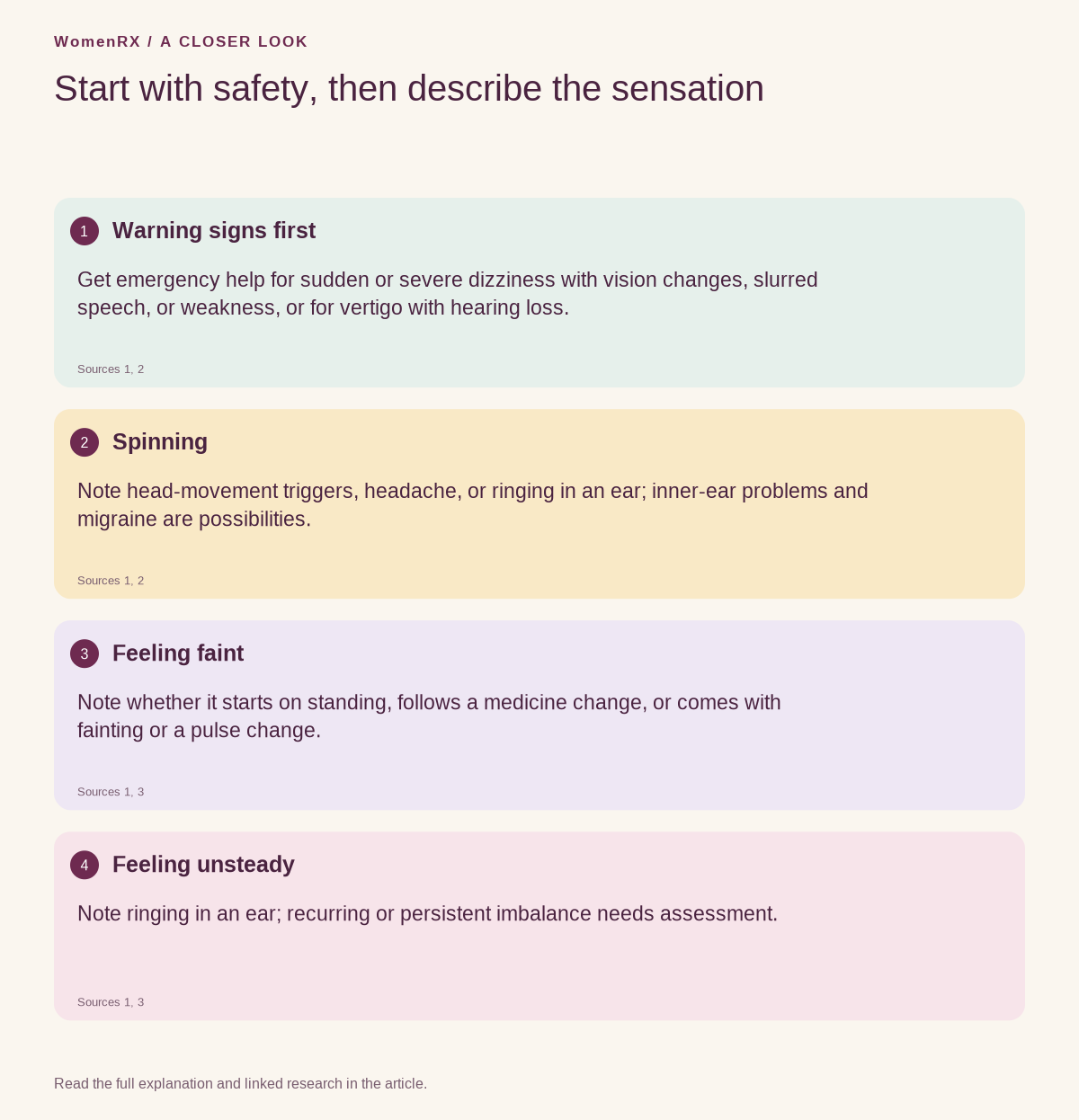
Start with safety, then describe the sensation
Warning signs first: Get emergency help for sudden or severe dizziness with vision changes, slurred speech, or weakness, or for vertigo with hearing loss.12
Spinning: Note head-movement triggers, headache, or ringing in an ear; inner-ear problems and migraine are possibilities.12
Feeling faint: Note whether it starts on standing, follows a medicine change, or comes with fainting or a pulse change.13
Feeling unsteady: Note ringing in an ear; recurring or persistent imbalance needs assessment.13
Read the figure as text
This is a guide to what information matters next, not a way to diagnose yourself.- Warning signs first: Get emergency help for sudden or severe dizziness with vision changes, slurred speech, or weakness, or for vertigo with hearing loss.12
- Spinning: Note head-movement triggers, headache, or ringing in an ear; inner-ear problems and migraine are possibilities.12
- Feeling faint: Note whether it starts on standing, follows a medicine change, or comes with fainting or a pulse change.13
- Feeling unsteady: Note ringing in an ear; recurring or persistent imbalance needs assessment.13
More questions, answered
Could hot flashes explain my dizzy spells?
Tell your clinician if the sensations happen together, but don’t assume a hot flash caused the dizziness. Spinning, near-fainting, and imbalance have different possible explanations, including inner-ear problems, blood-pressure changes, medicines, and anemia. 134
Should I try vertigo exercises at home?
The right approach depends on the cause. A clinician may use a positional test to check for BPPV, while balance exercises are among the treatments used for some causes of vertigo. New warning signs need assessment before a home exercise plan. 12
Sources you can check
- Dizziness | Vertigo | MedlinePlusAccessed 2026-09-25Return to first citation
- Vertigo - NHSAccessed 2026-09-25Return to first citation
- Dizziness - NHSAccessed 2026-09-25Return to first citation
- The 2023 nonhormone therapy position statement of The North American Menopause Society.Menopause (New York, N.Y.) · 2023Return to first citation
- Neuroanatomical correlates of stroke-related dizziness and vertigo: secondary analysis from the INSPiRE-TMS trial.Tang Y, Temuulen U, Rios AS, Khalil A, Ahmadi M, Horn A, Endres M, Audebert HJ, Kufner A. · Journal of neurology · 2026Return to first citation
- Dysautonomia and Postural Orthostatic Tachycardia Syndrome (POTS) in the ENT Clinic: Differentiating Orthostatic Dizziness From Vestibular Migraine and Persistent Postural-Perceptual Dizziness (PPPD).Zitser P, Kolomiyets I, Imran M, Kulkarni A, Patel J, St Martin N, Ahmadi A. · Cureus · 2026Return to first citation
- Herbal remedies and complementary medicines for menopause symptoms - NHSAccessed 2026-09-25Return to first citation
- Menopause | Menopause Symptoms | MedlinePlusAccessed 2026-09-25Return to first citation