Bloating Around Menopause: What Could Be Causing It?
Bloating can overlap with the menopause transition, but meals, gas and bowel changes may matter just as much.
Bloating may change during perimenopause, but it isn’t proof that menopause is the cause. Gas, food and drink, swallowed air, digestion and constipation can also contribute. Notice whether it follows meals, bowel changes or, if you still have periods, a point in your cycle. Seek assessment for bloating that is frequent, persistent or accompanied by concerning changes. 1 2 3
Start with what you mean by “swollen”
Bloating usually means a full or uncomfortable feeling in your abdomen, sometimes with rumbling or a belly that feels bigger than usual. That’s different from noticing puffiness in your hands or feet. Write down which you’re experiencing rather than assuming either one is fluid retention or a menopause symptom. 1
Bloating can be uncomfortable even when there’s no obvious change in belly size. A diary can help you describe the pattern, but it can’t diagnose the cause.
Menopause may be part of the pattern, not the whole explanation
Some women report more bloating during the menopause transition, but the research doesn’t show that every new bout of bloating is hormonal. In a longitudinal study of 291 women, early and late transition stages were associated with greater bloating severity in the researchers’ multivariable analysis. The study found associations, not proof that menopause caused the symptoms. 2
A scoping review of 122 studies found that research on digestive symptoms in natural perimenopause and postmenopause has used varied methods and definitions, with conflicting findings across studies. So far, the evidence doesn’t give a clear rule that bloating should increase, or ease, after menopause. 3
If you still have periods, note whether bloating repeatedly clusters around the same part of your cycle. Digestive symptoms have been reported around menstruation, including in women with and without irritable bowel syndrome, but the research reviewed on hormone fluctuations was limited and doesn’t establish a simple hormone-to-bloating explanation. 1 4
Check meals and bowel habits, too
Gas is a common reason for bloating. Some foods and fizzy drinks can contribute, as can swallowing air while eating. Digestion and constipation may also be relevant. 1
For a short, useful record, note:
- Timing: When bloating starts, how long it lasts and whether it follows meals.
- Food and drink: Anything noticeably different, including fizzy drinks or foods that seem to trigger gas.
- Bowel pattern: Whether you’re constipated, having diarrhea or noticing another change.
- Where you notice it: Abdominal fullness or a larger-feeling belly, puffiness elsewhere, or both.
- Cycle and other symptoms: If you still have periods, whether there’s a repeatable cycle pattern, and any pain or other changes.
Look for a repeated pattern rather than cutting out many foods after one uncomfortable day. If constipation seems to be part of the picture, general guidance includes soluble-fiber foods such as oats or linseed; smaller meals and chewing with your mouth closed may also help some people. 1
When to get checked
Arrange medical assessment if bloating is frequent, very uncomfortable or doesn’t go away, especially if changing your diet hasn’t helped. Don’t put off assessment if it comes with unintentional weight loss or blood in your stool. Persistent bloating can sometimes signal a more serious problem, so it shouldn’t automatically be written off as menopause. 1
Seek urgent care for bloating with vomiting, diarrhea or constipation, abdominal pain, or fever. A suddenly severe stomach ache with a swollen abdomen, vomiting blood, or severe difficulty breathing needs emergency attention. 1
The main takeaway: use the pattern to describe what’s happening, not to self-diagnose. Menopause is one possible part of the picture; persistent or concerning changes deserve assessment even if they began during the transition.
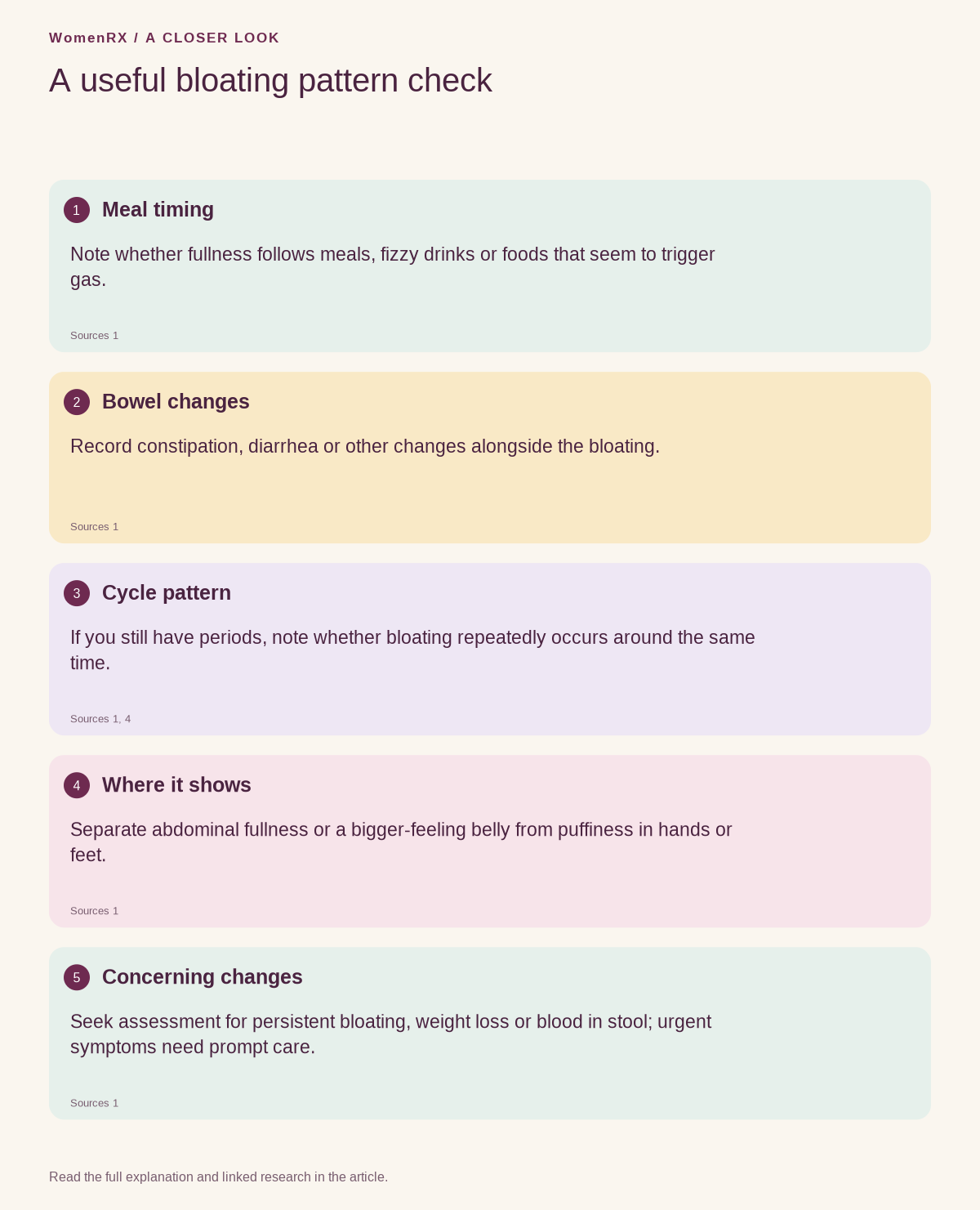
A useful bloating pattern check
Meal timing: Note whether fullness follows meals, fizzy drinks or foods that seem to trigger gas.1
Bowel changes: Record constipation, diarrhea or other changes alongside the bloating.1
Cycle pattern: If you still have periods, note whether bloating repeatedly occurs around the same time.14
Where it shows: Separate abdominal fullness or a bigger-feeling belly from puffiness in hands or feet.1
Concerning changes: Seek assessment for persistent bloating, weight loss or blood in stool; urgent symptoms need prompt care.1
Read the figure as text
Record what happens around the symptom so a repeated pattern is easier to describe; this checklist is not a diagnostic score.- Meal timing: Note whether fullness follows meals, fizzy drinks or foods that seem to trigger gas.1
- Bowel changes: Record constipation, diarrhea or other changes alongside the bloating.1
- Cycle pattern: If you still have periods, note whether bloating repeatedly occurs around the same time.14
- Where it shows: Separate abdominal fullness or a bigger-feeling belly from puffiness in hands or feet.1
- Concerning changes: Seek assessment for persistent bloating, weight loss or blood in stool; urgent symptoms need prompt care.1
More questions, answered
Does bloating mean I’m retaining fluid?
Not necessarily. Bloating describes abdominal fullness or a belly that feels bigger; puffiness in your hands or feet is a different observation. Record each separately rather than assuming they have the same cause. 1
Sources you can check
- Bloating - NHSAccessed 2026-09-25Return to first citation
- Bloating During the Menopause Transition: Observations from the Seattle Midlife Women's Health Study.Kamp KJ, Callan NGL, Mitchell ES, Heitkemper MM, Woods NF. · Journal of women's health (2002) · 2026Return to first citation
- The volume and characteristics of research on gastrointestinal symptoms in 'natural' peri- and postmenopause: A scoping review.Shaw N, Abbott R, Pettinger C. · Women's health (London, England) · 2025Return to first citation
- Do fluctuations in ovarian hormones affect gastrointestinal symptoms in women with irritable bowel syndrome?Heitkemper MM, Chang L. · Gender medicine · 2009Return to first citation