Menopause and Bloating: What to Track and When to Act
Bloating can change during the menopause transition, but meals, bowel habits, and other causes matter too.
Bloating may vary during perimenopause, and some women notice it around their periods, but research does not show that menopause explains every episode. Gas, certain foods or drinks, swallowed air, and digestive conditions can also contribute. Track when it happens and what comes with it; get medical advice for bloating that persists, keeps returning, or occurs with concerning symptoms. 1234
Bloating can feel like a full, tight or uncomfortable abdomen, sometimes with more gas than usual. It may come and go, and you might notice a pattern around meals, bowel movements or menstrual changes. Menopause could be part of that pattern, especially during perimenopause, but it isn’t the only possible explanation. 123
Start with the pattern, not the label
A longitudinal study of 291 women in the Seattle Midlife Women’s Health Study found that early and late menopause-transition stages were associated with greater bloating severity in its multivariable analysis. Tension was also associated with greater severity. The study describes associations, not proof that hormonal changes cause bloating or that menopause is the cause for any one person. 2
A review of research on gastrointestinal symptoms during natural perimenopause and postmenopause found mixed results and limitations in how studies defined menopause stages and assessed symptoms. A separate review describes reports of digestive symptoms around menstruation and perimenopause, including among women with and without irritable bowel syndrome, while noting that the role of ovarian hormones needs more study. Taken together, these findings make it reasonable to notice cycle-related changes, but not to assume that new or ongoing bloating is simply menopause. 34
Keep a simple, useful record
For each episode, note when it starts and eases, what you ate and drank, whether you had a bowel movement and any constipation or diarrhea, and whether you’re having menstrual-cycle changes. Include other symptoms, such as pain, nausea or changes in appetite. This isn’t a diagnostic test. It’s a way to spot a possible pattern and describe it clearly if you seek care.
For example, if bloating tends to follow fizzy drinks or a particular food, that may be a more useful clue than the fact that you’re also in perimenopause. If it appears around a period, record that too. The NHS lists gas, some foods and drinks, swallowed air, food intolerance and IBS among possible contributors, and notes that some people feel bloated around their period. 1
Try modest changes when symptoms come and go
If the pattern points to a possible everyday trigger, try a practical adjustment rather than starting a supplement advertised for “menopause bloating.” You could chew with your mouth closed to reduce swallowed air, limit a food or drink you already suspect bothers you, or take regular exercise. Don’t cut out a broad range of foods based on one episode; look for a repeatable link. These steps may help with common contributors, but they don’t identify or treat every cause of bloating. 1
There isn’t enough consistent evidence to promise that a menopause-specific natural remedy will resolve bloating. Research on gastrointestinal symptoms in natural peri- and postmenopause remains uncertain, and findings across studies conflict. 3
Know when not to wait it out
Arrange medical evaluation if bloating is persistent, happens often, or doesn’t go away, particularly if it is new after menopause. Also seek advice if it continues despite reasonable changes, or comes with unintentional weight loss or blood in your stool. Persistent bloating can sometimes signal a condition that needs attention, so it shouldn’t automatically be written off as a menopause symptom. 1
Bloating with abdominal pain, vomiting, diarrhea or constipation, or fever also warrants prompt medical advice. A swollen abdomen with sudden, severe abdominal pain calls for urgent emergency assessment. 1
The useful distinction is not “menopause or not.” It’s whether symptoms are occasional and linked to a plausible trigger, or persistent, changing, or accompanied by other concerning signs. Your notes can help make that distinction clearer, but they shouldn’t delay care when symptoms are worrying.
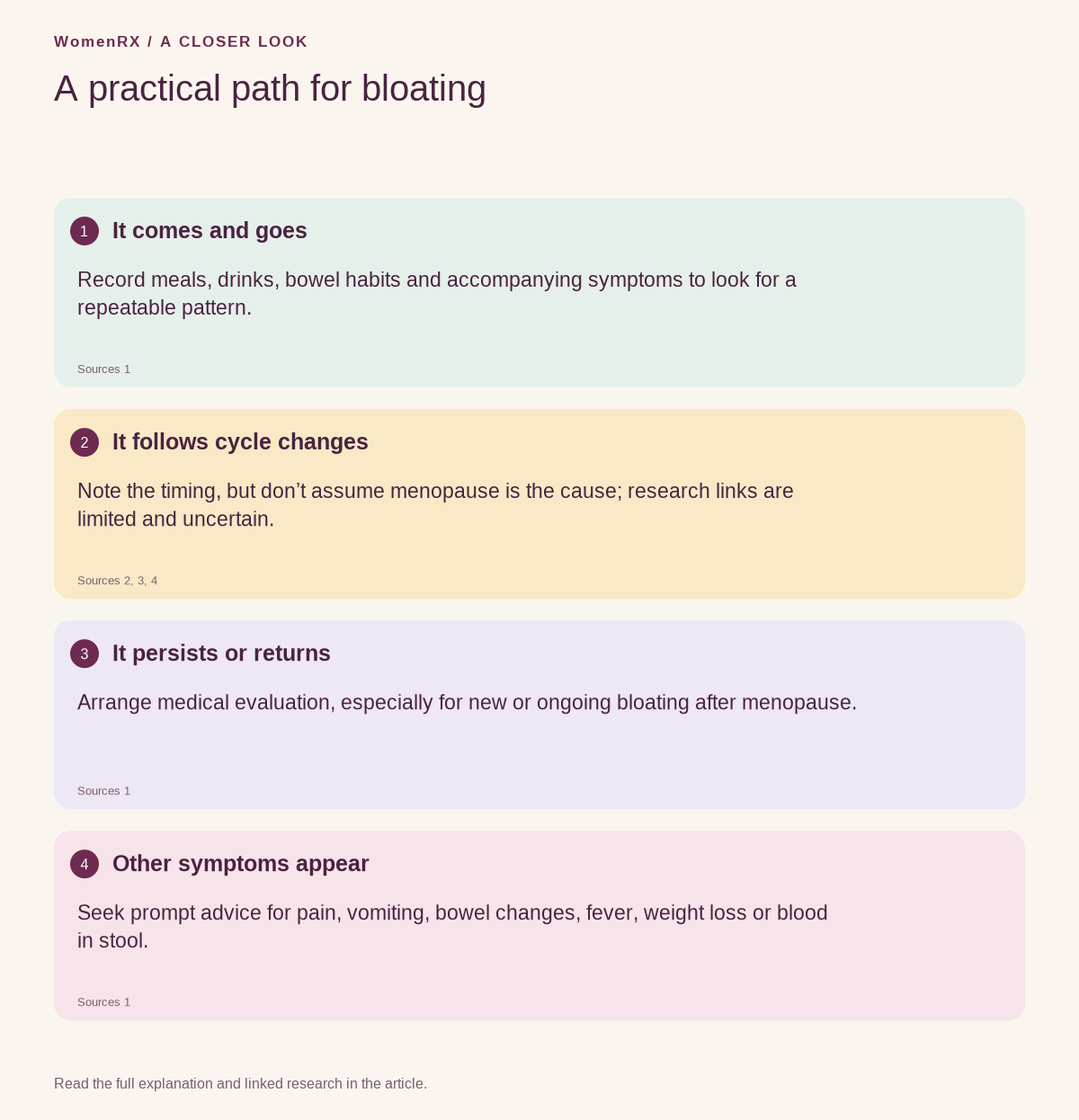
A practical path for bloating
It comes and goes: Record meals, drinks, bowel habits and accompanying symptoms to look for a repeatable pattern.1
It follows cycle changes: Note the timing, but don’t assume menopause is the cause; research links are limited and uncertain.234
It persists or returns: Arrange medical evaluation, especially for new or ongoing bloating after menopause.1
Other symptoms appear: Seek prompt advice for pain, vomiting, bowel changes, fever, weight loss or blood in stool.1
Read the figure as text
Use the symptom pattern to decide whether to observe a possible trigger or seek medical assessment. This is guidance, not a diagnostic tool.- It comes and goes: Record meals, drinks, bowel habits and accompanying symptoms to look for a repeatable pattern.1
- It follows cycle changes: Note the timing, but don’t assume menopause is the cause; research links are limited and uncertain.234
- It persists or returns: Arrange medical evaluation, especially for new or ongoing bloating after menopause.1
- Other symptoms appear: Seek prompt advice for pain, vomiting, bowel changes, fever, weight loss or blood in stool.1
More questions, answered
Can bloating around a period continue during perimenopause?
It can be worth tracking. Digestive symptoms have been reported around menstrual periods and during perimenopause, but the evidence does not establish that hormone changes are the cause in every case. 34
Should new bloating after menopause be assumed to be hormonal?
No. Research on digestive symptoms after menopause is limited and mixed. Persistent or recurrent bloating, especially with other concerning symptoms, deserves medical evaluation rather than being automatically attributed to menopause. 13
Sources you can check
- Bloating - NHSAccessed 2026-09-25Return to first citation
- Bloating During the Menopause Transition: Observations from the Seattle Midlife Women's Health Study.Kamp KJ, Callan NGL, Mitchell ES, Heitkemper MM, Woods NF. · Journal of women's health (2002) · 2026Return to first citation
- The volume and characteristics of research on gastrointestinal symptoms in 'natural' peri- and postmenopause: A scoping review.Shaw N, Abbott R, Pettinger C. · Women's health (London, England) · 2025Return to first citation
- Do fluctuations in ovarian hormones affect gastrointestinal symptoms in women with irritable bowel syndrome?Heitkemper MM, Chang L. · Gender medicine · 2009Return to first citation