Perimenopause Bloating: What Your Symptom Pattern Can Tell You
Bloating can happen around your period or during the menopause transition, but its timing alone can’t identify the cause.
Bloating may recur around your period, and one longitudinal study found an association between menopause-transition stages and bloating severity. Neither finding means bloating is a reliable sign of perimenopause or proves hormones are causing it. Notice whether it repeats and settles, follows meals or drinks, or persists. Ongoing or concerning symptoms deserve assessment. 1 2
Start with the pattern, not the label
If you still have periods, even irregular ones, notice whether bloating tends to show up around the same part of your cycle and then ease. Some people feel bloated around their period, and a review describes digestive symptoms, including bloating, around menstrual phases in women with and without irritable bowel syndrome (IBS). That makes cycle timing a useful clue to observe, not a diagnosis. 1 3
Bloating has also been studied during the menopause transition. In a longitudinal study of 291 women, early and late transition stages were associated with increased bloating severity in a multivariable analysis. The study found an association, not proof that hormonal changes caused the bloating. A broader review of digestive symptoms during natural peri- and postmenopause found limitations in how studies defined menopause stages and assessed symptoms. 2 5
Bloating by itself can’t tell you whether you’re in perimenopause. One recent cross-sectional study examined symptoms alongside menstrual patterns, underscoring why a digestive symptom alone shouldn’t be treated as a menopause test. 4
Compare cycle timing with other clues
A pattern that repeatedly appears around your period and eases afterward may be cycle-related, but it doesn’t rule out another or additional cause. Gas is a common reason for bloating. Some foods and fizzy drinks, swallowing air while eating, and food intolerance can contribute too. Notice whether symptoms seem to follow particular meals or drinks, or happen along with constipation or diarrhea. 1
For example, you could note when the bloating starts and eases, where you are in your cycle, what you ate or drank, and any other digestive symptoms. The point isn’t to score or diagnose yourself. It’s to see whether a repeating cycle pattern stands out from meal-related clues or symptoms that continue regardless of your cycle.
If you already have IBS or another digestive condition, keep that in the picture when considering a change in symptoms. Reviews describe digestive symptoms linked with menstrual phases, including among people with IBS, but don’t establish a single hormone-based explanation that applies to everyone. 3
When the pattern calls for assessment
Frequent bloating or bloating that doesn’t go away is worth getting checked, rather than assuming it’s part of perimenopause. Seek medical evaluation especially if it comes with unintentional weight loss or blood in your stool. 1
Get prompt medical attention if bloating occurs with vomiting, diarrhea, constipation, abdominal pain, or a fever. If your abdomen is swollen and you also have sudden, severe abdominal pain, seek immediate medical attention. 1
The practical distinction is not simply “hormonal or not.” Look at whether bloating repeats around your period and settles, whether meals or bowel symptoms offer other clues, and whether it persists or comes with symptoms that need attention.
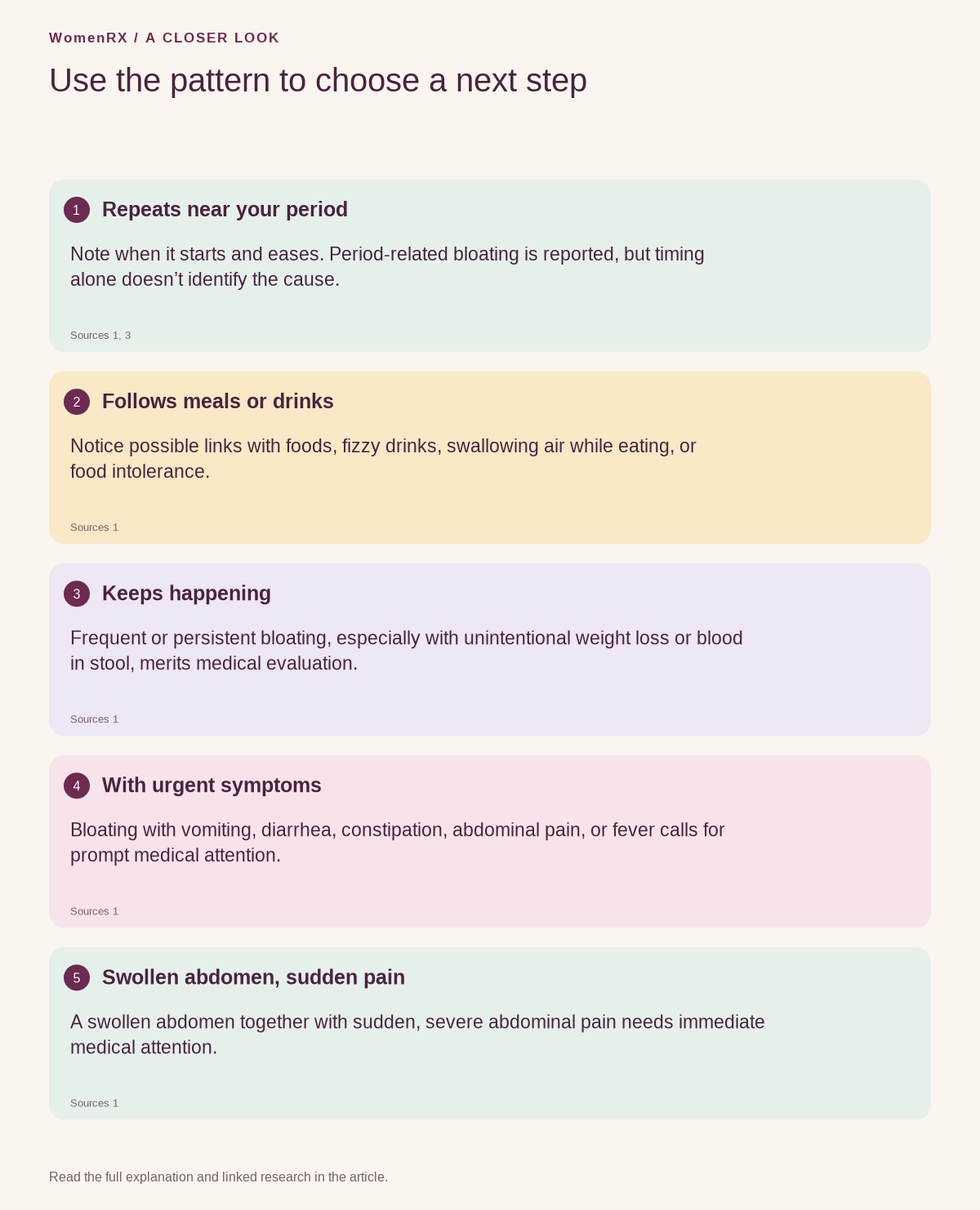
Use the pattern to choose a next step
Repeats near your period: Note when it starts and eases. Period-related bloating is reported, but timing alone doesn’t identify the cause.13
Follows meals or drinks: Notice possible links with foods, fizzy drinks, swallowing air while eating, or food intolerance.1
Keeps happening: Frequent or persistent bloating, especially with unintentional weight loss or blood in stool, merits medical evaluation.1
With urgent symptoms: Bloating with vomiting, diarrhea, constipation, abdominal pain, or fever calls for prompt medical attention.1
Swollen abdomen, sudden pain: A swollen abdomen together with sudden, severe abdominal pain needs immediate medical attention.1
Read the figure as text
Cycle timing, possible meal links, persistence, and specific accompanying symptoms point to different next steps.- Repeats near your period: Note when it starts and eases. Period-related bloating is reported, but timing alone doesn’t identify the cause.13
- Follows meals or drinks: Notice possible links with foods, fizzy drinks, swallowing air while eating, or food intolerance.1
- Keeps happening: Frequent or persistent bloating, especially with unintentional weight loss or blood in stool, merits medical evaluation.1
- With urgent symptoms: Bloating with vomiting, diarrhea, constipation, abdominal pain, or fever calls for prompt medical attention.1
- Swollen abdomen, sudden pain: A swollen abdomen together with sudden, severe abdominal pain needs immediate medical attention.1
More questions, answered
Does bloating mean I’m in perimenopause?
No. Bloating can happen around periods, and one longitudinal study found an association between transition stages and bloating severity. Those findings don’t make bloating specific to perimenopause or establish its cause. 1 2
What details are useful to track?
Note when bloating starts and eases, its timing in relation to your period, possible food or drink links, and any other digestive symptoms. This can help you describe the pattern, but it can’t diagnose the cause.
Sources you can check
- Bloating - NHSAccessed 2026-09-25Return to first citation
- Bloating During the Menopause Transition: Observations from the Seattle Midlife Women's Health Study.Kamp KJ, Callan NGL, Mitchell ES, Heitkemper MM, Woods NF. · Journal of women's health (2002) · 2026Return to first citation
- Do fluctuations in ovarian hormones affect gastrointestinal symptoms in women with irritable bowel syndrome?Heitkemper MM, Chang L. · Gender medicine · 2009Return to first citation
- Symptom profiles in the late reproductive stage, earlier premenopause and early perimenopause in the absence of vasomotor symptoms: a cross-sectional study.Bresolin S, Islam RM, Bond M, Davis SR. · BMJ sexual & reproductive health · 2026Return to first citation
- The volume and characteristics of research on gastrointestinal symptoms in 'natural' peri- and postmenopause: A scoping review.Shaw N, Abbott R, Pettinger C. · Women's health (London, England) · 2025Return to first citation