Bloating: What Your Symptom Pattern Can Tell You
Whether bloating follows meals, bowel changes, or your period can offer clues, but frequent or persistent symptoms deserve more than a guess.
Bloating is the uncomfortable feeling of fullness; distension means your abdomen actually looks or measures larger. Notice whether symptoms follow meals, changes in bowel habits, or your period. These patterns can offer clues, not a diagnosis. If bloating keeps returning or does not go away, arrange an assessment, including if you’re pregnant. Sudden severe pain or a hard, tender abdomen needs emergency help. 3 5 1
First, separate the feeling from the change you can see
Bloating is a sensation of fullness or discomfort. Distension is an observable increase in abdominal size, which may happen with bloating but is not the same thing. Feeling swollen does not prove that trapped gas or a particular food is the cause. Bloating and distension can occur with conditions such as irritable bowel syndrome (IBS) or indigestion, among other causes. 5
That distinction is useful: note whether you feel pressure or fullness, see a change in your abdomen, or experience both. Note whether a visible change is new or keeps returning, and discuss frequent or persistent bloating even if you cannot connect it to a meal. 3
Look for a pattern, not a single culprit
After meals or a particular food: If symptoms repeatedly follow the same food, record what you ate and when symptoms started. Food-intolerance symptoms commonly begin a few hours after eating, and lactose intolerance is a common example. A recurring link is a clue, not proof that the food caused the bloating. Avoid cutting out many foods on your own: unhelpful restrictions can create nutritional risks, and home food-intolerance tests are not recommended. 2 3 5
Along with constipation, diarrhea, or abdominal pain: Bloating can be part of IBS, which often involves abdominal pain and altered bowel habits, including constipation, diarrhea, or both. That pattern is worth discussing if it keeps recurring; bloating by itself does not establish an IBS diagnosis. 4
Around your period: Some people feel bloated around the time of menstruation. If it reliably comes and goes with your cycle, note that timing. But a cycle-related pattern should not be used to explain symptoms that are new, persistent, or getting worse. 3
If you’re pregnant: Pregnancy alone is not a way to identify the cause of bloating. If the feeling is new and does not go away, or it keeps returning, arrange an assessment rather than assuming it needs no attention. Use the warning signs below to decide if you need help sooner. These are general bloating thresholds, not a pregnancy-specific test. 3
Try small, reversible steps while you observe
For mild symptoms, try chewing with your mouth closed, and keep up regular movement if that is comfortable for you. Note meals, symptom timing, bowel changes, and, if relevant, where you are in your cycle. This can help reveal a repeatable pattern without turning every food into a suspect. 3
If you think a specific food may be involved, avoid broad elimination diets or commercial intolerance tests as a first move. When a food intolerance is suspected, guidance describes a planned period of avoidance followed by reintroduction, ideally with support from a dietitian or clinician. 2 For people with IBS, a low-FODMAP diet has been studied, but a 2025 review found substantial differences among trials and its pooled estimate for overall symptom improvement was not statistically conclusive. It is not a reason to assume that a restrictive diet will help every person with bloating. 4
When to get assessed
Arrange a routine medical assessment if bloating happens often, does not go away, or continues despite reasonable changes. Persistent bloating can sometimes have a serious cause, including ovarian cancer. Bloating alone does not mean you have cancer, but a food or cycle pattern is not a reason to dismiss a symptom that does not go away. Unintentional weight loss or blood in your stool also calls for assessment, even if you suspect a food trigger. If you have abdominal pain with blood in your stool, get medical help immediately. 3 1
Seek urgent medical advice if bloating comes with vomiting, diarrhea or constipation, abdominal pain, fever, a lump or swelling in your abdomen, or inability to pass urine, stool, or gas. These combinations call for more than a routine appointment. 3
Get emergency help for sudden, severe abdominal pain; a hard and tender abdomen; vomiting blood; or abdominal pain with blood in your stool. If you have a swollen abdomen with severe pain that came on suddenly, vomiting blood, or severe difficulty breathing, seek emergency help. 1 3
The useful question is not only “What did I eat?” It is also “Is this a sensation or visible distension, what else changes with it, and is the pattern new or persistent?” Those details help separate a manageable recurring pattern from symptoms that need prompt attention.
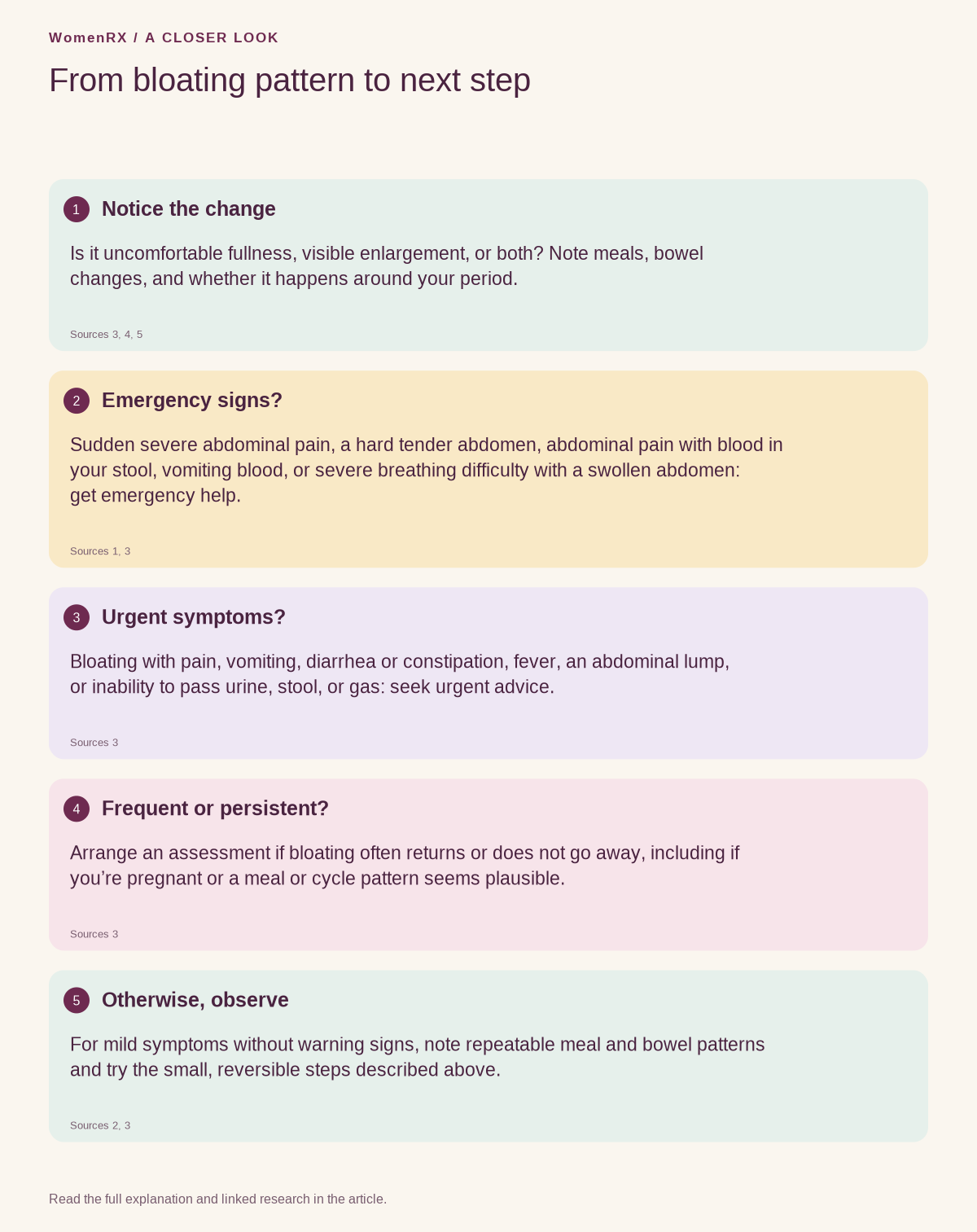
From bloating pattern to next step
Notice the change: Is it uncomfortable fullness, visible enlargement, or both? Note meals, bowel changes, and whether it happens around your period.345
Emergency signs?: Sudden severe abdominal pain, a hard tender abdomen, abdominal pain with blood in your stool, vomiting blood, or severe breathing difficulty with a swollen abdomen: get emergency help.13
Urgent symptoms?: Bloating with pain, vomiting, diarrhea or constipation, fever, an abdominal lump, or inability to pass urine, stool, or gas: seek urgent advice.3
Frequent or persistent?: Arrange an assessment if bloating often returns or does not go away, including if you’re pregnant or a meal or cycle pattern seems plausible.3
Otherwise, observe: For mild symptoms without warning signs, note repeatable meal and bowel patterns and try the small, reversible steps described above.23
Read the figure as text
Notice what changes, then check for warning signs before deciding whether to observe the pattern or arrange care.- Notice the change: Is it uncomfortable fullness, visible enlargement, or both? Note meals, bowel changes, and whether it happens around your period.345
- Emergency signs?: Sudden severe abdominal pain, a hard tender abdomen, abdominal pain with blood in your stool, vomiting blood, or severe breathing difficulty with a swollen abdomen: get emergency help.13
- Urgent symptoms?: Bloating with pain, vomiting, diarrhea or constipation, fever, an abdominal lump, or inability to pass urine, stool, or gas: seek urgent advice.3
- Frequent or persistent?: Arrange an assessment if bloating often returns or does not go away, including if you’re pregnant or a meal or cycle pattern seems plausible.3
- Otherwise, observe: For mild symptoms without warning signs, note repeatable meal and bowel patterns and try the small, reversible steps described above.23
More questions, answered
Does bloating mean I have IBS?
No. Bloating can occur with IBS, but IBS typically involves recurring abdominal pain alongside changes in bowel habits. Bloating alone is not enough to identify the cause. 4
Should I cut out foods to find the cause?
Start by noting repeatable food and symptom patterns rather than removing many foods at once. Broad restrictions can carry nutritional risks, and home food-intolerance tests are not recommended. 2 5
Sources you can check
- Abdominal Pain | MedlinePlusAccessed 2026-09-25Return to first citation
- Food intolerance - NHSAccessed 2026-09-25Return to first citation
- Bloating - NHSAccessed 2026-09-25Return to first citation
- The Efficacy of the Low-FODMAP (Fermentable Oligosaccharides, Disaccharides, Monosaccharides, and Polyols) Diet in Irritable Bowel Syndrome: A Systematic Review and Meta-Analysis.Khan Z, Muhammad SA, Amin MS, Gul A. · Cureus · 2025Return to first citation
- Management of abdominal bloating and distension, from subjective to objective.Ezquerra-Durán A, Barba E. · Revista espanola de enfermedades digestivas · 2024Return to first citation