Probiotics for Bloating: What the Evidence Can Tell You
A probiotic may help some people with IBS, but bloating alone doesn’t point to one cause or one proven product.
Probiotics may modestly ease some IBS symptoms, including bloating, but results vary and the evidence is uncertain. Bloating can also relate to gas, foods, swallowed air, constipation, or the menstrual cycle, so a probiotic isn’t a universal fix. If you’re considering a trial, first clarify the symptom pattern and agree on a limited, measurable trial rather than choosing by a high CFU count. 1 2 4
First, sort out what the bloating comes with
Bloating is a feeling of fullness or discomfort, often with more gas than usual. Gas can be related to foods or drinks, fizzy drinks, or swallowing air while eating. Some people also feel bloated around their period. These patterns don’t, on their own, establish IBS or mean a probiotic is the right answer. 2
IBS is a different, recurring pattern: abdominal discomfort or pain along with bloating and changes in stool form or frequency. If hard or infrequent stools are part of your experience, mention that when discussing what may be causing the bloating. Constipation and IBS aren’t interchangeable labels. 1
A brief note of when bloating happens, what your bowel movements are like, and whether symptoms track with meals or your cycle can help you describe the pattern. It doesn’t diagnose the cause, but it can make a conversation about next steps more useful.
What probiotic research says, and what it doesn’t
Reviews of trials in people diagnosed with IBS suggest probiotics may modestly improve some overall symptoms. In one meta-analysis summarized by the NIH Office of Dietary Supplements, 23 trials with 2,575 people found a 21% relative reduction in the risk that IBS symptoms would persist or not improve. The studies varied, and their quality was low. That result is about IBS symptoms overall, not a guarantee that bloating by itself will improve. 1
A later umbrella review of 27 systematic reviews also found that evidence was mostly low or very low certainty. Across those reviews, effects on bloating were small or inconsistent. A separate meta-analysis of 12 trials of multistrain products reported an improvement in a bloating subscore, but results across the measured outcomes were highly heterogeneous. Taken together, these findings support a possible benefit for some people with IBS, not a dependable effect for everyone with bloating. 3 4
“Probiotic” also isn’t a single treatment. Products can contain different organisms and strains, and effects may be specific to a strain or combination. Research on one product can’t automatically be applied to another, even if both contain Lactobacillus or Bifidobacterium. A larger CFU number doesn’t mean a product works better, either. 1
If you’re considering a trial
A practical plan to discuss with your clinician could look like this:
- Start with the pattern. Is bloating occasional, tied to your period, or recurring with abdominal pain and changes in bowel habits? Are hard or infrequent stools part of it? These details can help clarify what may be behind the symptom. 1 2
- Choose one question to test. For example: “Does this product lessen my bloating?” Don’t assume a product aimed at general gut health has evidence for your specific symptom.
- Check the product identity. Look for the full strain designation, not only the genus or species. NIH advises looking for CFU listed through the product’s use-by date; higher CFU counts are not necessarily more effective. 1
- Agree on a defined trial and how you’ll judge it. Note your usual bloating and bowel pattern first, then check whether the symptom you chose actually changes. One practical checkpoint to discuss is reassessing after four weeks. That’s a way to limit the trial, not a duration established as best or universally effective in research. If there’s no worthwhile change, stop rather than continuing indefinitely. 1 4
- Stop and reassess if it worsens symptoms or brings no worthwhile change. Gas can occur as a minor, temporary side effect. Probiotics also deserve extra caution if you’re critically ill or immunocompromised. 1
Cycle-related bloating and pregnancy are separate questions
If bloating repeatedly appears around your period, that timing is useful context. IBS probiotic trials address IBS symptoms, not whether probiotics ease cycle-related bloating; the cycle pattern alone doesn’t establish IBS. 2 4
Pregnancy is another distinct context. The IBS findings above do not establish that a probiotic will help pregnancy-related bloating. 1 4
When bloating needs assessment first
Arrange medical assessment if bloating is frequent, persistent, or doesn’t settle, particularly if it comes with unintentional weight loss or blood in your stool. Seek urgent medical advice for bloating with vomiting, diarrhea, constipation, abdominal pain, or a fever. If your stomach is swollen and you have severe, sudden abdominal pain, get emergency care now. In these situations, evaluating the cause comes before experimenting with a probiotic. 2
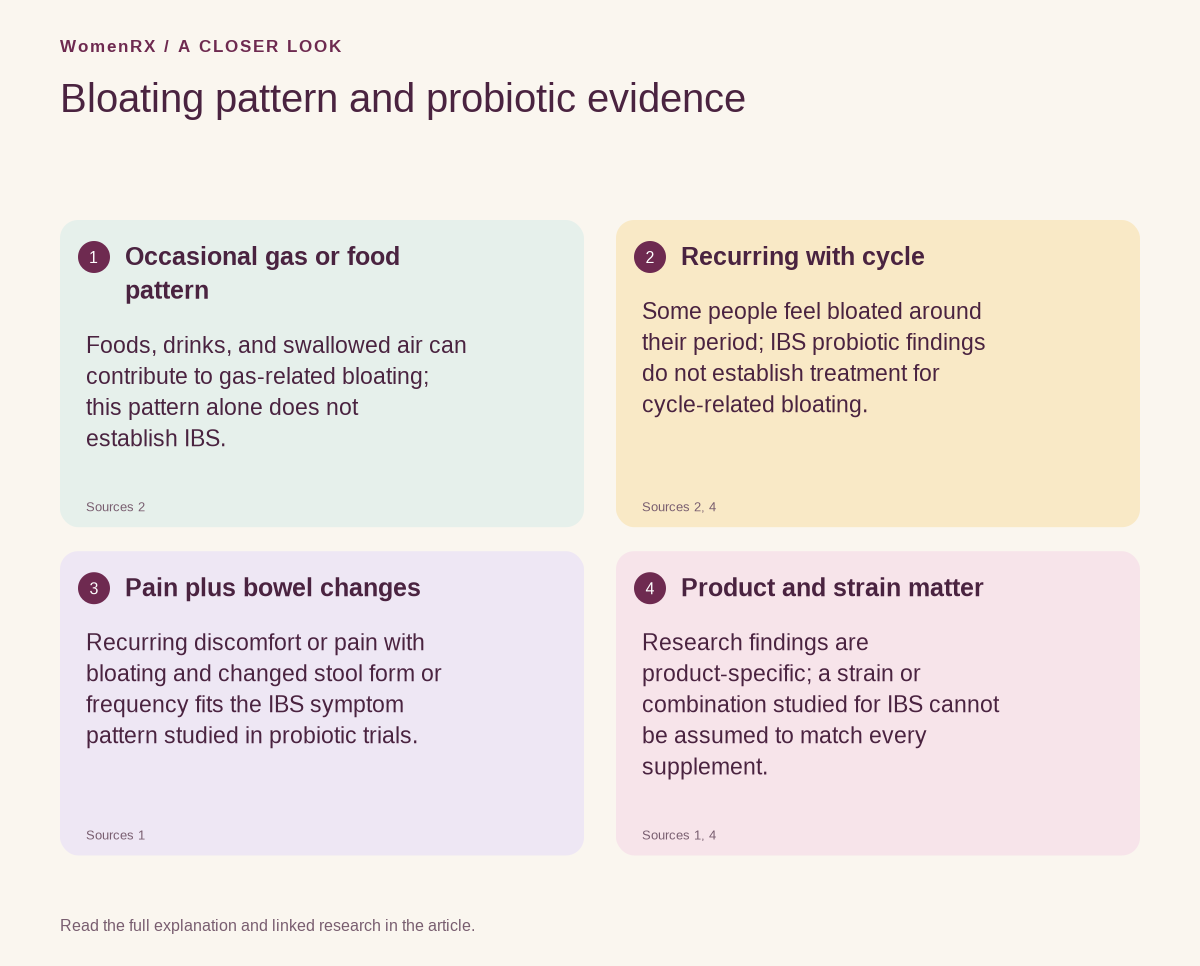
Bloating pattern and probiotic evidence
Occasional gas or food pattern: Foods, drinks, and swallowed air can contribute to gas-related bloating; this pattern alone does not establish IBS.2
Recurring with cycle: Some people feel bloated around their period; IBS probiotic findings do not establish treatment for cycle-related bloating.24
Pain plus bowel changes: Recurring discomfort or pain with bloating and changed stool form or frequency fits the IBS symptom pattern studied in probiotic trials.1
Product and strain matter: Research findings are product-specific; a strain or combination studied for IBS cannot be assumed to match every supplement.14
Read the figure as text
The same symptom can come with different patterns. This comparison separates common bloating contexts from IBS trial evidence and shows why a probiotic is not a one-size-fits-all choice.- Occasional gas or food pattern: Foods, drinks, and swallowed air can contribute to gas-related bloating; this pattern alone does not establish IBS.2
- Recurring with cycle: Some people feel bloated around their period; IBS probiotic findings do not establish treatment for cycle-related bloating.24
- Pain plus bowel changes: Recurring discomfort or pain with bloating and changed stool form or frequency fits the IBS symptom pattern studied in probiotic trials.1
- Product and strain matter: Research findings are product-specific; a strain or combination studied for IBS cannot be assumed to match every supplement.14
More questions, answered
Does a higher CFU count mean a probiotic will work better?
No. CFU counts the viable microorganisms, but products with higher counts aren’t necessarily more effective. The specific strain and evidence for the symptom or condition matter more than choosing the largest number on the label. 1
Can I use IBS probiotic research to decide what to take for period-related bloating?
Not reliably. Some people feel bloated around their period, but IBS trials don’t establish that probiotics treat cycle-related bloating. A recurring cycle pattern is useful to mention when discussing the symptom. 2 4
Sources you can check
- Probiotics - Health Professional Fact SheetAccessed 2026-09-25Return to first citation
- Bloating - NHSAccessed 2026-09-25Return to first citation
- Effect of multistrain probiotics on symptom severity in irritable bowel syndrome: a systematic review and meta-analysis of irritable bowel syndrome-symptom severity score outcomes.Anwar DFF, Salma ZN, Oktaviani SD, Adiyatma FN, Tauhid FM, Mustofa A, Saputra PBT, Karimah R, Alkaff FF. · European journal of gastroenterology & hepatology · 2026Return to first citation
- Probiotics in Irritable Bowel Syndrome: An Umbrella Review of 27 Systematic Reviews on Methodological Quality and Certainty of Evidence.Ballena-Caicedo J, Zuzunaga-Montoya FE, Acosta-Porzoliz R, García-Ahumada F, Rivera-Lozada O, Valladares-Garrido MJ, Vera-Ponce VJ. · Journal of clinical medicine · 2026Return to first citation