Can Probiotics Improve Mood? What the Evidence Shows
Probiotic studies find some changes in mood scores, but results vary too much to treat a supplement as a substitute for mental-health care.
Probiotics may affect mood symptoms, but the evidence doesn’t show that they reliably treat depression or anxiety. Reviews find lower average rating-scale scores across varied studies, while individual trials have mixed results. The formulation and people studied matter, and a change in a symptom score isn’t the same as recovery from a diagnosed disorder. 456
Why the gut-brain idea is worth testing
Your gut and brain communicate through nerves and immune signaling. Researchers are studying whether changing gut microbes with probiotics can influence those signals and, in turn, mood. That’s a plausible reason to run clinical trials, not evidence that a probiotic will relieve depression or anxiety. 5
There’s another catch behind the word probiotic: it describes many different products, not one treatment. Supplements can contain one species or a mixture, in different amounts. Many products on store shelves haven’t themselves been studied for a health benefit. 1
What the mood studies actually measure
A 2025 review combined 72 randomized trials of probiotics, prebiotics, and synbiotics. Across the studies that measured them, average depression and anxiety rating-scale scores were lower in intervention groups than in control groups. But the participants ranged from healthy people with symptoms to people with diagnosed conditions or chronic disease. The interventions varied too. The reviewers noted substantial differences between studies and limitations in study quality. 6
Another meta-analysis also found lower average anxiety and depression scores, but its results varied markedly between trials. It grouped more than one type of gut-focused intervention, so its pooled estimate isn’t a prediction of what a particular probiotic capsule will do for you. 7
A lower score is not the same outcome as recovery. Rating scales help researchers measure symptoms. An average change across groups doesn’t tell you how many people recovered from a diagnosed disorder, whether daily life improved, or whether a benefit lasted. That distinction matters if a product claims to “treat depression” based on a study that measured short-term symptom scores. 67
Two trials show why the details matter
In one randomized trial, 74 adult smokers in Iran took either a probiotic containing four species or a placebo for 12 weeks. The probiotic provided 1.8 billion colony-forming units, or CFU, per day. The researchers found no significant improvement in anxiety or depression scores. That result doesn’t rule out an effect from every probiotic, but it doesn’t support a mood benefit from this formulation in this group. 4
A pilot trial asked a different question: could probiotics help alongside standard antidepressant care? It enrolled 58 adults aged 60 or older with moderate depression. The tested capsule contained Lactobacillus helveticus and Bifidobacterium longum, totaling about 6 billion CFU per day, or participants received a placebo. Overall depression and anxiety scores were lower in the probiotic group, but the difference in how symptoms changed over time between groups wasn’t statistically significant. More than half the participants dropped out over the 24-week study period, making the result harder to interpret. 5
Those CFU amounts describe what the researchers tested, not a recommended dose for mood. The trial descriptions above identify the organisms by species, but don’t provide unique strain identifiers you could use to match a store product exactly. Two labels listing B. longum, for example, don’t necessarily identify the same strain. When assessing a product claim, look for the specific organisms and amount tested, then check whether the study measured an outcome relevant to you. 145
Does the evidence apply specifically to women?
One 12-week randomized trial studied 102 women with obesity. It tested a blend with three identified strains: Lacticaseibacillus rhamnosus LRa05, Limosilactobacillus reuteri LR08, and Lactobacillus crispatus LCr86. Anxiety and depression scores improved in the probiotic group. That reported improvement alone doesn’t establish that mood scores improved more than they did with placebo. Nor does the study show that the blend treats a diagnosed mood disorder. 8
This is a finding in a specific group of women, not evidence that probiotics work differently for women in general. It also can’t answer questions about premenstrual mood symptoms, PMDD, depression during pregnancy, or postpartum depression. Those conditions need to be studied on their own rather than inferred from a general mood score. 8
Where probiotics fit if your mood is suffering
It’s reasonable to be curious about a gut-brain effect. The most useful question is narrower than “Do probiotics work?”: Which formulation was tested, in whom, against what comparison, and for what outcome? A trial measuring symptom scores in smokers, for example, won’t answer whether a product treats postpartum depression. 46
If anxiety is interfering with work, relationships, or other daily activities, or low mood or loss of interest has lasted at least two weeks and is affecting your life, don’t make a supplement your only next step. Psychotherapy and medication are established treatment options for anxiety disorders and depression. The older-adult probiotic trial studied an addition to antidepressant care, not a replacement for it. 235
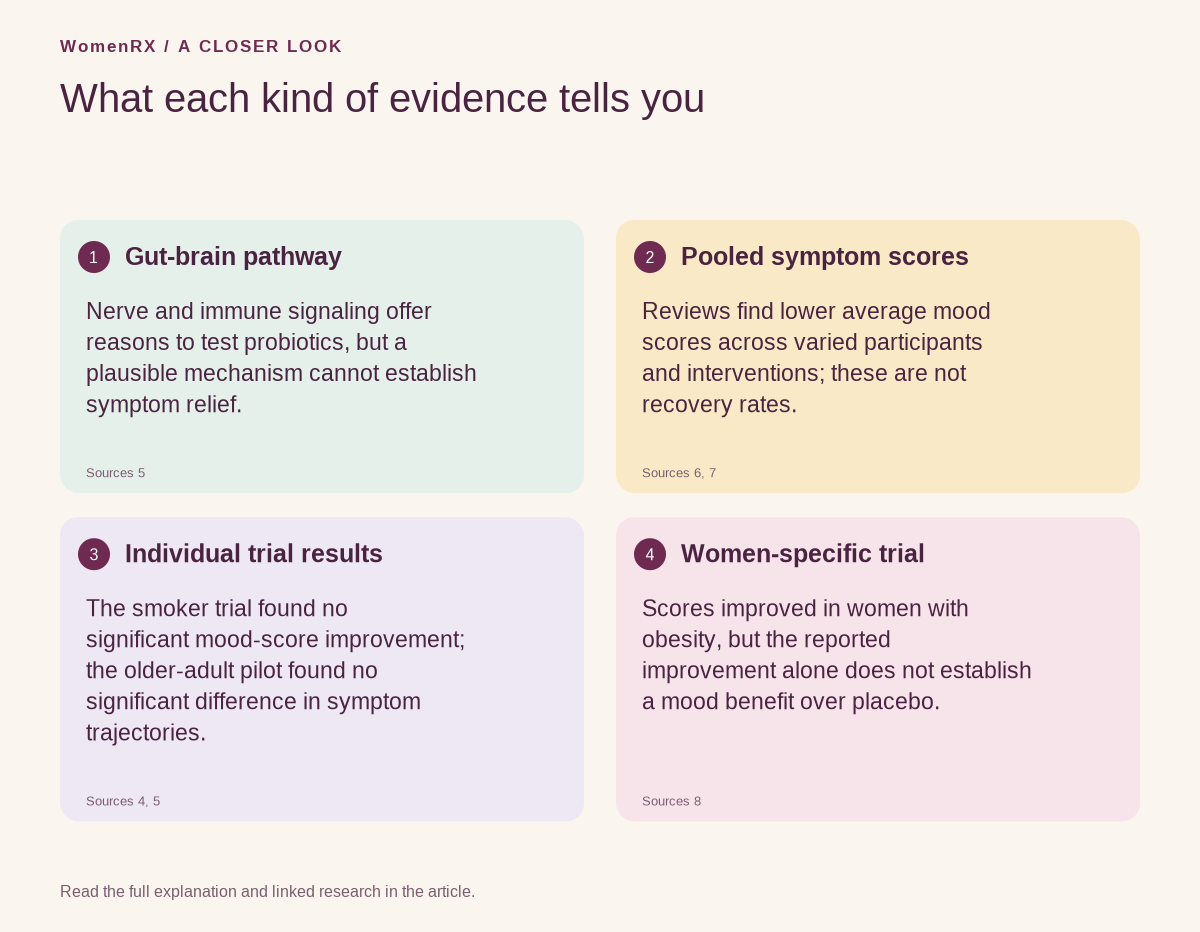
What each kind of evidence tells you
Gut-brain pathway: Nerve and immune signaling offer reasons to test probiotics, but a plausible mechanism cannot establish symptom relief.5
Pooled symptom scores: Reviews find lower average mood scores across varied participants and interventions; these are not recovery rates.67
Individual trial results: The smoker trial found no significant mood-score improvement; the older-adult pilot found no significant difference in symptom trajectories.45
Women-specific trial: Scores improved in women with obesity, but the reported improvement alone does not establish a mood benefit over placebo.8
Read the figure as text
The proposed gut-brain pathway and the measured clinical outcomes answer different questions.- Gut-brain pathway: Nerve and immune signaling offer reasons to test probiotics, but a plausible mechanism cannot establish symptom relief.5
- Pooled symptom scores: Reviews find lower average mood scores across varied participants and interventions; these are not recovery rates.67
- Individual trial results: The smoker trial found no significant mood-score improvement; the older-adult pilot found no significant difference in symptom trajectories.45
- Women-specific trial: Scores improved in women with obesity, but the reported improvement alone does not establish a mood benefit over placebo.8
Sources you can check
- Probiotics - Health Professional Fact SheetAccessed 2026-09-25Return to first citation
- Anxiety: MedlinePlusAccessed 2026-09-25Return to first citation
- Depression: MedlinePlusAccessed 2026-09-25Return to first citation
- The effect of probiotics on anxiety, depression, nicotine dependence, and metabolic biomarkers in smokers: a randomized clinical trial.Sadeghi N, Shams S, Mirlohian RS, Haerifar F, Bakhshi-Kashi M, Ghaderi A. · BMC complementary medicine and therapies · 2025Return to first citation
- Efficacy of Adjunct PRObiotics as Compared to the Standard Care in Moderate Unipolar Depression Among Geriatric Patients: A Randomized Double-Blind Placebo-Controlled Pilot Multi-Center Trial (PRODG).Sinha P, Chatterjee P, Kathiresan P, Raju KS, Panwar R, Mukherjee A, Kumar G, Cherian JJ, Velayuthan A, Chakrawarty A, Mondal S, Kalita M, Kamboj S, Sen S, Bhattacharjee M, Mondal ... · Journal of the American Geriatrics Society · 2026Return to first citation
- The efficacy of probiotics, prebiotics, and synbiotics on anxiety, depression, and sleep: a systematic review and meta-analysis of randomized controlled trials.Zhang J, Zhu L, Meng Q, Wang Z, Zhu H. · BMC psychiatry · 2025Return to first citation
- The Effect of Prebiotics and Probiotics on Levels of Depression, Anxiety, and Cognitive Function: A Meta-Analysis of Randomized Clinical Trials.Zandifar A, Badrfam R, Mohammaditabar M, Kargar B, Goodarzi S, Hajialigol A, Ketabforoush S, Heidari A, Fathi H, Shafiee A, Pourjafar H. · Brain and behavior · 2025Return to first citation
- Safety and efficacy of Lacticaseibacillus rhamnosus LRa05, Limosilactobacillus reuteri LR08, and Lactobacillus crispatus LCr86 on hormone metabolism, body composition, and emotional regulation in overweight women: a randomized, double - blind, placebo - controlled trial.Yin L, Wang S, Liu Y, Zhu C, Wang Z, Wang S, Cai Y, Xu F, Cheng Q. · Journal of applied microbiology · 2026Return to first citation