Probiotics in Menopause: What the Research Has Tested
Research has looked at menopause symptoms, vaginal and urinary health, and bone measures, but results depend on the outcome and the specific probiotic.
Some menopause-related probiotic research has reported possible improvements in symptom scores or vaginal measures, but those findings are limited by study quality and mixed results. Urinary and vaginal outcomes remain uncertain, and a 12-month trial of one synbiotic did not reduce bone loss across its full group of postmenopausal participants. A product’s strain matters more than a high CFU count alone. 3 4 5 1
What probiotics have actually been tested for
“Probiotics for menopause” can mean very different things: an oral supplement for hot flashes, a vaginal product for genitourinary symptoms, or a synbiotic tested for bone measures. These aren’t interchangeable uses. Research on one outcome or formulation doesn’t show that probiotics broadly balance hormones or ease menopause symptoms.
A 2025 systematic review and meta-analysis reported possible benefits for total menopause symptom scores, vasomotor symptoms, psychological symptoms, vaginal dryness, and a vaginal microbiota measure. But the review also judged the included studies to have a high risk of bias. That makes the findings promising, not a reliable reason to expect a particular product to relieve your symptoms. 5
Vaginal and urinary health: measures aren’t the same as relief
A review focused on postmenopausal women with genitourinary syndrome of menopause included nine studies, with 751 participants. The studies tested different routes and formulations and measured outcomes such as vaginal microbiota, vaginal pH, vaginal health, vulvar pain, urinary symptoms, and recurrent urinary infections. Evidence for improving vaginal symptoms and lower urinary tract symptoms was limited and inconsistent. Studies of recurrent cystitis suggested possible benefit in some settings, but randomized trials had mixed or negative results compared with antibiotic prevention. 4
This distinction matters: a change in vaginal bacteria or pH is a measured biological outcome, but it doesn’t automatically mean less dryness, pain, or urinary discomfort. If your main concern is vaginal or urinary symptoms, the evidence doesn’t support treating every Lactobacillus product as equivalent. The North American Menopause Society identifies hormone therapy as an effective treatment for genitourinary symptoms, with other options available depending on the situation. Probiotics shouldn’t be assumed to replace established treatment. 2 4
Bone health: one synbiotic trial, one important result
A 12-month randomized, double-blind trial tested SBD111, a synbiotic containing probiotics and prebiotics, in 286 healthy women one to six years after menopause. For the full group, the product did not significantly reduce bone loss at the lumbar spine compared with placebo. The researchers reported possible differences at other bone sites in prespecified subgroups, including women with osteopenia or a BMI of 30 or higher, but those subgroup findings need confirmation. The study tested one particular product, not probiotics as a category. 3
That’s a useful example of why headlines about “probiotics for bones” can overstate the evidence. The trial’s main result was not a significant reduction in lumbar-spine bone loss across all participants, and it did not establish that the product prevents fractures. 3
Gut symptoms and the microbiome: a plausible idea, not a proven menopause treatment
Estrogen and gut microbes may interact, and researchers are studying whether that relationship matters during the menopause transition. But a proposed mechanism or a measured microbiome difference isn’t proof that a probiotic will improve bloating, constipation, or other gut symptoms. The menopause-focused clinical findings discussed above center more on symptom scales, genitourinary outcomes, and bone measures than on demonstrating relief of common digestive complaints. 5 6
If you’re considering a product, look for its exact strain names, not just “Lactobacillus” or “Bifidobacterium.” Probiotic effects can differ by strain, and products can contain combinations that haven’t themselves been studied. A higher CFU count doesn’t necessarily mean a product works better; the number alone doesn’t tell you whether that strain and formulation have evidence for your goal. 1
The practical takeaway: match the evidence to the concern. A vaginal microbiota finding doesn’t establish relief from hot flashes; a bone measure from one synbiotic trial doesn’t validate a different capsule; and a broad label such as “women’s probiotic” doesn’t identify a proven menopause treatment. For any product you’re weighing, the useful questions are what exact strains it contains, whether that formulation was tested in people like you, and whether the study measured a symptom you actually want to improve. 1 3 4 5
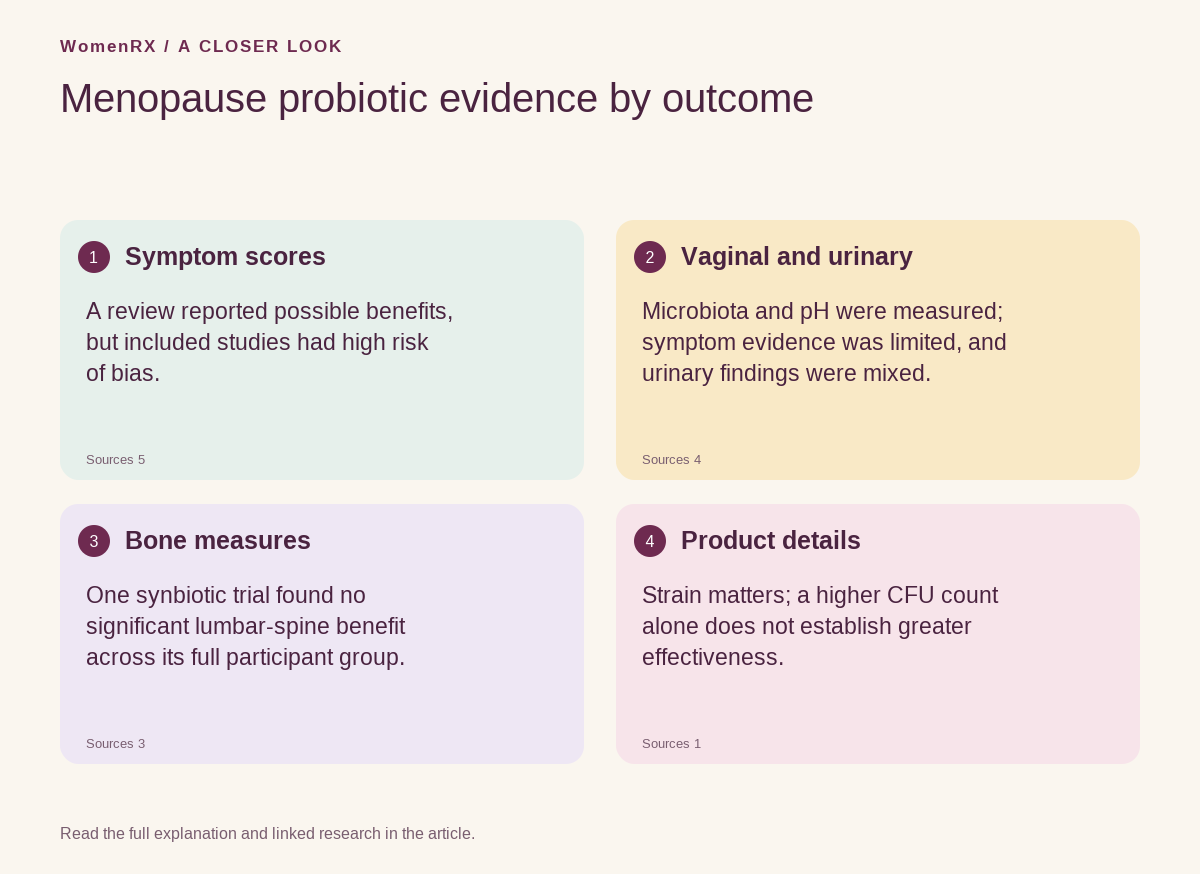
Menopause probiotic evidence by outcome
Symptom scores: A review reported possible benefits, but included studies had high risk of bias.5
Vaginal and urinary: Microbiota and pH were measured; symptom evidence was limited, and urinary findings were mixed.4
Bone measures: One synbiotic trial found no significant lumbar-spine benefit across its full participant group.3
Product details: Strain matters; a higher CFU count alone does not establish greater effectiveness.1
Read the figure as text
These studies measure different things. A biological change, a symptom result, and a bone measure answer different questions.- Symptom scores: A review reported possible benefits, but included studies had high risk of bias.5
- Vaginal and urinary: Microbiota and pH were measured; symptom evidence was limited, and urinary findings were mixed.4
- Bone measures: One synbiotic trial found no significant lumbar-spine benefit across its full participant group.3
- Product details: Strain matters; a higher CFU count alone does not establish greater effectiveness.1
More questions, answered
Does a higher CFU count mean a probiotic is more effective?
No. CFU describes the number of viable organisms listed for a product, but a higher count doesn’t necessarily mean greater effectiveness. Evidence depends on the strain and the outcome being studied. 1
Can a vaginal microbiome result show that symptoms will improve?
Not by itself. Microbiota and pH are measurable outcomes, but they don’t automatically establish relief from dryness, pain, or urinary symptoms. Clinical studies need to measure those experiences directly, and current findings are limited and mixed. 4
Sources you can check
- Probiotics - Health Professional Fact SheetAccessed 2026-09-25Return to first citation
- The 2022 hormone therapy position statement of The North American Menopause Society.“The 2022 Hormone Therapy Position Statement of The North American Menopause Society” Advisory Panel. · Menopause (New York, N.Y.) · 2022Return to first citation
- A randomized, double-blind, placebo-controlled clinical study to evaluate the efficacy of the synbiotic medical food, SBD111, for the clinical dietary management of bone loss in menopausal women.Schott EM, Charbonneau MR, Kiel DP, Bukata S, Zuscik MJ, Rosen C, Ballok A, Toledo GV, Steels E, Huntress H, Rao A, Ebelt P, Travison TG, Soto-Giron MJ, Wolff I, Easson DD, Engelke... · Osteoporosis international : a journal established as result of cooperation between the European Foundation for Osteoporosis and the National Osteoporosis Foundation of the USA · 2025Return to first citation
- Effect of Lactobacillus-based probiotics on genitourinary syndrome of menopause in post-menopausal women: A systematic review.Tsuboi I, Inoue S, Maruyama Y, Mitsui Y, Hirakawa H, Araki M, Sadahira T. · Maturitas · 2026Return to first citation
- Investigating the effects of probiotics during the menopause transition: A systematic review & meta-analysis.Andrews RAF, Lacey A, Roach H, Tomlinson R, Kidd EJ, Bache K. · Clinical nutrition ESPEN · 2025Return to first citation
- Diet, the Gut Microbiome, and Estrogen Physiology: A Review in Menopausal Health and Interventions.Lim MJS, Parlindungan E, See E, Gan CH, Yap R, Yong GJM. · Nutrients · 2026Return to first citation