Can Probiotics Prevent Recurrent UTIs?
Vaginal probiotics show a possible benefit in small studies, but they aren’t a dependable substitute for a prevention plan or treatment of an active UTI.
Probiotics may help prevent recurrent UTIs, but the evidence isn’t strong enough to recommend a general probiotic product. A review of four trials in 616 adult women found a more consistent trend toward benefit with vaginal probiotics than with oral ones, though a reported vaginal result remained uncertain. Probiotics don’t treat an active UTI. 6 2
Why vaginal probiotics are being studied
UTI-causing bacteria can enter the urinary tract through the urethra. Researchers are studying whether Lactobacillus probiotics can support a vaginal microbial community that makes it harder for those bacteria to take hold. That’s a plausible prevention strategy, not proof that a probiotic will stop your next infection. 1 5
A systematic review brought together four randomized trials involving 616 adult women with recurrent uncomplicated UTIs. Compared with placebo, the trials showed a signal toward fewer recurrences and a longer time until the first recurrence. The products and study methods differed enough that the reviewers described the findings rather than combining them into one overall effect estimate. 6
One result shows both the promise and the uncertainty. In a trial of vaginal Lactobacillus crispatus, 15% of participants had a recurrence, compared with 27% of those given placebo. The estimated relative risk was 0.50, but its 95% confidence interval ran from 0.20 to 1.20. That range includes the possibility of no benefit, so the result isn’t conclusive. 6
A vaginal product isn’t the same as an oral capsule
The review found a more consistent trend toward benefit with vaginal probiotics. It did not establish a reliable oral-specific benefit. That doesn’t mean every oral formulation is ineffective; it means you can’t assume an oral capsule will reproduce a result seen with a vaginal product. 6
The organisms in the product matter, too. Probiotics vary by strain and amount, and many products on shelves haven’t been studied for the benefit they imply. A higher colony-forming-unit count, often shortened to CFU, doesn’t necessarily mean a product works better. If you’re considering one, the useful question is whether that specific formulation and route have been studied for recurrent UTIs, not whether its label says “women’s probiotic.” 3
Put probiotics alongside other prevention choices
If infections keep returning, a probiotic doesn’t have to be the only option you consider. Reviews of recurrent-UTI prevention discuss risk-factor changes, methenamine hippurate, and topical estrogen, among other non-antibiotic approaches. Antibiotic prevention is also an option described in UTI guidance. The probiotic findings above don’t establish that probiotics work as well as these approaches or provide a ranking that fits every woman. 4 1 6
Life stage can change the conversation. After menopause, lower estrogen levels can alter vaginal microbiota and urinary defenses. Topical estrogen is among the prevention approaches discussed in recurrent-UTI reviews, while evidence for natural products, including probiotics, remains limited specifically for postmenopausal women. The probiotic trial review covered adult women but did not establish a separate effect for each life stage. 7 4 6
A common definition of recurrent UTI is two infections within six months or three within twelve months. If that sounds familiar, it’s worth discussing whether the episodes were confirmed as UTIs and which prevention options fit your circumstances. 1 4
For that discussion, you could ask:
- Were my recent episodes confirmed as UTIs, or do we need to clarify what’s causing the symptoms?
- If I’m considering a probiotic, is there evidence for this strain, product, and route? 3 6
- Which other prevention options make sense for me, including methenamine, topical estrogen if relevant, or antibiotic prevention? 4 1
When symptoms need care instead of prevention
Prevention research doesn’t make probiotics a treatment for an infection that has already started. If you develop symptoms that make you suspect a UTI, get assessed rather than waiting for a supplement to work. Seek prompt care if urinary symptoms come with fever or pain in your back or side below the ribs, which can signal a more concerning infection. 1 2
What the prevention evidence tells you
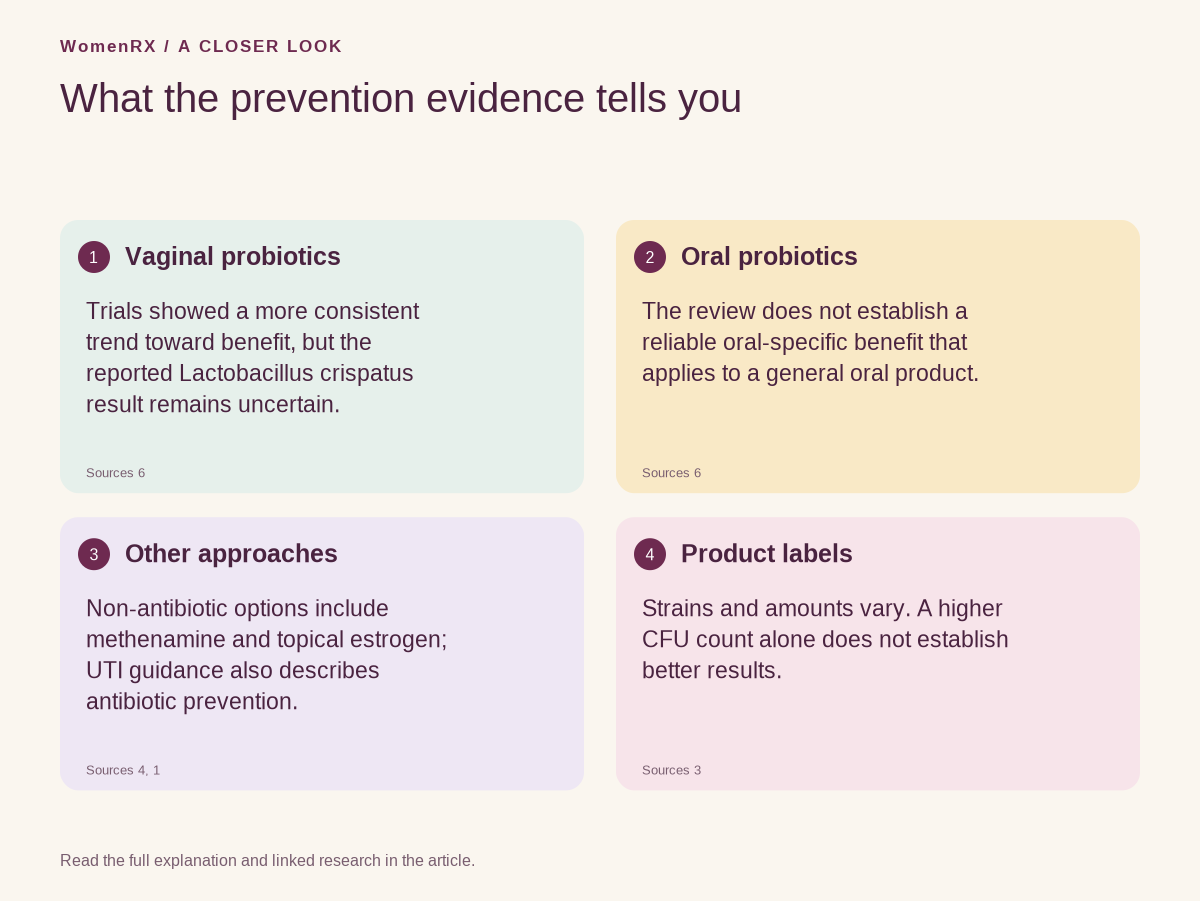
Vaginal probiotics: Trials showed a more consistent trend toward benefit, but the reported Lactobacillus crispatus result remains uncertain.6
Oral probiotics: The review does not establish a reliable oral-specific benefit that applies to a general oral product.6
Other approaches: Non-antibiotic options include methenamine and topical estrogen; UTI guidance also describes antibiotic prevention.41
Product labels: Strains and amounts vary. A higher CFU count alone does not establish better results.3
Read the figure as text
Route and product matter when interpreting probiotic findings alongside other prevention choices.- Vaginal probiotics: Trials showed a more consistent trend toward benefit, but the reported Lactobacillus crispatus result remains uncertain.6
- Oral probiotics: The review does not establish a reliable oral-specific benefit that applies to a general oral product.6
- Other approaches: Non-antibiotic options include methenamine and topical estrogen; UTI guidance also describes antibiotic prevention.41
- Product labels: Strains and amounts vary. A higher CFU count alone does not establish better results.3
More questions, answered
Does a higher CFU count mean better UTI prevention?
No. CFUs indicate how many viable organisms a product contains, but a higher count doesn’t necessarily make it more effective. The strains and the evidence for that particular product matter more than a large number on the label. 3
Sources you can check
- Urinary tract infections (UTIs) - NHSAccessed 2026-09-25Return to first citation
- Urinary Tract Infections | UTI | UTI Symptoms | MedlinePlusAccessed 2026-09-25Return to first citation
- Probiotics - Health Professional Fact SheetAccessed 2026-09-25Return to first citation
- Non-Antibiotic Prophylaxis for Recurrent Urinary Tract Infection: A Narrative Review & Clinical Guide for Primary and Hospital Care.Antoniou V, Somani B. · British journal of hospital medicine (London, England : 2005) · 2026Return to first citation
- The effect of the probiotic supplement-ASTARTE™-on the reduction of recurrent urinary tract infection in women aged 18-40 years: protocol for a randomized, double-blind, placebo-controlled study.Ghathian KSA, Halkjær SI, Krogfelt KA, Frimodt-Møller N, Hansen KH, Frederiksen AKS, Holm A, Petersen AM. · Trials · 2026Return to first citation
- Probiotic prophylaxis in adult women with recurrent uncomplicated urinary tract infections: A systematic review of randomized controlled trials.Yauri-Idelfonso M, Picón-Rafaelo C, Rosales-Goñe P, Pulido-Capurro V, Acevedo-Flores J, Gómez-Gonzales W, Arteaga-Livias K. · Journal of global antimicrobial resistance · 2026Return to first citation
- Bioactive Compounds in Natural Remedies and Functional Foods for Managing Recurrent Urinary Tract Infections in Postmenopausal Women.Chamodini K, Samarasingha S, Didulanga K, Jayasekara C. · Journal of menopausal medicine · 2025Return to first citation