Vaginal Probiotics: What the Evidence Actually Shows
Probiotics have been studied most for bacterial vaginosis, but results depend on the product and the outcome researchers measured.
For bacterial vaginosis (BV), some studies suggest probiotics may help when added to antibiotics, but results vary and probiotics aren’t established as a replacement. Findings about BV don’t show that probiotics treat a yeast infection. Because discharge, odor, itching, or soreness can have different causes, getting the cause checked is safer than trying to diagnose or treat symptoms with a supplement. 1 3 7
BV is the condition probiotics have been studied most
Bacterial vaginosis is an imbalance in vaginal bacteria. A 2022 meta-analysis of randomized trials in adult women found a higher relative cure rate when probiotics were added to antibiotics than with antibiotics alone or with placebo (risk ratio 1.23, 95% CI 1.05-1.43). In a separate comparison, probiotics alone did not clearly differ from antibiotics (risk ratio 1.12, 95% CI 0.60-2.07). That second finding does not show that the treatments are equivalent, and the review’s authors called for stronger evidence. The pooled results combine different products and approaches, so they don’t establish that any probiotic will work for BV. 3
Individual trials underline that uncertainty. In a randomized trial of 126 Chinese women with BV, adding oral Lacticaseibacillus rhamnosus GR-1 and Limosilactobacillus reuteri RC-14 to metronidazole did not improve cure at 30 or 90 days compared with metronidazole alone. A small South African pilot also found no significant difference in BV cure, recurrence, or symptoms when a commercial oral-and-vaginal probiotic was added after standard treatment. 8 5
Other results measure different things. A 12-week trial in reproductive-aged Korean women with Nugent scores of 4-6 found that one specific five-strain oral product reduced Nugent scores compared with placebo. A Nugent score is a measure of vaginal bacteria; a change in it doesn’t by itself establish that symptoms improved or that a diagnosed infection was cured. 4
A pilot study of 120 women reported faster reductions in BV symptoms with one vaginal Bacillus spray than with its control. That is a result for the product and study tested, not proof that vaginal probiotics as a group treat BV or prevent it from returning. 9
The route, strain, and outcome all matter
An oral capsule and a product used in the vagina aren’t interchangeable just because both are called probiotics. The meta-analysis reported a signal favoring oral over vaginal probiotics in some comparisons, but also called for stronger evidence. Trials of particular oral and vaginal products have not produced one consistent result. 3 5 8 9
The specific strains matter, too. Probiotic products can contain different strains and combinations, and many commercial products haven’t been examined in research. A higher colony-forming-unit (CFU) count alone doesn’t mean a product will be more effective. When you see a claim, check whether the studied product, route, condition, and outcome match what the label promises. 2
Yeast infection isn’t the same question as BV
Evidence about BV can’t be assumed to apply to vulvovaginal candidiasis, commonly called a yeast infection. A pregnancy trial tested an oral probiotic blend to prevent repeat vaginal infections after diagnosed infections had been treated and cleared. It found no difference in the rate of vaginal infections between the probiotic and placebo groups. Because the outcome combined different infections, it doesn’t show whether probiotics prevent yeast specifically, and it did not test probiotics as treatment for an active yeast infection. 7
For general “vaginal balance” claims, one small three-week trial in healthy women found improved self-reported vaginal well-being with a particular oral product, but no significant change in the vaginal bacterial community. Feeling better is a meaningful personal outcome, but that trial doesn’t establish that probiotics prevent or treat an infection. 6
Symptoms need a cause, not a guess
Thin, greyish-white discharge with a strong fishy smell can occur with BV. BV often doesn’t cause itching or soreness, but symptoms alone can’t confirm the diagnosis. A clinician may test a vaginal sample to check for BV and other infections; BV itself isn’t classified as a sexually transmitted infection. 1
If symptoms are new, keep returning, or persist after treatment, don’t use a probiotic as a way to identify the cause. BV is commonly treated with prescribed antibiotics and can recur. During pregnancy, suspected BV deserves assessment because treatment may be needed. 1
Life stage also limits what these results can tell you. Several BV studies enrolled reproductive-aged women, and the recurrence trial focused on pregnancy. Those findings don’t establish whether probiotics help after menopause, so they shouldn’t be treated as evidence for that stage. 4 7
A useful way to sort a product claim is to ask what researchers actually measured: confirmed BV cure, recurrence, symptoms, a microbiome marker, or a person’s sense of well-being. Those are different outcomes, and a result on one doesn’t automatically answer the others.
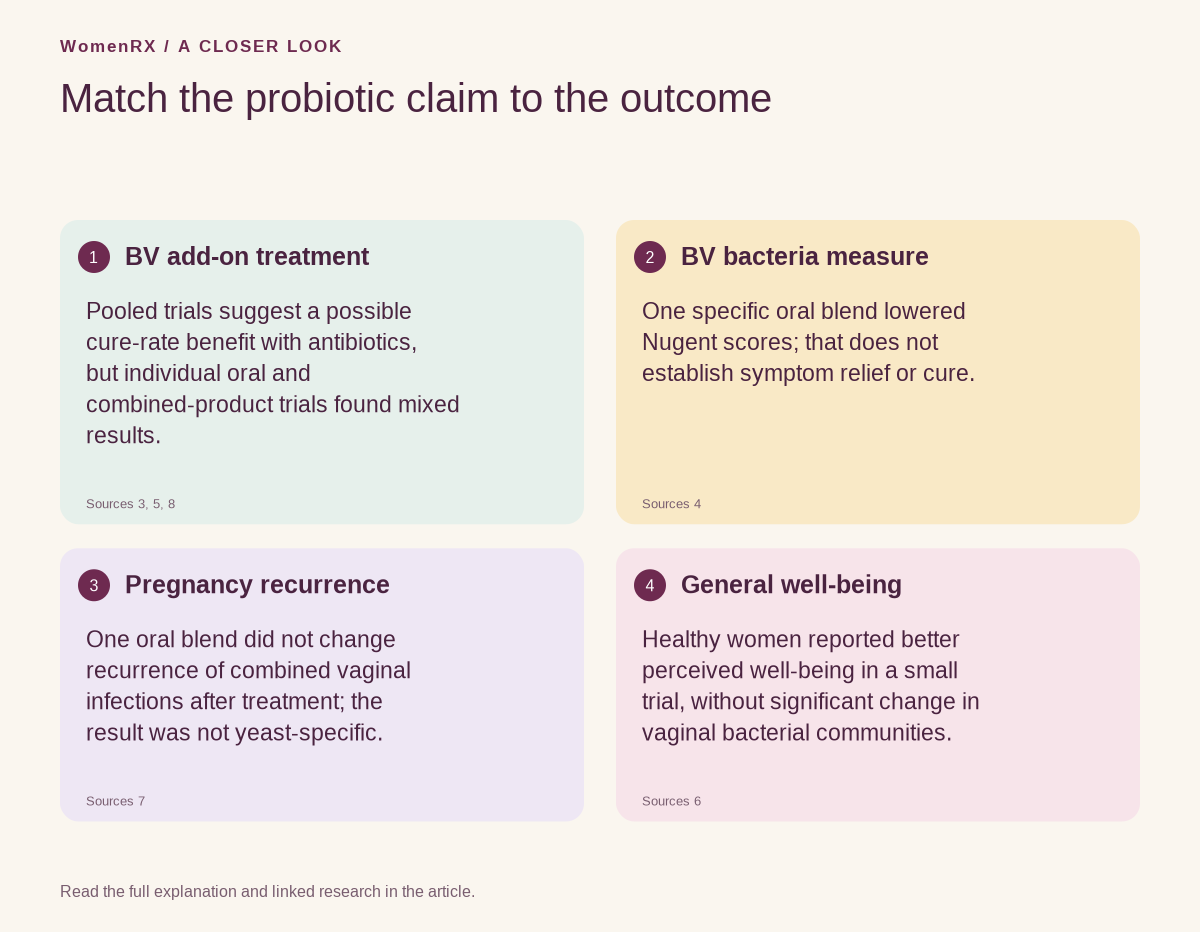
Match the probiotic claim to the outcome
BV add-on treatment: Pooled trials suggest a possible cure-rate benefit with antibiotics, but individual oral and combined-product trials found mixed results.358
BV bacteria measure: One specific oral blend lowered Nugent scores; that does not establish symptom relief or cure.4
Pregnancy recurrence: One oral blend did not change recurrence of combined vaginal infections after treatment; the result was not yeast-specific.7
General well-being: Healthy women reported better perceived well-being in a small trial, without significant change in vaginal bacterial communities.6
Read the figure as text
The condition, route, and outcome measured shape what a probiotic study can tell you.- BV add-on treatment: Pooled trials suggest a possible cure-rate benefit with antibiotics, but individual oral and combined-product trials found mixed results.358
- BV bacteria measure: One specific oral blend lowered Nugent scores; that does not establish symptom relief or cure.4
- Pregnancy recurrence: One oral blend did not change recurrence of combined vaginal infections after treatment; the result was not yeast-specific.7
- General well-being: Healthy women reported better perceived well-being in a small trial, without significant change in vaginal bacterial communities.6
More questions, answered
Can a probiotic replace antibiotics for BV?
The evidence doesn’t establish probiotics as a replacement. The meta-analysis found no clear difference between probiotics alone and antibiotics, which is not proof that the treatments are equivalent. BV is commonly treated with prescribed antibiotics. 1 3
Do oral probiotics prevent vaginal infections during pregnancy?
One randomized pregnancy trial found no difference in repeat vaginal infections with the oral blend it tested compared with placebo. The outcome combined infections, so it doesn’t establish a yeast-specific effect or tell us whether other products work. 7
Sources you can check
- Bacterial vaginosis - NHSAccessed 2026-09-25Return to first citation
- Probiotics - Health Professional Fact SheetAccessed 2026-09-25Return to first citation
- Probiotics are a good choice for the treatment of bacterial vaginosis: a meta-analysis of randomized controlled trial.Chen R, Li R, Qing W, Zhang Y, Zhou Z, Hou Y, Shi Y, Zhou H, Chen M. · Reproductive health · 2022Return to first citation
- Efficacy and Safety of MED-01 Probiotics on Vaginal Health: A 12-Week, Multicenter, Randomized, Double-Blind, Placebo-Controlled Clinical Trial.Park SH, Lee ES, Park ST, Jeong SY, Yun Y, Kim Y, Jeong Y, Kang CH, Choi HJ. · Nutrients · 2023Return to first citation
- Testing the regulatory framework in South Africa - a single-blind randomized pilot trial of commercial probiotic supplementation to standard therapy in women with bacterial vaginosis.Happel AU, Singh R, Mitchev N, Mlisana K, Jaspan HB, Barnabas SL, Passmore JS. · BMC infectious diseases · 2020Return to first citation
- Assessing the Efficacy of Ligilactobacillus salivarius CLS0420 and Lacticaseibacillus paracasei CLPC0603 on Vaginal Well-Being in Healthy Women: A Pilot, Randomized, Double-Blind, Placebo-Controlled Trial.Kim SY, Seol D, Jeong M, Kwak W, Kim H, Cho S, Kim TH. · Probiotics and antimicrobial proteins · 2026Return to first citation
- Oral Probiotics to Prevent Recurrent Vulvovaginal Infections During Pregnancy-Multicenter Double-Blind, Randomized, Placebo-Controlled Trial.Nachum Z, Suleiman A, Colodner R, Battino S, Wattad M, Kuzmin O, Yefet E. · Nutrients · 2025Return to first citation
- Probiotic Lacticaseibacillus rhamnosus GR-1 and Limosilactobacillus reuteri RC-14 as an Adjunctive Treatment for Bacterial Vaginosis Do Not Increase the Cure Rate in a Chinese Cohort: A Prospective, Parallel-Group, Randomized, Controlled Study.Zhang Y, Lyu J, Ge L, Huang L, Peng Z, Liang Y, Zhang X, Fan S. · Frontiers in cellular and infection microbiology · 2021Return to first citation
- Vaginal-spray Bacillus spore probiotics as a potential treatment and reducing recurrence of bacterial vaginosis: randomized, double-blind, and controlled pilot study.Bui HT, Bui ATP, Ngo HT, Ngo XT, Nguyen HT, Nguyen AH, Tran VC, Pham TD, Nguyen ATV. · Communications medicine · 2025Return to first citation