Vaginal Probiotics: Evidence Depends on the Infection
A probiotic studied as an add-on for bacterial vaginosis is not automatically useful for yeast infections or for another product.
Some specific probiotics may help with bacterial vaginosis (BV), particularly as an add-on to standard treatment, but results vary by strain, route and study. Evidence does not show that probiotics generally treat vaginal infections, and the research here does not establish probiotics as a yeast-infection treatment. If symptoms persist or keep returning, first ask what infection, if any, is causing them.
The useful question is: which probiotic, for which infection?
“Probiotic” describes a broad group of live microorganisms, not one treatment. Research findings can depend on the exact strain, product and route of use. A result for one named strain or vaginal preparation can’t be assumed to apply to a different capsule, a combination product or a product used in the vagina. 3
That distinction matters because BV and vaginal yeast infections are different conditions. BV involves a change in the balance of vaginal bacteria; unusual thin, grayish-white discharge and a fishy smell can occur, though some people have no symptoms. 1 Yeast is a fungal infection, not a bacterial imbalance. 2
BV: a possible add-on, not a proven substitute
The clearest overall signal is for probiotics used alongside antibiotics. A 2022 meta-analysis of 14 randomized trials in nonpregnant women of childbearing age found a higher relative cure rate when probiotics were added to antibiotics than with antibiotics alone or antibiotics plus placebo (risk ratio 1.23, 95% CI 1.05-1.43). But the trials used varied probiotic regimens, so this pooled result does not identify one product that works for everyone. 4
The same review did not establish that probiotics alone work as well as antibiotics: across three trials, the comparison was not statistically significant (risk ratio 1.12, 95% CI 0.60-2.07). That is not evidence to replace prescribed BV treatment with a supplement. 4 A separate randomized trial in 126 Chinese women also found no significant improvement from adding oral Lacticaseibacillus rhamnosus GR-1 and Limosilactobacillus reuteri RC-14 to metronidazole. Cure rates were 57.69% with the add-on and 59.57% with metronidazole alone at 30 days; at 90 days, they were 36.54% and 48.94%. 7
Other findings are promising but answer narrower questions. In a 12-week trial, an oral five-strain product called MED-01 lowered Nugent scores in reproductive-aged women with scores of 4-6, a measure of vaginal bacterial balance. That result is not the same as proving that probiotics clear symptomatic, diagnosed BV. 6 A 2025 pilot trial of a specific vaginal spray also reported symptom improvements, but it studied one formulation over a short follow-up. Those results do not establish that other vaginal products, or oral products, have the same effect. 8
Taken together, these studies leave room for a strain- and product-specific benefit, especially as an add-on, while falling short of a general claim that probiotics cure BV or prevent it from returning. BV is commonly treated with antibiotics, and symptoms can have other causes, so a probiotic shouldn’t delay diagnosis or indicated treatment. 14
Yeast and pregnancy need separate answers
The BV findings don’t transfer to vaginal yeast infections. The studies above tested BV or changes in vaginal bacteria, not a general probiotic treatment for yeast. One small randomized trial in pregnant women looked at oral probiotics after vaginal infections had already been treated and cleared. The mixed infection group included BV, abnormal vaginal flora and candidiasis. The study reported recurrence of any vaginal infection in 16 women (67%) in the probiotic group and 11 (48%) in the placebo group; the difference was not statistically significant. The trial therefore does not establish that probiotics prevent or treat yeast infections. 5
That pregnancy study also tested one oral six-strain product, not probiotics as a category. If you’re pregnant and think you may have BV, seek assessment rather than relying on a probiotic; pregnancy is a reason to get suspected BV treated. The study was about prevention after an infection was cleared, not treating symptoms during pregnancy. 15
What to ask before spending money on a product
If you’re considering a probiotic, make the conversation specific:
- What’s the diagnosis? Could these symptoms be BV, yeast, another infection or something else? Confirming BV can help distinguish it from other causes, including sexually transmitted infections. 1
- What exact strain and route were studied? Ask whether the evidence is for the same named strain and whether it was taken orally or used vaginally. Probiotic effects can be strain-specific. 3
- Was it studied alone or alongside treatment? An add-on result doesn’t show that the probiotic works by itself or can replace treatment. 47
- Was the outcome symptom relief, infection clearance or recurrence? A shift in a laboratory score or vaginal bacteria isn’t automatically the same as feeling better or having an infection cured. 6
If symptoms persist, return after treatment or recur, get the cause checked rather than cycling through products. The decision is not simply whether probiotics are “good for vaginal health.” It’s whether a particular product has evidence for your diagnosis, route and goal.
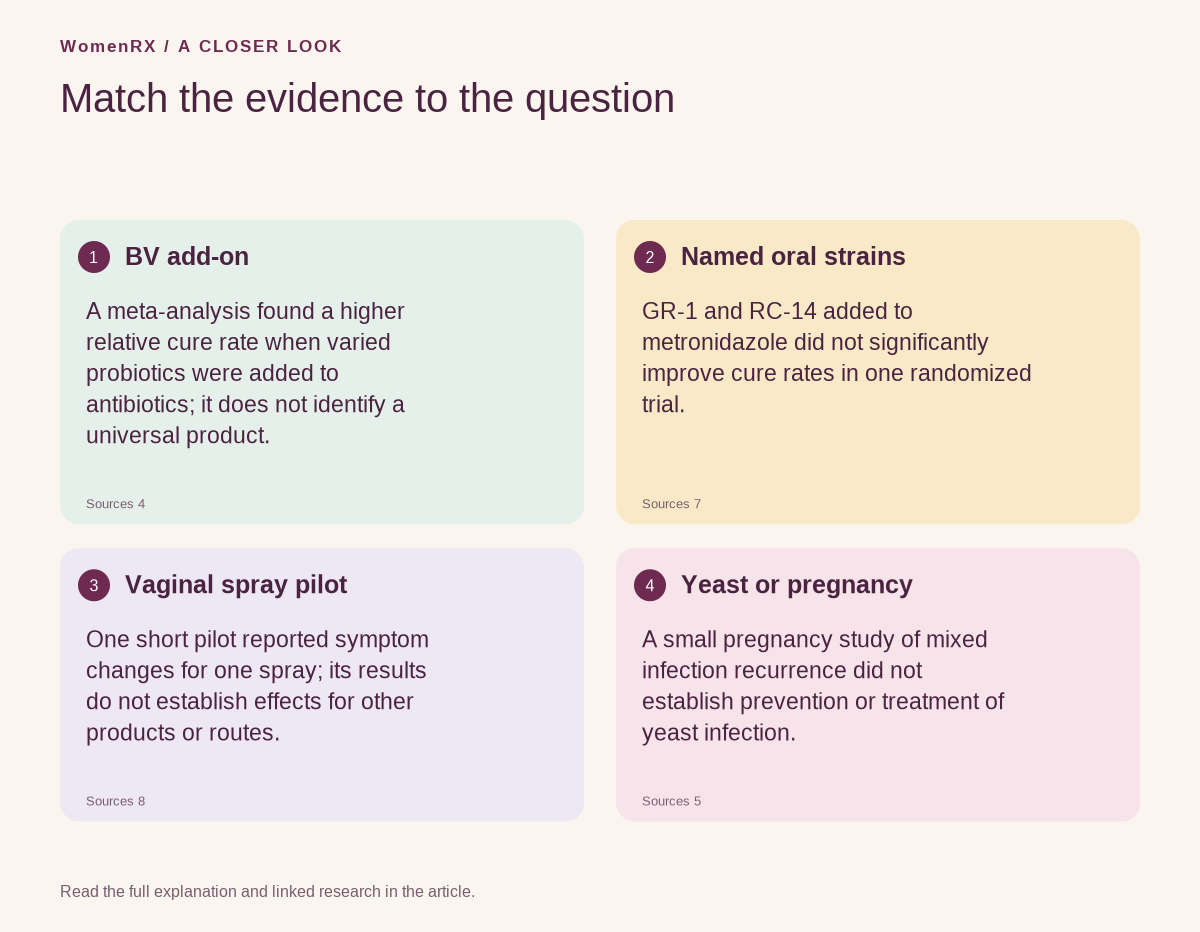
Match the evidence to the question
BV add-on: A meta-analysis found a higher relative cure rate when varied probiotics were added to antibiotics; it does not identify a universal product.4
Named oral strains: GR-1 and RC-14 added to metronidazole did not significantly improve cure rates in one randomized trial.7
Vaginal spray pilot: One short pilot reported symptom changes for one spray; its results do not establish effects for other products or routes.8
Yeast or pregnancy: A small pregnancy study of mixed infection recurrence did not establish prevention or treatment of yeast infection.5
Read the figure as text
These findings concern different infections, products and outcomes. A result in one row should not be treated as proof for another.- BV add-on: A meta-analysis found a higher relative cure rate when varied probiotics were added to antibiotics; it does not identify a universal product.4
- Named oral strains: GR-1 and RC-14 added to metronidazole did not significantly improve cure rates in one randomized trial.7
- Vaginal spray pilot: One short pilot reported symptom changes for one spray; its results do not establish effects for other products or routes.8
- Yeast or pregnancy: A small pregnancy study of mixed infection recurrence did not establish prevention or treatment of yeast infection.5
Sources you can check
- Bacterial vaginosis - NHSAccessed 2026-09-25Return to first citation
- Yeast Infections: MedlinePlusAccessed 2026-09-25Return to first citation
- Probiotics - Health Professional Fact SheetAccessed 2026-09-25Return to first citation
- Probiotics are a good choice for the treatment of bacterial vaginosis: a meta-analysis of randomized controlled trial.Chen R, Li R, Qing W, Zhang Y, Zhou Z, Hou Y, Shi Y, Zhou H, Chen M. · Reproductive health · 2022Return to first citation
- Oral Probiotics to Prevent Recurrent Vulvovaginal Infections During Pregnancy-Multicenter Double-Blind, Randomized, Placebo-Controlled Trial.Nachum Z, Suleiman A, Colodner R, Battino S, Wattad M, Kuzmin O, Yefet E. · Nutrients · 2025Return to first citation
- Efficacy and Safety of MED-01 Probiotics on Vaginal Health: A 12-Week, Multicenter, Randomized, Double-Blind, Placebo-Controlled Clinical Trial.Park SH, Lee ES, Park ST, Jeong SY, Yun Y, Kim Y, Jeong Y, Kang CH, Choi HJ. · Nutrients · 2023Return to first citation
- Probiotic Lacticaseibacillus rhamnosus GR-1 and Limosilactobacillus reuteri RC-14 as an Adjunctive Treatment for Bacterial Vaginosis Do Not Increase the Cure Rate in a Chinese Cohort: A Prospective, Parallel-Group, Randomized, Controlled Study.Zhang Y, Lyu J, Ge L, Huang L, Peng Z, Liang Y, Zhang X, Fan S. · Frontiers in cellular and infection microbiology · 2021Return to first citation
- Vaginal-spray Bacillus spore probiotics as a potential treatment and reducing recurrence of bacterial vaginosis: randomized, double-blind, and controlled pilot study.Bui HT, Bui ATP, Ngo HT, Ngo XT, Nguyen HT, Nguyen AH, Tran VC, Pham TD, Nguyen ATV. · Communications medicine · 2025Return to first citation