UTI, BV, or Yeast? How Testing and Treatment Differ
Where the discomfort shows up and what a test finds help distinguish three problems that can feel confusingly similar.
A UTI affects the urinary tract, while bacterial vaginosis (BV) and vaginal yeast infection affect the vagina or vulva. Burning with urination can occur with more than one, and discharge or itching alone cannot reliably identify the cause. Clinicians use urine testing for a suspected UTI and vaginal examination or swab testing for BV and yeast; treatment differs, so repeated symptoms deserve a fresh assessment. 1 2 5
Start with where you feel it
Burning when you pee, vaginal discharge, odor, and itching can overlap, but they point to different places in the body. A UTI involves the urinary tract. BV is a change in the balance of bacteria in the vagina. A yeast infection is an overgrowth of Candida that causes inflammation of the vulva or vagina. More than one condition can also be present at once. 1 2 4
That’s why symptoms are useful clues, not a diagnosis. In a small retrospective study at one US free clinic, vaginal symptoms did not consistently match BV, yeast, or trichomoniasis test results. The study has limits, but it illustrates why treating every episode based on how it feels can miss the cause. 6
The clues, and the tests behind them
| Condition | Clues that may fit | What testing looks for |
|---|---|---|
| UTI | Urinary burning, urgency, or frequency. In a study of postmenopausal women with suspected UTI, these were among the symptoms recorded. | A urine test can help identify a UTI; urine culture was used to check for bacteria in a large postmenopausal cohort. 1 7 |
| BV | Thin, watery, grayish-white discharge with a fishy smell, often more noticeable after sex. BV usually doesn’t cause itching or soreness. | A clinician may examine the vagina and take a swab of vaginal discharge to test for BV and other infections. 2 |
| Yeast infection | Vulvar itching, burning, soreness, redness, or swelling; discharge may be thick and have little odor. Burning when urine touches irritated external skin can occur. | A vaginal sample can be examined under a microscope, including with a wet preparation and KOH; a swab may also be used for culture. 5 |
These are patterns, not a home diagnostic checklist. The review of yeast diagnosis describes Candida being found in some people without symptoms, so a positive result needs to be interpreted alongside symptoms and an examination. It also notes that symptoms can overlap with other vaginal conditions. 4 5
Why the treatments aren’t interchangeable
A UTI is treated with antibiotics when an infection is identified or judged likely. BV is also treated with antibiotics, often as a tablet, gel, or cream. Vaginal yeast infections are treated with antifungal medicines. Antibiotics do not treat yeast, and using the wrong treatment can leave the actual cause unaddressed. 1 2 3
If symptoms continue after treatment, return soon, or keep recurring, don’t assume the same condition is back. A clinician may need to repeat testing, check for another cause, or consider that more than one condition is present. With yeast symptoms in particular, the review notes that non-albicans Candida and resistance can complicate recurrent cases, reinforcing the value of reassessment rather than repeatedly guessing. 4
Pregnancy and menopause can change the picture
If you’re pregnant and your vaginal discharge changes, contact your pregnancy care team for assessment. BV can occur without symptoms, and pregnancy is a reason to have suspected BV evaluated because it may carry a small risk of complications, although most pregnancies with BV have no problems. 2
After menopause, urinary urgency, frequency, or burning may resemble a UTI even when the explanation is genitourinary syndrome of menopause (GSM), rather than a bacterial infection. In one retrospective study of postmenopausal women who had UTI symptoms, only 36.2% had a urine culture completed; among those cultures, 60.9% were positive. Those figures describe that particular health-system cohort, not every postmenopausal woman, but they show why symptoms alone may not settle the question. 7
BV isn’t classified as an STI, and people who haven’t had sex can develop it. Sexual activity can be associated with BV, but it isn’t the only explanation, and symptoms aren’t proof of poor hygiene. 2
The practical next step
If this is your first episode, the symptoms don’t fit a familiar pattern, or treatment hasn’t helped, ask what test can distinguish a urinary infection from a vaginal cause. Mention whether the burning feels internal during urination or happens when urine touches irritated skin, and whether odor, discharge, or itching is present. Those details help direct testing, but the test result and clinical picture should guide treatment. 2 5 7
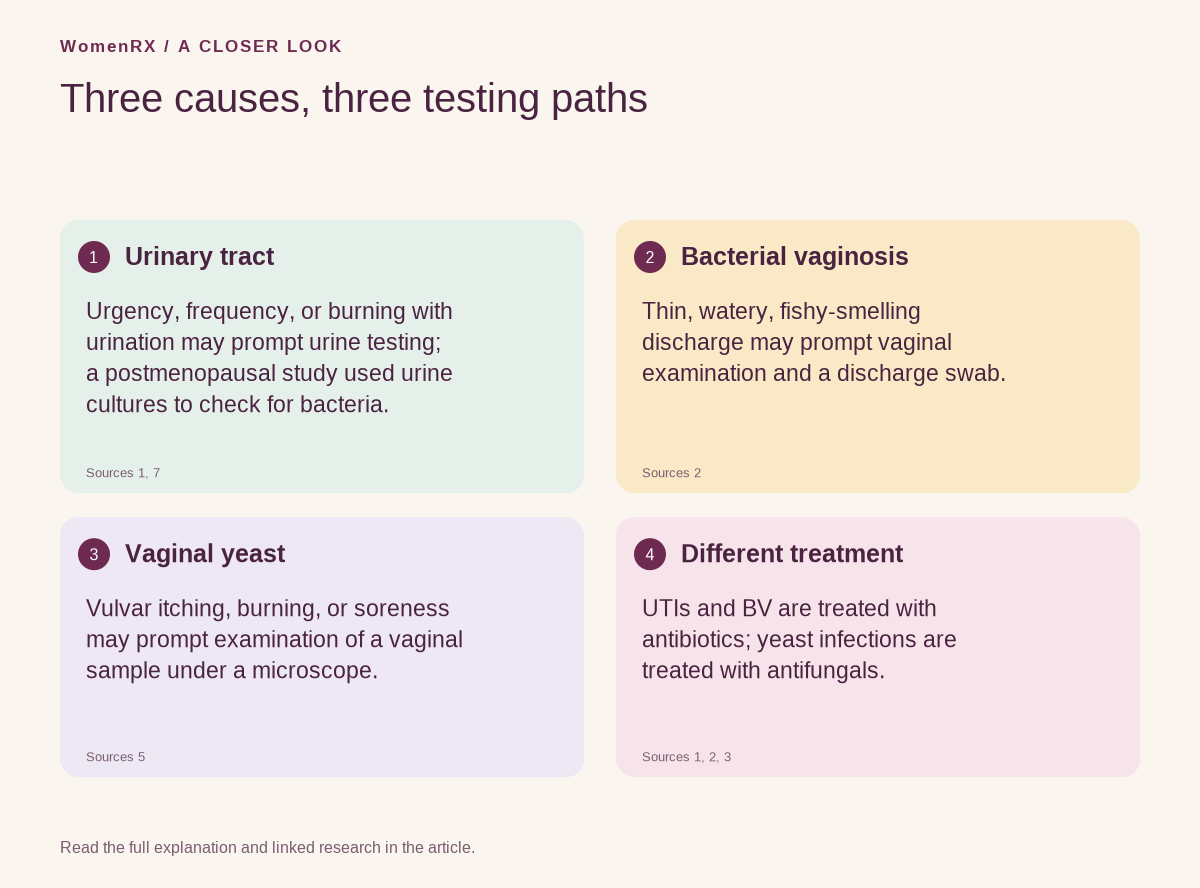
Three causes, three testing paths
Urinary tract: Urgency, frequency, or burning with urination may prompt urine testing; a postmenopausal study used urine cultures to check for bacteria.17
Bacterial vaginosis: Thin, watery, fishy-smelling discharge may prompt vaginal examination and a discharge swab.2
Vaginal yeast: Vulvar itching, burning, or soreness may prompt examination of a vaginal sample under a microscope.5
Different treatment: UTIs and BV are treated with antibiotics; yeast infections are treated with antifungals.123
Read the figure as text
Symptoms can overlap, but the body location and sample used for testing differ. This comparison shows what each pattern may suggest without using symptoms as a diagnosis.- Urinary tract: Urgency, frequency, or burning with urination may prompt urine testing; a postmenopausal study used urine cultures to check for bacteria.17
- Bacterial vaginosis: Thin, watery, fishy-smelling discharge may prompt vaginal examination and a discharge swab.2
- Vaginal yeast: Vulvar itching, burning, or soreness may prompt examination of a vaginal sample under a microscope.5
- Different treatment: UTIs and BV are treated with antibiotics; yeast infections are treated with antifungals.123
More questions, answered
Can a yeast infection cause burning when I pee?
Yes. Yeast-related vulvar irritation can cause external burning, including when urine touches inflamed skin. That’s different from assuming the urinary tract itself is infected, so the location of the discomfort and appropriate testing matter. 5
Can BV happen if I haven’t had sex?
Yes. BV is not classified as an STI, and people who haven’t had sex can develop it, even though sexual activity can be associated with BV. 2
Sources you can check
- Urinary Tract Infections | UTI | UTI Symptoms | MedlinePlusAccessed 2026-09-25Return to first citation
- Bacterial vaginosis - NHSAccessed 2026-09-25Return to first citation
- Yeast Infections: MedlinePlusAccessed 2026-09-25Return to first citation
- State-of-the-Art Review: Managing Vulvovaginal Candidiasis.Rautemaa-Richardson R, Sobel JD, Stone N, De Seta F, Cassone A, Vieira-Baptista P, Comar M, Warris A, Roselletti E. · Clinical infectious diseases : an official publication of the Infectious Diseases Society of America · 2026Return to first citation
- A Comprehensive Overview of Candida albicans as the Leading Pathogen in Vulvovaginal Candidiasis.Srb N, Talapko J, Meštrović T, Fureš R, Stupnišek M, Srb AM, Škrlec I. · Journal of fungi (Basel, Switzerland) · 2025Return to first citation
- Vaginitis testing outcomes by documented symptom status in a student-run free clinic: a retrospective study.Lee GA, Meyer G, Wang YA, Gluzman I, Dunlop H, Trezza F, Makkar N, Donnelly B, Helsabeck N, Shihabuddin CD. · Journal of obstetrics and gynaecology : the journal of the Institute of Obstetrics and Gynaecology · 2026Return to first citation
- Underdiagnosed and overmedicated: Investigating the management of urinary tract infection and vaginal estrogen use in a large cohort of postmenopausal women.Nahum R, Machtinger R, Oberman B, Shtrall T, Reichenberg Y, Arbib N, Kaplan B. · Maturitas · 2026Return to first citation