BV or a yeast infection? Clues, overlap, and testing
A fishy odor and thin discharge are more typical of BV; itching, burning, and redness fit yeast better, but symptoms can overlap or have another cause.
BV more often causes thin, grayish-white discharge with a fishy smell and usually little itching or soreness. A yeast infection more often causes itching, burning, redness, and sometimes thick white discharge. These are clues, not a diagnosis: symptoms can overlap, Candida can be present without causing infection, and BV and yeast can occur together. A vaginal swab or other testing can help when the cause is unclear. 1 6 7 8
The clues that may point one way
| Feature | More typical of BV | More typical of yeast |
|---|---|---|
| Discharge | Often thin and watery, grayish-white | Sometimes thick and white, clumpy |
| Odor | A strong, fishy smell, sometimes more noticeable after sex | Itching and irritation are more characteristic clues than odor |
| Itching or soreness | Usually not prominent | Itching, burning, and vulvar redness are common |
BV is an imbalance in vaginal bacteria. Many people with BV have no symptoms; when symptoms occur, a fishy smell and thin, grayish-white discharge are common, and itching or soreness is not typical. 1
Yeast infection, also called vulvovaginal candidiasis, more often involves inflammation: itching, burning, and redness around the vulva or vagina. Thick, white, clumpy discharge can occur, but it isn't present in every case. In a survey of 284 nonpregnant women with a history of yeast infection, itching was the most commonly reported symptom, followed by burning; the survey describes women's reported experiences, not a test that can diagnose an individual. 7
Why appearance alone can mislead
Discharge varies normally, including in amount and texture. A change in odor, color, or consistency can be a clue that something has changed, but it doesn't identify the cause on its own. 3
There is another reason a yeast-like symptom pattern isn't proof of yeast: Candida can live in the vagina without causing an infection. A diagnosis relies on symptoms together with evidence of yeast, rather than finding yeast alone. 6
BV and yeast can also occur together. In one diagnostic study of 500 symptomatic women, microscopy identified BV and yeast together in 12 women (2.4%); an automated method identified 13 (2.6%). Those results show that both can be present at once, but the figures come from one study and aren't a general estimate for everyone with vaginal symptoms. 8
And not every change is BV or yeast. Green, yellow, or frothy discharge can occur with trichomoniasis; discharge with pelvic pain or bleeding can be associated with chlamydia or gonorrhea; blisters or sores can occur with genital herpes. These patterns don't establish a diagnosis, but they're reasons not to assume the cause is BV or yeast. 3
When testing is more useful than guessing
Testing is worth considering when the pattern doesn't clearly fit, symptoms keep returning, or this episode feels different from what you've had before. Symptoms alone may not settle an uncertain or recurring case: yeast symptoms are nonspecific, yeast can be present without causing them, and BV and yeast can occur together. 6 8
Assessment may include questions about symptoms and an examination. A vaginal swab can be tested for BV and other infections; clinical testing may also use microscopy or a molecular test, depending on the setting. 1 8 9 If an STI is possible, ask whether testing for that is appropriate too. In a study of symptomatic women, molecular testing was used to look for BV, yeast, and sexually transmitted infections, illustrating that more than one cause can be assessed from testing. 9
Home yeast tests are not a sure way to rule infection in or out. In a study of 140 vaginal samples, four marketed Candida self-tests had sensitivities from 30.8% to 73.0% when compared with culture. That means their ability to detect culture-positive samples varied substantially in that study; it doesn't tell us how every product performs in every setting. 5
Getting the cause right matters because BV and yeast are treated differently: metronidazole is an antibiotic used for BV, while antifungal medicines treat yeast infections. Using a treatment aimed at the wrong cause may leave the actual problem unaddressed. 2 4 If you're pregnant and have symptoms that might be BV, seek assessment rather than relying on a guess; treatment may be needed during pregnancy. 1
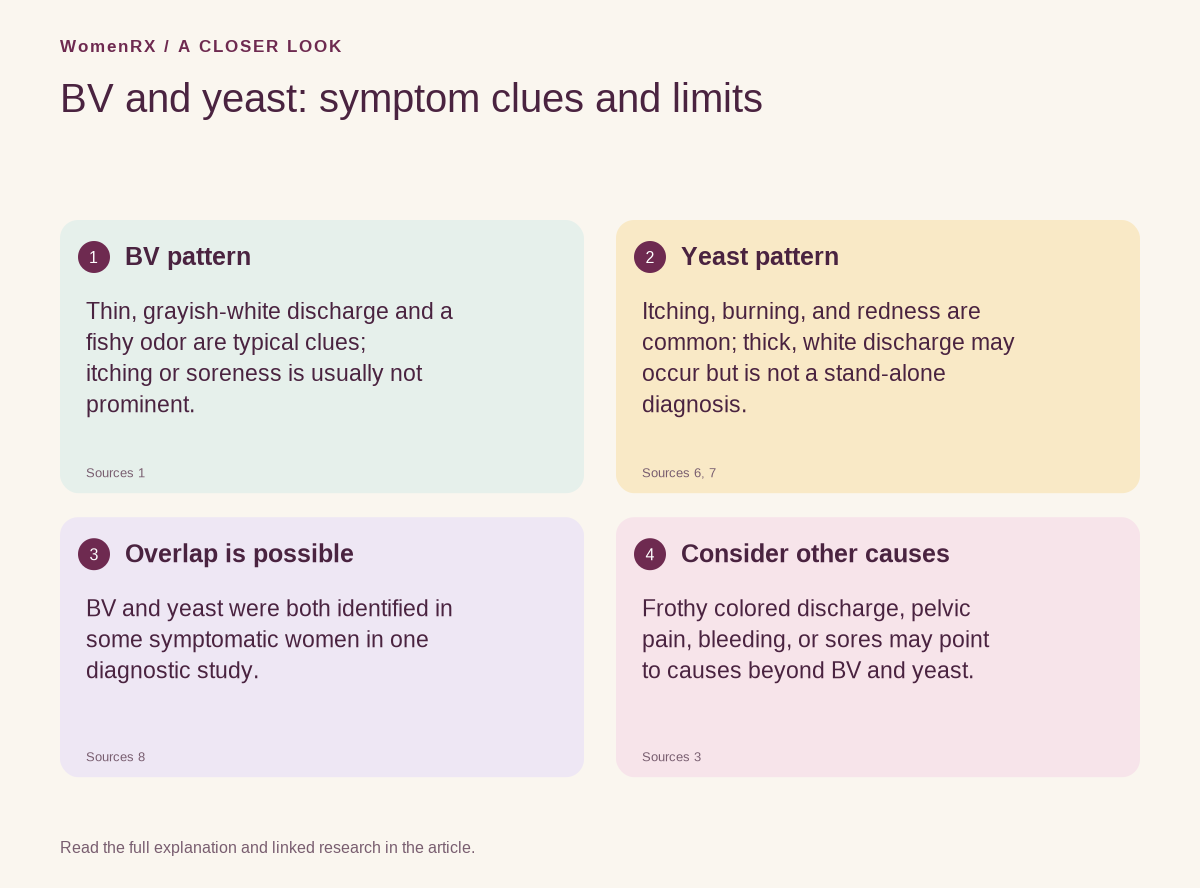
BV and yeast: symptom clues and limits
BV pattern: Thin, grayish-white discharge and a fishy odor are typical clues; itching or soreness is usually not prominent.1
Yeast pattern: Itching, burning, and redness are common; thick, white discharge may occur but is not a stand-alone diagnosis.67
Overlap is possible: BV and yeast were both identified in some symptomatic women in one diagnostic study.8
Consider other causes: Frothy colored discharge, pelvic pain, bleeding, or sores may point to causes beyond BV and yeast.3
Read the figure as text
Compare common patterns without treating them as a diagnosis; both can overlap, and other infections can cause vaginal symptoms.- BV pattern: Thin, grayish-white discharge and a fishy odor are typical clues; itching or soreness is usually not prominent.1
- Yeast pattern: Itching, burning, and redness are common; thick, white discharge may occur but is not a stand-alone diagnosis.67
- Overlap is possible: BV and yeast were both identified in some symptomatic women in one diagnostic study.8
- Consider other causes: Frothy colored discharge, pelvic pain, bleeding, or sores may point to causes beyond BV and yeast.3
More questions, answered
Can BV and a yeast infection happen at the same time?
Yes. In one study of 500 women with vaginal symptoms, microscopy identified BV and yeast together in 12 participants (2.4%). The study shows that overlap is possible, not how often it occurs in every population. 8
Can a home yeast test rule out a yeast infection?
Not reliably based on one study of four marketed tests: compared with culture, their sensitivity ranged from 30.8% to 73.0% across 140 samples. A negative result could miss yeast, and the study doesn't establish the performance of every test in everyday use. 5
Sources you can check
- Bacterial vaginosis - NHSAccessed 2026-09-25Return to first citation
- Yeast Infections: MedlinePlusAccessed 2026-09-25Return to first citation
- Vaginal discharge - NHSAccessed 2026-09-25Return to first citation
- About metronidazole - NHSAccessed 2026-09-25Return to first citation
- Evaluation of the diagnostic performance of four self-tests for vulvovaginal candidiasis.Himschoot L, Vanraepenbusch A, Selis N, Meakin P, Blumin Y, Schmid DA, Bruisten SM, Cools P. · Sexually transmitted infections · 2025Return to first citation
- Recurrent vulvovaginal candidiasis.Blostein F, Levin-Sparenberg E, Wagner J, Foxman B. · Annals of epidemiology · 2017Return to first citation
- Current patient perspectives of vulvovaginal candidiasis: incidence, symptoms, management and post-treatment outcomes.Yano J, Sobel JD, Nyirjesy P, Sobel R, Williams VL, Yu Q, Noverr MC, Fidel PL. · BMC women's health · 2019Return to first citation
- Diagnostic performance of deep learning-based vaginal microecological morphology assessment for bacterial vaginosis and vulvovaginal candidiasis.Zhang P, Li HM, Gao HH, Yan L. · Frontiers in microbiology · 2026Return to first citation
- Clinical utility of nucleic acid amplification testing for detection of sexually transmitted infections in women with symptomatic bacterial vaginosis and vulvovaginal candidiasis identified by conventional versus molecular diagnoses.Getman D, Seña AC, Nenninger A, Schwebke JR. · Journal of clinical microbiology · 2026Return to first citation