Yeast Infection After Menopause: Clues and Other Causes
Itching or discharge can fit a yeast infection, but symptoms alone can’t reliably distinguish yeast from menopause-related tissue changes or other conditions.
A yeast infection is one possibility when itching comes with thick, white discharge, but those clues don’t confirm it. Other vaginal infections can also cause irritation or discharge, and postmenopausal vulvar itching may have noninfectious causes, including atrophic changes or skin conditions. If symptoms are new, persistent, or keep returning, an exam and vaginal testing can help identify the right cause. 457
Symptoms offer clues, not a diagnosis
Vulvovaginal candidiasis, often called a vaginal yeast infection, can cause itching and thick, cottage-cheese-like discharge. But vaginal and vulvar symptoms overlap: irritation, burning, painful urination, pain with sex, and changes in discharge can occur with more than one cause. A symptom pattern can point toward a possibility, but it can’t confirm which one you have. 45
That distinction matters after menopause, too. A new bout of itching or discharge isn’t automatically yeast, and familiar symptoms don’t prove that an antifungal is the right treatment. Symptom-based diagnosis can lead to both missed infections and treatment for the wrong condition. 4
What else can feel similar?
Genitourinary syndrome of menopause (GSM) is a menopause-associated condition. A review of vulvar itching describes hormonal effects on skin hydration and its protective barrier, and includes atrophic vulvovaginitis among possible causes of vulvar itch. That means irritation after menopause can have a noninfectious explanation, though itching by itself can’t tell you whether GSM is the cause. 67
Other vaginal infections can cause overlapping symptoms. Bacterial vaginosis and trichomoniasis, for example, are among the different causes of discharge described in a study of women ages 15 to 65. The study wasn’t specific to postmenopausal women, so its symptom descriptions shouldn’t be treated as a menopause-specific diagnostic guide. 5
Vulvar skin conditions can also cause itching. A review lists conditions such as irritant or atopic dermatitis, psoriasis, and lichen sclerosus among possible causes. Their symptoms can be mistaken for infection, which is one reason persistent vulvar irritation deserves more than repeated guessing. 7
| A possible cause | Clue that may fit | What the clue can’t tell you |
|---|---|---|
| Yeast infection | Itching with thick, white discharge 5 | Symptoms alone can’t confirm yeast. 4 |
| GSM or atrophic changes | A menopause-associated, noninfectious possibility for vulvar symptoms 67 | Itching alone doesn’t establish GSM. 7 |
| Another vaginal infection | Discharge, odor, itching, or irritation can overlap across infections 5 | A symptom pattern may not identify the specific cause. 5 |
| Vulvar skin condition | Several skin disorders can cause vulvar itch 7 | An exam may be needed to distinguish these from infection. 47 |
When testing can make a difference
A clinician can assess the symptoms and, when appropriate, examine a vaginal sample. Microscopy and fungal culture are among the tests used to help confirm candidiasis; testing is especially useful when symptoms recur or don’t improve as expected. A positive result also needs to be interpreted alongside symptoms, because finding Candida doesn’t always prove it is causing them. 34
Testing can prevent a cycle of treating presumed yeast while missing another explanation. If treatment for a suspected yeast infection hasn’t helped, symptoms keep returning, or this is a new pattern for you after menopause, ask whether an exam and testing are appropriate rather than automatically repeating antifungal treatment. 34
Match treatment to the cause
Antifungal medicines such as fluconazole work against yeast. They won’t treat GSM or a vulvar skin condition, so taking an antifungal when yeast isn’t the cause may leave the real problem unchanged. 127
For bothersome GSM symptoms that haven’t improved with over-the-counter therapies, the North American Menopause Society lists low-dose vaginal estrogen and other therapies as options for appropriate women. Estrogen addresses GSM; it is not an antifungal treatment for candidiasis. The right approach depends on what is causing your symptoms. 6
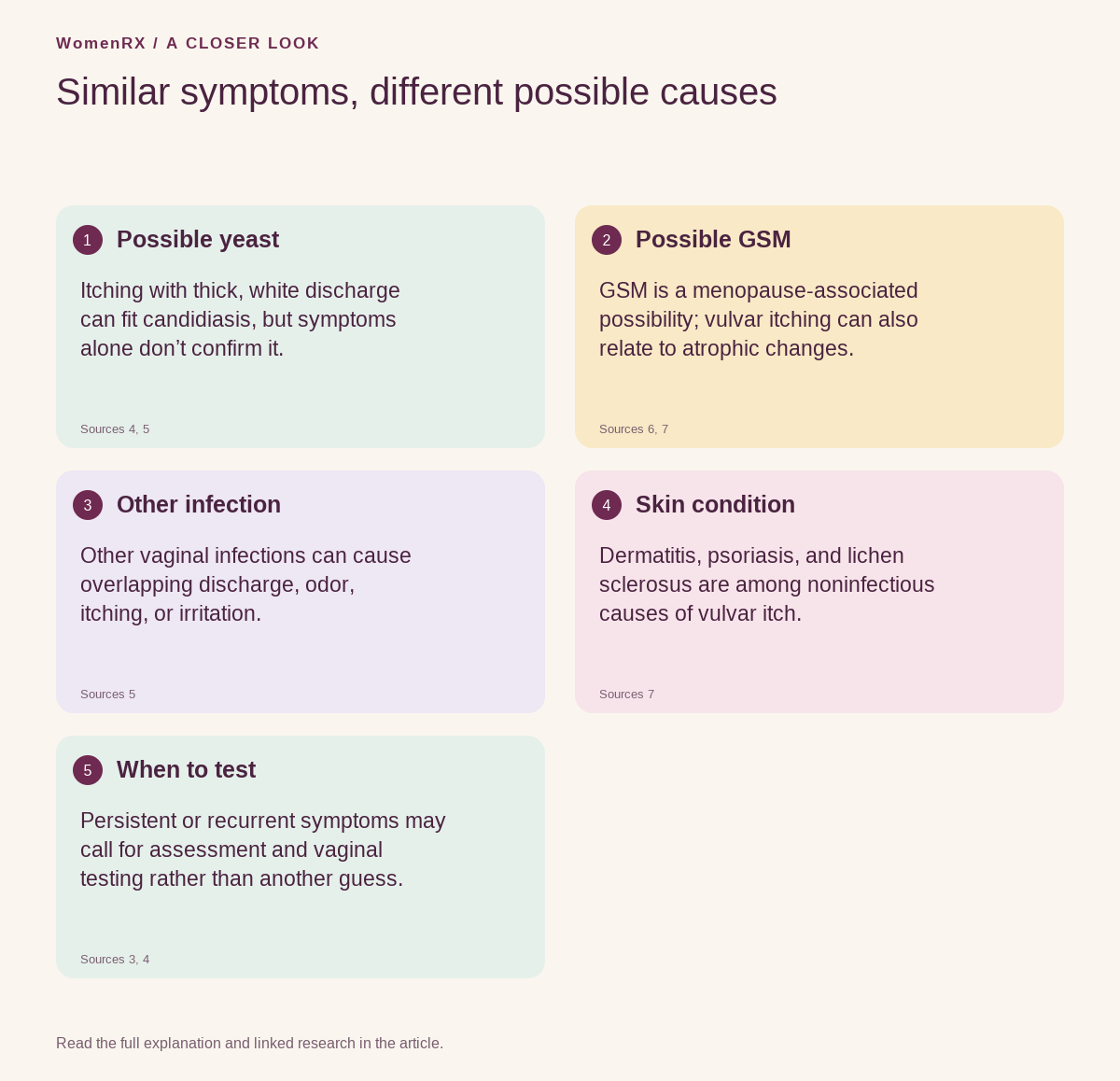
Similar symptoms, different possible causes
Possible yeast: Itching with thick, white discharge can fit candidiasis, but symptoms alone don’t confirm it.45
Possible GSM: GSM is a menopause-associated possibility; vulvar itching can also relate to atrophic changes.67
Other infection: Other vaginal infections can cause overlapping discharge, odor, itching, or irritation.5
Skin condition: Dermatitis, psoriasis, and lichen sclerosus are among noninfectious causes of vulvar itch.7
When to test: Persistent or recurrent symptoms may call for assessment and vaginal testing rather than another guess.34
Read the figure as text
These clues can orient you, but they don’t diagnose the cause. Testing and clinical assessment can help separate infection from menopause-related or skin-related conditions.- Possible yeast: Itching with thick, white discharge can fit candidiasis, but symptoms alone don’t confirm it.45
- Possible GSM: GSM is a menopause-associated possibility; vulvar itching can also relate to atrophic changes.67
- Other infection: Other vaginal infections can cause overlapping discharge, odor, itching, or irritation.5
- Skin condition: Dermatitis, psoriasis, and lichen sclerosus are among noninfectious causes of vulvar itch.7
- When to test: Persistent or recurrent symptoms may call for assessment and vaginal testing rather than another guess.34
More questions, answered
Can symptoms alone tell me whether it’s yeast?
No. Itching and thick, white discharge can fit yeast, but symptoms overlap with other infections and noninfectious causes. An exam and testing can help when the diagnosis is uncertain, symptoms persist, or infections keep recurring. 45
Does vaginal estrogen treat a yeast infection?
No. Fluconazole is an antifungal used to treat fungal infections; vaginal estrogen is an option for some women with bothersome GSM symptoms. They address different causes. 16
Sources you can check
- About fluconazole - NHSAccessed 2026-09-25Return to first citation
- Common questions about fluconazole - NHSAccessed 2026-09-25Return to first citation
- Standardizing Vulvovaginal candidiasis diagnosis in Uganda: A case for British Association for Sexual Health and HIV 2019 guidelines.Jonani B. · IJID regions · 2025Return to first citation
- Clinical challenges in diagnosis and treatment of recurrent vulvovaginal candidiasis.Neal CM, Martens MG. · SAGE open medicine · 2022Return to first citation
- Vaginal discharge: The diagnostic enigma.Amrin SS, Lakshmi GJ. · Indian journal of sexually transmitted diseases and AIDS · 2021Return to first citation
- The 2022 hormone therapy position statement of The North American Menopause Society.“The 2022 Hormone Therapy Position Statement of The North American Menopause Society” Advisory Panel. · Menopause (New York, N.Y.) · 2022Return to first citation
- Female-specific pruritus from childhood to postmenopause: clinical features, hormonal factors, and treatment considerations.Rimoin LP, Kwatra SG, Yosipovitch G. · Dermatologic therapy · 2013Return to first citation