Yeast Infection or Menopause-Related Vaginal Symptoms?
Itching, soreness, and discharge can overlap, so recurring symptoms deserve more than another guess-and-treat cycle.
Yeast infections can cause itching, burning, soreness, and discharge, but none of these symptoms confirms yeast on its own. Around and after menopause, lower hormone levels can also contribute to dryness and pain, while skin conditions and other infections can cause irritation too. If symptoms are new, keep returning, or don’t improve with antifungal treatment, an examination and appropriate testing can help identify the cause.
Why the symptoms can be hard to tell apart
A yeast infection may cause vulvar itching, burning, soreness, redness, small skin cracks, pain with sex, or vaginal discharge. But those symptoms aren’t unique to yeast. Other skin conditions and infections can feel similar, and more than one cause can be present at once. A symptom pattern can offer clues, but it can’t confirm the diagnosis by itself. 6
After menopause, itching and soreness may also be related to genitourinary syndrome of menopause (GSM), a group of genital and urinary changes associated with lower reproductive hormone levels. Dryness and pain can begin in late perimenopause, too. Skin conditions and other causes remain possible, so it’s best not to assume that every new irritation is either menopause or yeast. 2 3
Clues are useful, but they aren’t a diagnosis
Thick, white discharge can occur with yeast, but discharge changes have several possible causes. For example, fishy-smelling discharge may point toward bacterial vaginosis, while green or yellow discharge can have other infectious causes. These are clues to share when seeking care, not a reliable way to diagnose yourself. 1
Dryness or pain, especially when symptoms start around the menopause transition, can fit with GSM. But itching can also come from vulvar skin conditions, and a person can have overlapping problems. A review focused on postmenopausal itching emphasizes that the possible causes include hormonal, dermatologic, infectious, and autoimmune conditions. 2 3
When testing can save you another round of treatment
If this is your first episode, the symptoms don’t fit what you’ve experienced before, or symptoms keep coming back, arrange an evaluation rather than repeatedly treating based on symptoms alone. A clinician may examine the vulva and vagina and use a sample for testing. Depending on the situation, tests may include microscopy, culture, or a molecular test. 4 6
Testing matters because Candida can be present without causing symptoms. That means a positive result needs to be considered alongside your symptoms and examination; it doesn’t automatically prove that yeast is the reason for the irritation. 6
If antifungal treatment hasn’t helped, the next useful step is to reconsider the cause rather than simply repeat the same approach. Recurrent or persistent symptoms can involve a different condition, a mixed cause, or yeast that needs further evaluation. 4 6
What to bring into the conversation
A concise description can make the evaluation more useful: when the symptoms began, whether dryness or pain is part of the picture, what the discharge is like, whether this has happened before, and what treatments you’ve already tried and how they worked. If you’ve had repeat episodes, mention the pattern. That helps distinguish an isolated episode from symptoms that need a closer look. 5
For mild irritation while you’re arranging care, avoid adding scented or heavily marketed intimate products that may irritate vulvar skin. Gentle washing with warm water is one simple way to reduce exposure to potential irritants. 1 6
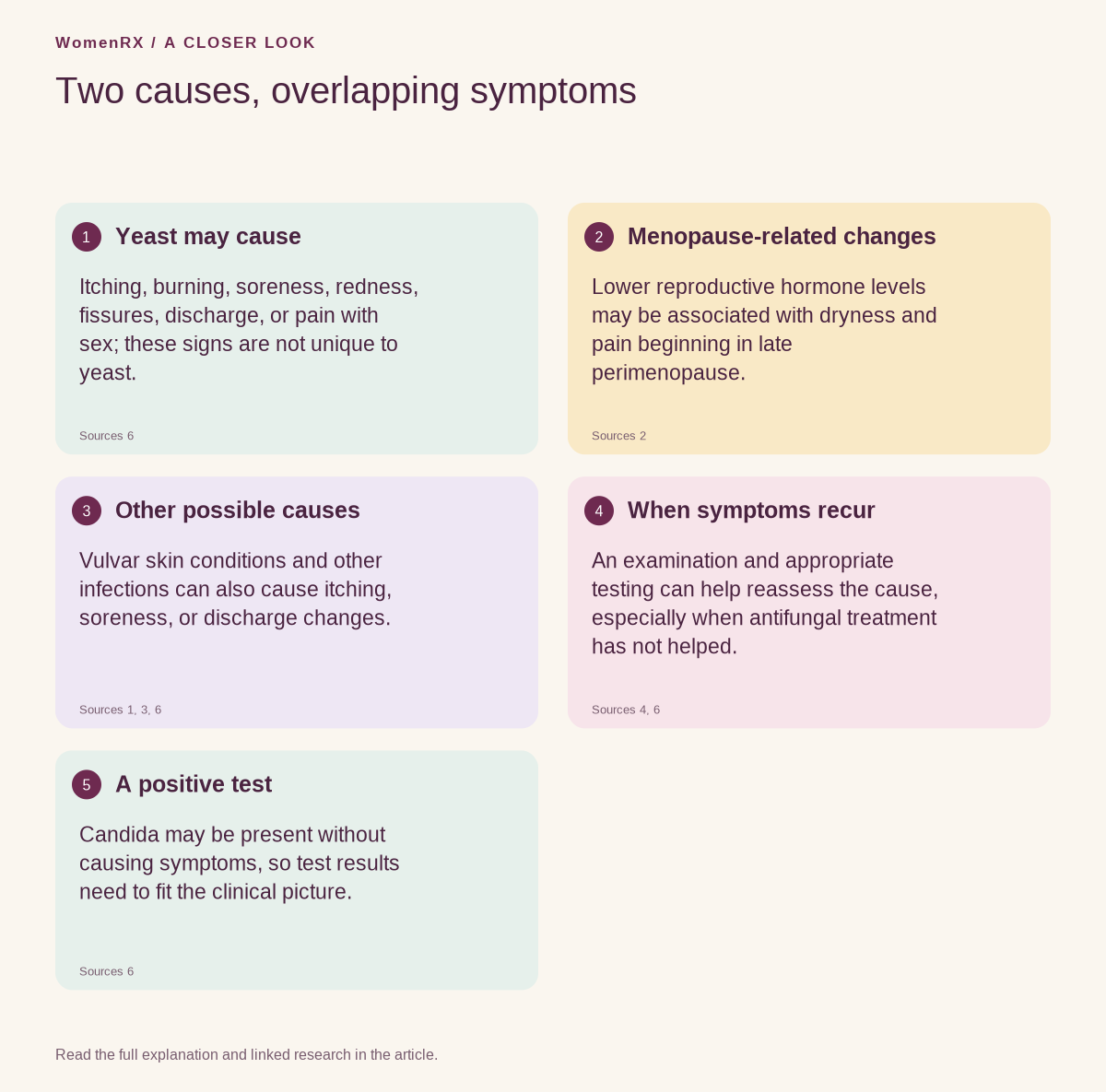
Two causes, overlapping symptoms
Yeast may cause: Itching, burning, soreness, redness, fissures, discharge, or pain with sex; these signs are not unique to yeast.6
Menopause-related changes: Lower reproductive hormone levels may be associated with dryness and pain beginning in late perimenopause.2
Other possible causes: Vulvar skin conditions and other infections can also cause itching, soreness, or discharge changes.136
When symptoms recur: An examination and appropriate testing can help reassess the cause, especially when antifungal treatment has not helped.46
A positive test: Candida may be present without causing symptoms, so test results need to fit the clinical picture.6
Read the figure as text
These patterns can help frame the question, but symptoms alone cannot tell you whether yeast is causing the irritation.- Yeast may cause: Itching, burning, soreness, redness, fissures, discharge, or pain with sex; these signs are not unique to yeast.6
- Menopause-related changes: Lower reproductive hormone levels may be associated with dryness and pain beginning in late perimenopause.2
- Other possible causes: Vulvar skin conditions and other infections can also cause itching, soreness, or discharge changes.136
- When symptoms recur: An examination and appropriate testing can help reassess the cause, especially when antifungal treatment has not helped.46
- A positive test: Candida may be present without causing symptoms, so test results need to fit the clinical picture.6
More questions, answered
Does a positive yeast test always mean yeast is causing my symptoms?
No. Candida can be present without causing symptoms, so a positive test needs to be interpreted alongside your symptoms and examination. 6
Should I keep using antifungal treatment if symptoms return?
Repeated symptoms are a reason to revisit the diagnosis, especially if treatment hasn’t helped. GSM, skin conditions, other infections, or overlapping causes may need to be considered. 3 4
Sources you can check
- Vaginal discharge - NHSAccessed 2026-09-25Return to first citation
- Genitourinary Syndrome of Menopause: Pathophysiology, Clinical Presentation, and Differential Diagnosis.Clark AL, Goetsch MF. · Clinical obstetrics and gynecology · 2024Return to first citation
- Evaluation and treatment of vulvovaginal itching in postmenopausal women.Mitchell C. · Menopause (New York, N.Y.) · 2023Return to first citation
- Assessment and Treatment of Vaginitis.Mitchell CM. · Obstetrics and gynecology · 2024Return to first citation
- 'It's not just thrush, it's recurrent thrush': a qualitative study of patient and clinician perspectives on diagnosing recurrent vulvovaginal candidiasis.Ford T, Ziebland S, Tonkin-Crine S, Hayward G, McNiven A. · The British journal of general practice : the journal of the Royal College of General Practitioners · 2026Return to first citation
- State-of-the-Art Review: Managing Vulvovaginal Candidiasis.Rautemaa-Richardson R, Sobel JD, Stone N, De Seta F, Cassone A, Vieira-Baptista P, Comar M, Warris A, Roselletti E. · Clinical infectious diseases : an official publication of the Infectious Diseases Society of America · 2026Return to first citation