When Yeast Symptoms Keep Returning Around Menopause
Recurring itching or irritation deserves a fresh look at the cause before another round of yeast treatment.
If symptoms you think are yeast infections keep returning, the useful next step is to confirm whether Candida is causing them. Symptoms can overlap with other conditions. If recurrent Candida is confirmed, identifying the species can guide treatment; if it isn’t confirmed, the evaluation needs to look beyond yeast. Perimenopause or postmenopause alone doesn’t settle the question. 3 5
First, separate recurring symptoms from recurring infection
Itching or irritation can feel familiar enough that you’re sure yeast is back. But similar vaginal symptoms can have different causes, and a review of vulvovaginal candidiasis describes that overlap as a reason examination and laboratory tests may be needed. Another antifungal treatment might help a yeast infection, but it won’t answer what’s causing symptoms that repeatedly return. 5
Start with what happened across episodes. For example, did symptoms go away with treatment and return later, or did they never fully improve? Were any episodes tested, and what did the results show? Bring previous results and the names of treatments you used if you have them. That history helps distinguish a documented pattern of Candida infection from a pattern of symptoms that still needs an explanation.
If Candida is confirmed, the species can change the discussion
Candida includes more than one species. A review of recurrent vulvovaginal candidiasis says species identification matters because effective treatment may need to be species-specific. If you’ve been told a test found Candida, it’s reasonable to ask whether the species was identified, particularly when symptoms have returned after treatment. 3
For confirmed recurrent Candida albicans, maintenance antifungal treatment is one approach described in the research. It can control episodes, though control isn’t necessarily a lasting cure. In a retrospective study of women with recurrent C. albicans who had received maintenance treatment, symptoms continued or returned for many after treatment ended. That finding is a reason to discuss a plan for recurrence, not to assume every future symptom is yeast or to keep treating yourself indefinitely. 2 3
If treatment hasn’t helped, say so plainly. The next question isn’t automatically whether you need more of the same medicine. It’s whether the diagnosis, the Candida species, or another cause of symptoms needs another look. 3 5
Where menopause fits, and where it doesn’t
Perimenopause may be the time you notice a new symptom pattern, but its timing cannot identify the cause. The same is true after menopause: vaginal symptoms aren’t automatically yeast, and menopause doesn’t rule yeast out. A review describes recurrent candidiasis as historically less common after menopause while noting that hormone therapy may extend the period of susceptibility. 3
Postmenopause also brings a different possibility to the discussion: genitourinary syndrome of menopause, which can involve vaginal dryness and itching and has treatment options distinct from antifungal medicines. It’s especially worth considering when repeated yeast treatment hasn’t resolved symptoms, without assuming it must be the answer instead. 1 6
If you use hormone therapy, include it in the history rather than changing it based on symptoms alone. One observational study at a specialist vulvar clinic found more culture-positive Candida among postmenopausal patients using hormone therapy than among those who weren’t. Its selected patient group and study design cannot establish that hormone therapy caused an individual infection or that stopping it is the right next step. 4
Let the finding guide the next step
There are two useful paths to discuss. If recurrent Candida is established, ask what the species and your response to past treatment mean for a treatment plan, including whether maintenance treatment is appropriate. If Candida hasn’t been established, or symptoms persist despite treatment, ask what else the examination and testing suggest. Menopause-related vaginal changes may be part of that discussion, particularly after menopause. 1 3 5
You don’t need to know which path is right before the visit. The useful shift is from “Which yeast treatment should I try next?” to “What have we confirmed, and what would explain the episodes that keep coming back?”
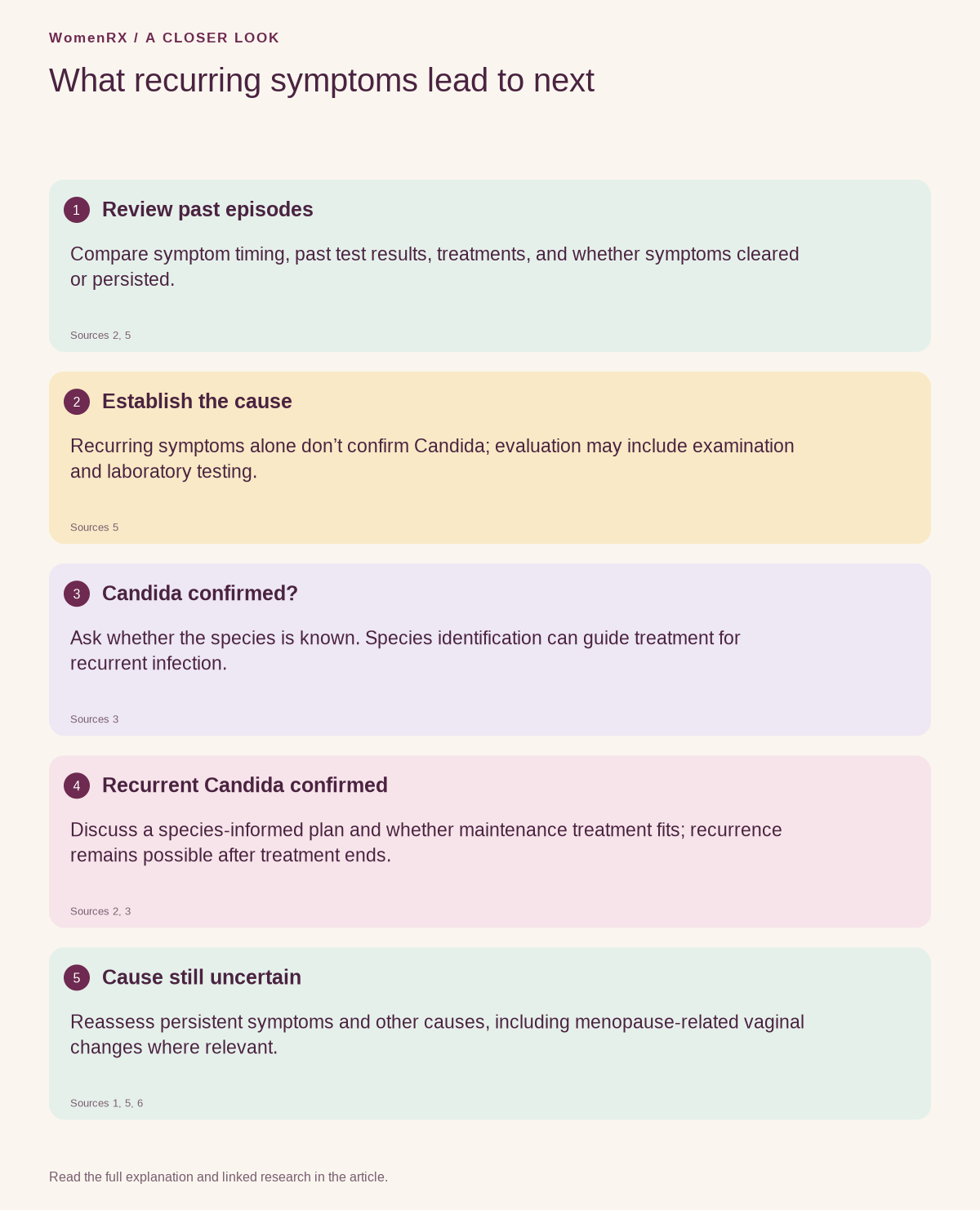
What recurring symptoms lead to next
Review past episodes: Compare symptom timing, past test results, treatments, and whether symptoms cleared or persisted.25
Establish the cause: Recurring symptoms alone don’t confirm Candida; evaluation may include examination and laboratory testing.5
Candida confirmed?: Ask whether the species is known. Species identification can guide treatment for recurrent infection.3
Recurrent Candida confirmed: Discuss a species-informed plan and whether maintenance treatment fits; recurrence remains possible after treatment ends.23
Cause still uncertain: Reassess persistent symptoms and other causes, including menopause-related vaginal changes where relevant.156
Read the figure as text
The pathway branches according to whether Candida has been confirmed, rather than treating every return of symptoms as the same infection.- Review past episodes: Compare symptom timing, past test results, treatments, and whether symptoms cleared or persisted.25
- Establish the cause: Recurring symptoms alone don’t confirm Candida; evaluation may include examination and laboratory testing.5
- Candida confirmed?: Ask whether the species is known. Species identification can guide treatment for recurrent infection.3
- Recurrent Candida confirmed: Discuss a species-informed plan and whether maintenance treatment fits; recurrence remains possible after treatment ends.23
- Cause still uncertain: Reassess persistent symptoms and other causes, including menopause-related vaginal changes where relevant.156
More questions, answered
Does a return of symptoms mean the antifungal stopped working?
Not necessarily. Symptoms may return after treatment for confirmed recurrent Candida, but similar symptoms can also have another cause. Reviewing the original test result and what happened during and after treatment helps separate those possibilities. 2 5
Sources you can check
- The 2022 hormone therapy position statement of The North American Menopause Society.“The 2022 Hormone Therapy Position Statement of The North American Menopause Society” Advisory Panel. · Menopause (New York, N.Y.) · 2022Return to first citation
- Long-Term Outcomes of Women With Recurrent Vulvovaginal Candidiasis After a Course of Maintenance Antifungal Therapy.Crouss T, Sobel JD, Smith K, Nyirjesy P. · Journal of lower genital tract disease · 2018Return to first citation
- Recurrent vulvovaginal candidiasis.Sobel JD. · American journal of obstetrics and gynecology · 2016Return to first citation
- Vulvovaginal candidiasis in postmenopausal women: the role of hormone replacement therapy.Fischer G, Bradford J. · Journal of lower genital tract disease · 2011Return to first citation
- Vulvovaginal candidiasis-an overview of current trends and the latest treatment strategies.Bhosale VB, Koparde AA, Thorat VM. · Microbial pathogenesis · 2025Return to first citation
- Expert Opinion on the Use of Probiotics in General Gynecological Conditions.Patki A, Pandit S, Ashraf N, Makhwana S, Ghosh Dastidar B. · Cureus · 2025Return to first citation