Why Yeast Infections Seem to Keep Coming Back
Recurring itching or discharge may be Candida, but confirming the cause can change what happens next.
If vaginal symptoms keep returning, the first question is whether each episode is actually a yeast infection. Itching, burning, and discharge overlap with other conditions, including bacterial vaginosis. A clinician can examine the area and test a vaginal sample; when Candida is confirmed but symptoms persist or recur, a culture can identify the yeast and help guide further evaluation. 146
Recurring symptoms aren't the same as recurring Candida
It’s understandable to call the next bout of itching a yeast infection, especially if an antifungal seemed to help before. But vulvar itching, irritation, burning, and discharge aren’t specific to Candida. Treating each episode based on symptoms alone can leave the actual cause unidentified. 4
For example, bacterial vaginosis (BV) commonly causes a thin, greyish-white discharge with a fishy smell and usually doesn’t cause itching. That pattern is a clue, not a diagnosis. Other changes in discharge can have other causes, including sexually transmitted infections. An examination and a vaginal sample can help distinguish them. 13
A history of repeated confirmed Candida infections tells a clinician something different from a history of repeated symptoms treated as yeast without testing. That distinction is especially useful when treatment hasn’t helped: the next move may be to check the diagnosis rather than assume you need more of the same treatment. 45
What testing can answer
A clinician may examine the vulva and vagina and collect a sample of discharge to look for an infection. Candida can be detected with microscopy or a yeast culture. Testing may also check for other causes of vaginitis when the symptoms or examination point that way. 14
A culture can do more than confirm that yeast grew: it can identify the species. That matters because not every yeast isolated from women with complicated or recurrent symptoms is Candida albicans. In a retrospective study of vaginal cultures from adult women in Leeds, UK, non-albicans yeasts and fluconazole-nonsensitive isolates were found among samples submitted for complicated or recurrent vulvovaginal candidiasis. Those findings don’t tell an individual woman what she has, but they explain why species identification, and sometimes susceptibility testing, can be useful when treatment isn’t working as expected. 6
A positive result also needs to be read alongside your symptoms and examination. Candida can be present without causing symptoms, so finding it doesn’t automatically explain every episode of irritation. 5
What might be contributing?
Sometimes there isn’t one clear trigger. For yeast infections in general, antibiotics can allow Candida to multiply, and a weak immune system can make treatment more difficult. Those possibilities are worth discussing if infections have been confirmed, but neither establishes why your vaginal symptoms keep returning. 2
If you have diabetes, include it in your health history when you’re assessed. Having diabetes does not, by itself, confirm that Candida is causing this episode or explain why symptoms keep returning.
It also helps to separate a change in discharge from an infection. Discharge can become more noticeable during pregnancy, with birth control use, or around ovulation. If you’re pregnant and your discharge changes in smell, color, or texture, or you have soreness or itching, seek an assessment rather than assuming the change is normal or is yeast. 3
When to get a fresh assessment
Arrange an assessment if symptoms return after treatment or don’t improve, particularly if past episodes were never tested. Describe what changed, such as itching versus odor, the appearance of discharge, and whether an antifungal helped. Those details can help direct the examination and tests, but they can’t replace them. 134
Don’t wait to have new pelvic pain or bleeding with unusual discharge assessed. Those symptoms can point to causes other than yeast. 3
The useful goal isn’t simply to count how many times you’ve had symptoms. It’s to establish whether Candida is causing them, check for a different condition when it isn’t, and identify the yeast when confirmed infections keep returning or treatment fails. 1456
When symptoms keep returning
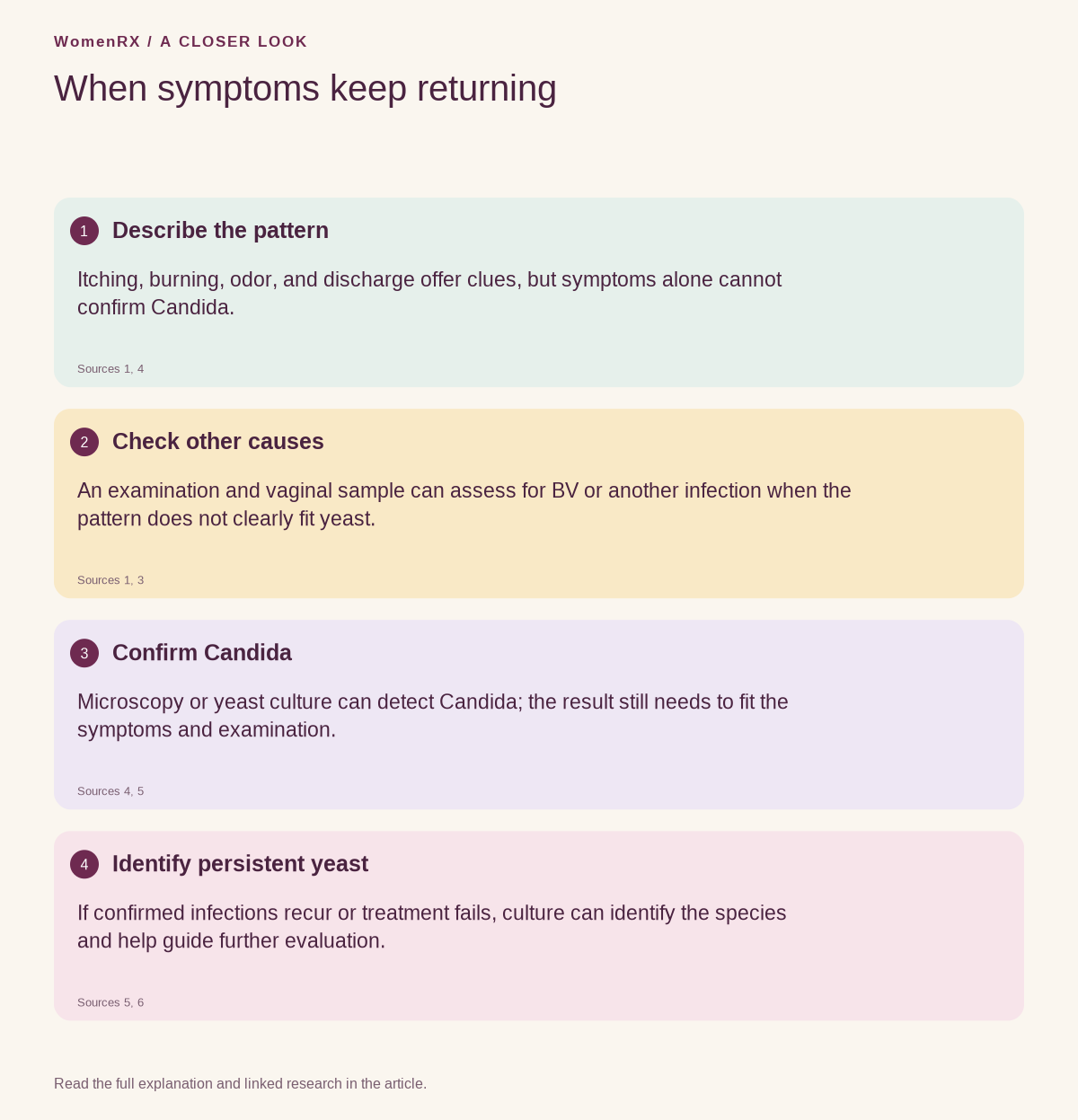
Describe the pattern: Itching, burning, odor, and discharge offer clues, but symptoms alone cannot confirm Candida.14
Check other causes: An examination and vaginal sample can assess for BV or another infection when the pattern does not clearly fit yeast.13
Confirm Candida: Microscopy or yeast culture can detect Candida; the result still needs to fit the symptoms and examination.45
Identify persistent yeast: If confirmed infections recur or treatment fails, culture can identify the species and help guide further evaluation.56
Read the figure as text
Follow what each step can clarify rather than assuming every episode needs the same treatment.- Describe the pattern: Itching, burning, odor, and discharge offer clues, but symptoms alone cannot confirm Candida.14
- Check other causes: An examination and vaginal sample can assess for BV or another infection when the pattern does not clearly fit yeast.13
- Confirm Candida: Microscopy or yeast culture can detect Candida; the result still needs to fit the symptoms and examination.45
- Identify persistent yeast: If confirmed infections recur or treatment fails, culture can identify the species and help guide further evaluation.56
More questions, answered
Does a positive yeast culture always mean yeast is causing my symptoms?
No. Candida can be present without symptoms. A clinician interprets the result alongside your symptoms and examination, rather than treating the culture result as the whole diagnosis. 5
What if symptoms return after antifungal treatment?
Arrange an assessment rather than assuming you need more of the same treatment. Symptoms alone cannot confirm Candida; an examination and testing can help check the cause. 14
Sources you can check
- Bacterial vaginosis - NHSAccessed 2026-09-25Return to first citation
- Yeast Infections: MedlinePlusAccessed 2026-09-25Return to first citation
- Vaginal discharge - NHSAccessed 2026-09-25Return to first citation
- Psychosocial impact of recurrent urogenital infections: a review.Thomas-White K, Navarro P, Wever F, King L, Dillard LR, Krapf J. · Women's health (London, England) · 2023Return to first citation
- Recurrent Vulvovaginal Candidiasis Caused by Fluconazole-Resistant Candida albicans: A Retrospective Study.Sasi S, Abdelmajid A, Salah H, Ibrahim E, Al-Maslamani M, Al-Khal A. · Cureus · 2025Return to first citation
- Increasing rate of non-Candida albicans yeasts and fluconazole resistance in yeast isolates from women with recurrent vulvovaginal candidiasis in Leeds, United Kingdom.Ratner JC, Wilson J, Roberts K, Armitage C, Barton RC. · Sexually transmitted infections · 2025Return to first citation